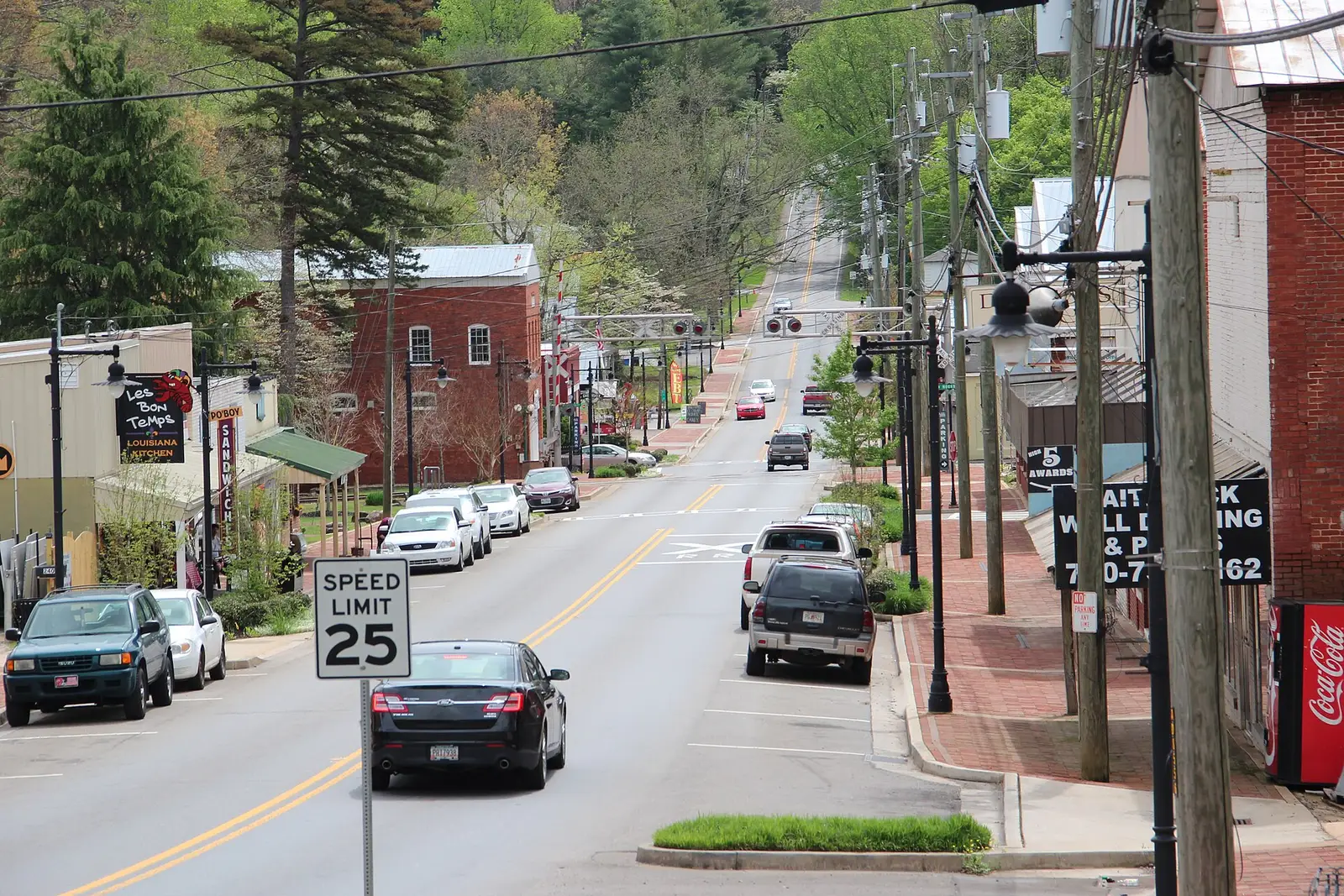
Ball Ground has grown from a two-store crossroads into a city of 2,560 residents at the 2020 census, more than tripling in two decades, and its association-governed housing tells that story in miniature. Inside the historic core, anchored by the street most residents still call Main Street even though the map says Gilmer Ferry Road, smaller in-town neighborhoods like Creekside Estates sit on wooded lots around a 50-acre green space and a Riggin Creek waterfall, a legacy of the slower growth Ball Ground saw for most of the twentieth century. Across the Forsyth County line along Matt Highway, in a pocket that carries a Ball Ground mailing address, amenity-rich subdivisions such as River Rock arrived with a clubhouse, a pool and splash pad, and four lighted tennis courts built for a very different pace of development. Closer to I-575, Sawgrass added a compact run of townhomes and small-lot single-family homes in 2022 and 2023 that has since sold out, while The Preserve at Long Swamp Creek pairs a handful of large wooded lots running down to the creek itself, on the rural, unincorporated fringe that still defines most of northeastern Cherokee County, with a newer, walkable townhome enclave closer to downtown.
That range, a hundred-home in-town neighborhood, a large-lot exurban enclave, and a sold-out 2023 townhome community, all inside one small city, is exactly what a boilerplate reserve study misses. A national template built around suburban Atlanta averages will misjudge how fast asphalt, decking, and exterior paint actually wear in the Blue Ridge foothills' summer humidity and clay soils, and it will not distinguish between a clubhouse-and-pool budget and a modest HOA whose main shared asset is a stormwater pond. Apex Reserve Group is based in Irvine, California, but a team member who lives in the Atlanta area walks every property we study in person, so the component list and funding plan your board receives reflects what is actually on your ground, not a regional average.
Why Ball Ground Associations Need Current Reserve Studies
Two forces are colliding in Ball Ground's association-governed communities right now: rapid, recent construction and a climate that is harder on buildings than it looks. Subdivisions like Sawgrass and the newest sections of River Rock are barely two to three years past their final certificates of occupancy, and their boards are budgeting for a first roof, a first repaving project, and a first pool-equipment replacement with no service history to draw on. A few miles away, Creekside Estates and other in-town neighborhoods dating to Ball Ground's slower-growth decades are already well into their own replacement cycles, with different components and a longer maintenance history entirely. Layered on top of that age gap is the Blue Ridge foothills climate: long stretches of summer heat and humidity that work into wood siding, decking, and asphalt joints; heavy tree canopy that keeps roofs and gutters damp and feeds mildew growth; red clay soils that expand and contract with rainfall and stress foundations, retaining walls, and paved surfaces; and the occasional ice storm or hailstorm that can shorten a roof's remaining life overnight. A reserve study grounded in an actual site visit, not a generic national schedule, is the most reliable way for a Ball Ground board to tell whether its dues are keeping pace with how quickly its own buildings are aging.
From the Historic Core to the Long Swamp Creek Corridor: Ball Ground's Association Landscape
Ball Ground's small footprint holds an unusually wide range of association types for a city this size. In town, near the historic district and Valley Street, Creekside Estates carries close to 100 homes around that 50-acre green space, with a component list leaning on walking trails and shared green space rather than pools or clubhouses. Across the Forsyth County line, River Rock is a larger community built in phases from the mid-2000s into the 2020s, where a clubhouse, a swimming pool and splash pad, and four lighted tennis courts put recreational equipment and larger paved areas on the reserve list alongside roofing and siding. Off Lower Bethany Road near I-575, Sawgrass is a 2022-2023 townhome and small-lot community whose original 1- and 2-year builder warranties have now largely expired, leaving only the longer-dated structural warranty active — which makes the near-term question less about replacement and more about setting a realistic funding schedule now that builder coverage is winding down. On the rural edge, The Preserve at Long Swamp Creek combines large wooded lots running down to the creek with minimal shared infrastructure and a newer, walkable townhome enclave with HOA-maintained yards near downtown, each carrying a different component list, while smaller subdivisions like Laurel Ridge Estates and Flatbottom Farms round out a mix that runs from a handful of homes on a private road to amenity-heavy developments that could pass for a small resort. No single template covers all of that, and we do not try to make one fit.
What Georgia Law and Your Lenders Expect
Georgia has no statewide law that requires an HOA or condominium association to commission a reserve study, whether your community is a century-old in-town neighborhood or a subdivision that broke ground last year. What actually governs a Ball Ground board's reserve obligations starts with its own declaration, bylaws, and recorded rules, documents that, in practice, often call for 'adequate reserves' without ever defining the number. Above that baseline, two state frameworks can come into play. A true condominium regime falls under the Georgia Condominium Act (O.C.G.A. Title 44, Chapter 3), which requires the annual budget to include a reserve line item for deferred maintenance and capital replacement but does not mandate a formal study or set a minimum funding percentage. Most of Ball Ground's single-family and townhome subdivisions are governed instead by their declarations directly, and some communities separately elect into the Georgia Property Owners' Association Act, a framework that only applies where a declaration expressly opts into it and which likewise stops short of requiring a reserve study. None of that gives a board a free pass to ignore foreseeable capital costs: Georgia board members owe the association a fiduciary duty of care, and a board that never plans for the roof, the paving, or the pool equipment is exposed to exactly the kind of claim that duty exists to prevent. Lenders apply a separate layer of pressure that does not depend on state law at all. FHA, Fannie Mae, and Freddie Mac condo project reviews generally look for reserve contributions around 10 percent of the annual budget, or a reserve study supporting a different figure, and scrutiny of deferred maintenance has only tightened since the 2021 Surfside collapse. For loan applications dated on or after January 4, 2027, Fannie Mae and Freddie Mac raise that benchmark to 15 percent of the budget, worth planning around now for any newer Ball Ground community still setting its first few years of dues.
Our Reserve Study Services in Ball Ground
Full Reserve Study — An on-site inspection of every shared component your association owns, from a green space and trail system typical of in-town neighborhoods to a clubhouse and tennis courts at a larger amenity community, paired with a 30-year funding schedule sized to your association's actual budget. Typical delivery: 3 to 4 weeks.
Reserve Study Update With Site Visit — A return visit every few years to re-inspect roofing, paving, decking, and amenities and adjust the funding plan for what our team member actually finds on the ground, which matters most in a climate this hard on exterior surfaces. Typical delivery: 2 to 3 weeks.
Off-Site Annual Update — A remote refresh between site visits that rolls in inflation, completed projects, and any changes to your reserve balance so the funding plan never goes stale. Typical delivery: 1 to 2 weeks.
Ball Ground Communities in Our Service Area
Ball Ground's small size means a single service area can cover nearly every kind of association the city has to offer. That area runs from in-town neighborhoods near the historic district and Valley Street, including Creekside Estates, out to larger amenity subdivisions just across the Forsyth County line such as River Rock, newer attached-home communities like Sawgrass off Lower Bethany Road, mixed-format communities such as The Preserve at Long Swamp Creek, and smaller subdivisions including Laurel Ridge Estates and Flatbottom Farms. It also reaches the unincorporated Cherokee County land ringing the city on every side, plus nearby Nelson, Holly Springs, and Canton for boards who would rather work with a firm that already understands this stretch of the county.