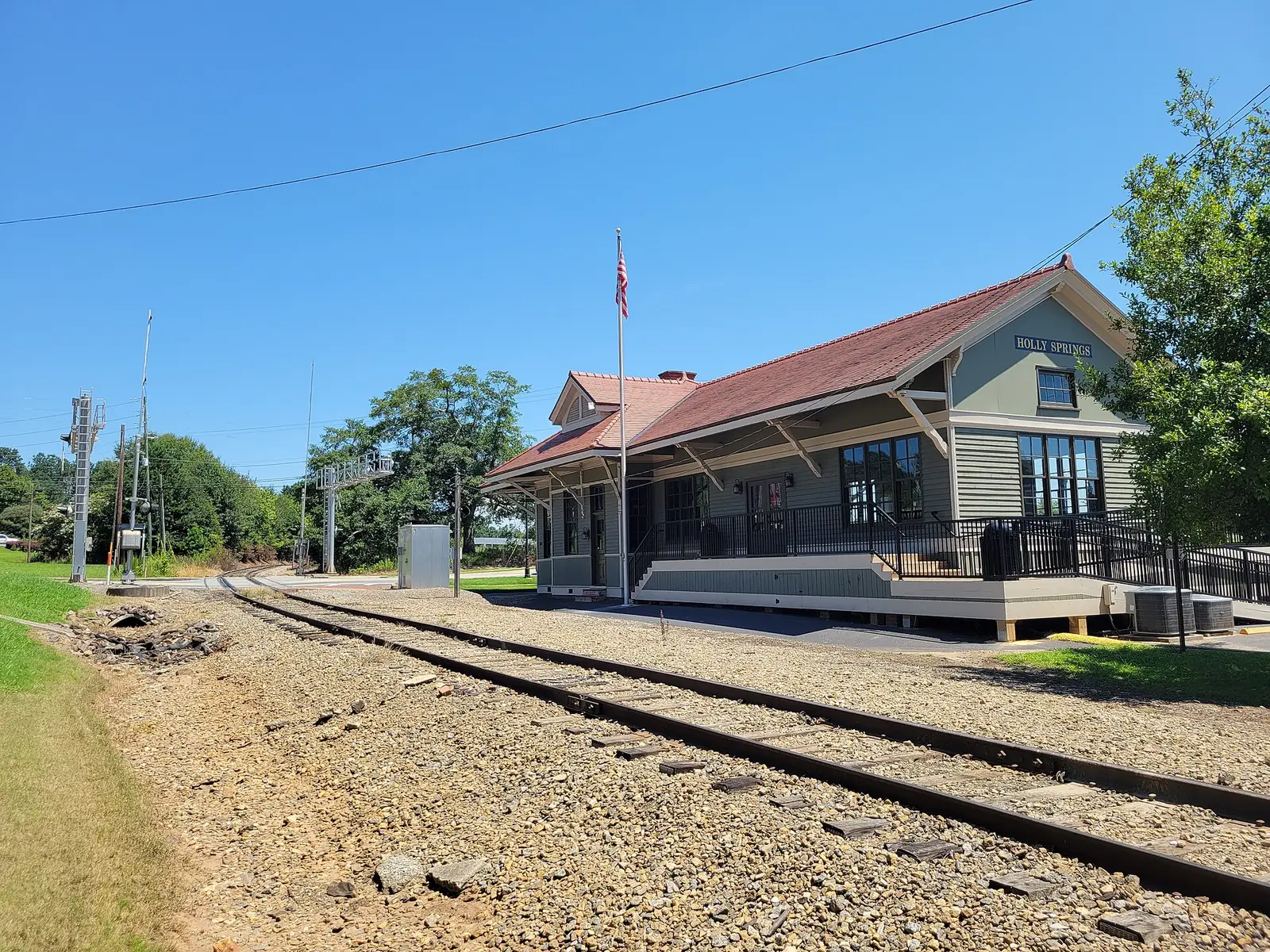
Holly Springs runs along I-575 between Canton, the Cherokee County seat to the north, and Woodstock to the south, and the city's own numbers tell the growth story: 2,406 residents in 1990, 9,189 at the 2010 census, and 16,213 by 2020, with current estimates well past 20,000. Barrett Farms, the single-family neighborhood Sun Quality Homes built off Hickory Road near Barrett Park between 1999 and 2001, is the oldest of the named sections here, predating even Harmony on the Lakes, the lake-and-clubhouse community that Macauley Companies started building off Hickory Road in 2003 and that represents the city's first large master-planned wave of growth — itself actually four HOAs sharing one address: the homeowner-run Harmony North and Harmony Southside associations, The Reserve's separately managed pool section, and The Gardens' builder-managed section under Lennar Homes. Behind it came Cypress Springs' 2006-to-2008 townhomes, then a third surge after 2018 that produced Crest Brooke and Holly Glen, plus townhome rows at Holly Commons and Hidden Springs and the age-targeted Courtyards at Redbud Lane near downtown. The city itself is mid-transformation too: the Holly Springs Town Center broke ground near Hickory Road and Holly Springs Parkway in 2021 and is still under construction, adding a new city hall, a market plaza, leased apartments, and for-sale townhomes to what was, a few years ago, a much smaller downtown built around the old railroad depot.
None of those communities age the same way. A clubhouse and three lakes built starting in 2003 carry a different repair timeline than a row of 2021 for-sale townhomes still under builder warranty, and a generic national reserve study — built around average useful-life tables rather than an actual walk of the property — tends to blur that distinction into one set of assumptions that fits none of them well. Apex Reserve Group runs out of Irvine, California, but the person inspecting your roof, your pond berm, or your clubhouse HVAC unit is our team member based in the Atlanta area, who knows what a Georgia summer actually does to a component versus what a spreadsheet assumes it will do.
Why Holly Springs Associations Need Current Reserve Studies
Holly Springs added most of its rooftops in three concentrated bursts rather than at a steady pace: the late-1990s-to-early-2000s wave that built Barrett Farms, the mid-2000s wave that built Harmony on the Lakes and Cypress Springs, and the post-2018 wave that produced Crest Brooke, Holly Glen, and the newer townhome sections around Holly Commons and Hidden Springs. That compression matters for reserve planning because a large share of the city's shared roofs, pool equipment, and paving is aging on nearly the same clock, rather than staggered across decades the way an older, slower-growing city's stock would be. A board that assumes its roof, its pool plaster, or its clubhouse HVAC unit will simply outlast a generic useful-life chart is planning around a number never calibrated to Cherokee County's summer humidity, frequent thunderstorms, and heavy tree canopy, all of which tend to push real replacement dates earlier than a national average suggests. A current reserve study replaces that guess with a documented, defensible number — one that also gives an incoming board, in a city whose population has more than doubled since 2010, a clear record of why the funding plan looks the way it does once turnover happens.
From Harmony on the Lakes to the New Town Center: Holly Springs' Association Landscape
Harmony on the Lakes is less a single association than four of them sharing an address. Built out from 2003 forward around three stocked lakes, a terraced great-lawn clubhouse, and the amphitheater at Observation Park, the community splits governance between the homeowner-run Harmony North and Harmony Southside HOAs, The Reserve's separately managed pool section, and The Gardens' section, still under builder management by Lennar Homes — four different reserve pictures living inside what looks, from the street, like one neighborhood. Off Hickory Road near Barrett Park, Barrett Farms is actually the oldest single-family section in this lineup, built by Sun Quality Homes Inc. between 1999 and 2001 — old enough that its roofing and original paving are likely already through at least one full replacement cycle. East of downtown, Cypress Springs' 2006-to-2008 townhomes are old enough now to be on a first or second exterior paint and roof cycle, while Crest Brooke, built out between 2019 and 2022, and Holly Glen, built out between 2019 and 2020, are just reaching the point where original paving and pool plaster start to show wear instead of looking new. Holly Commons and Hidden Springs contribute shared-wall townhome product with their own pools and playgrounds, and The Courtyards at Redbud Lane, a low-maintenance ranch-home enclave aimed at active-adult buyers near downtown, carries a different landscaping and amenity load than the family-oriented sections around it. Downtown itself is being rebuilt from the ground up: the Holly Springs Town Center project, under construction since a 2021 groundbreaking near Hickory Road and Holly Springs Parkway, is adding leased apartment flats, for-sale townhomes and detached city homes, and a new city hall around a market plaza — a new layer of association-governed property the city hasn't had to plan reserves for before. Just outside the city line, the unincorporated communities of Hickory Flat, Sixes, Toonigh, and Lebanon carry additional HOA and townhome growth from that same building boom.
What Georgia Law and Your Lenders Expect
There is no Georgia statute that tells a Holly Springs board how large its reserve fund has to be or how often to study it — a detail that catches new board members off guard when they assume every state regulates HOA finances the same way. Absent that mandate, three separate pressures still shape what a responsible board actually does.
The first is the paperwork your own community already signed. Whatever declaration and bylaws were recorded when your section of Harmony on the Lakes, Crest Brooke, or Cypress Springs was platted may already commit the association to maintaining adequate reserves or commissioning periodic studies, and those private obligations bind the board regardless of what the legislature has or hasn't passed.
The second is a pair of state statutes that touch reserves without ever mandating a study. Condominium regimes fall under the Georgia Condominium Act (O.C.G.A. Title 44, Chapter 3), which requires associations to break out deferred-maintenance and depreciation reserve figures in the annual budget — a disclosure rule, not a savings target. That mandate attaches to the budget itself; the Act's separate buyer-disclosure package applies only to a unit's initial sale by the developer, not to ordinary owner-to-owner resales, so Georgia has no statutory "resale certificate" regime requiring reserve figures to be handed to a buyer purchasing from a fellow owner. The Georgia Property Owners' Association Act covers ordinary HOAs the same way, but only for communities whose declaration has specifically adopted it, since the Act doesn't attach automatically; adopting it hands an association stronger assessment-collection and lien tools, but it doesn't create a reserve-study requirement either, adopted or not. What survives both statutes' silence is the board's fiduciary duty of care and loyalty: a board that lets a clubhouse roof or a stretch of shared paving fail without ever budgeting for it can still be found to have breached that duty, mandate or no mandate.
The third pressure, and the one tightening fastest, comes from mortgage underwriting rather than the state capitol. FHA, Fannie Mae, and Freddie Mac condo project reviews generally expect an association to be putting around 10 percent of its annual budget into reserves, or to hold a current reserve study demonstrating adequate funding some other way, and that expectation has only hardened since the 2021 Surfside condominium collapse put deferred maintenance on every underwriter's checklist. Fannie Mae and Freddie Mac are pushing that bar higher still, applying a 15 percent reserve-contribution standard to loan applications dated on or after January 4, 2027, unless a reserve study finished within the last three years shows the association funded at the highest recommended level. For a Holly Springs association with financed units — a Harmony on the Lakes townhome, a Town Center flat, or a Crest Brooke single-family home — that turns a current reserve study from a nice-to-have into a financing prerequisite.
Our Reserve Study Services in Holly Springs
Full Reserve Study — A full walk of the property — clubhouse, pools, paving, roofing, ponds, and every other shared component — translated into a 30-year capital plan and funding schedule sized to what Holly Springs' newer and older sections are each facing. Typical delivery: 3 to 4 weeks.
Reserve Study Update With Site Visit — A repeat site visit, generally every 3 to 5 years, to compare how your components have actually aged against the original projections and recalibrate contribution levels before the next major project comes due. Typical delivery: 2 to 3 weeks.
Off-Site Annual Update — A remote refresh for the years between full inspections, folding in inflation, finished projects, and your latest reserve balance so the plan doesn't go stale waiting for the next site visit. Typical delivery: 1 to 2 weeks.
Holly Springs Communities in Our Service Area
Holly Springs itself anchors our Cherokee County service area — Harmony on the Lakes (Harmony North, Harmony Southside, The Reserve's pool section, and The Gardens), Cypress Springs, Crest Brooke, Holly Glen, Barrett Farms, Holly Commons, Hidden Springs, and The Courtyards at Redbud Lane, plus the residential sections rising inside the Town Center district. Coverage extends into the unincorporated communities that border the city — Hickory Flat, Sixes, Toonigh, and Lebanon — and up and down the I-575 corridor into neighboring Woodstock and Canton.