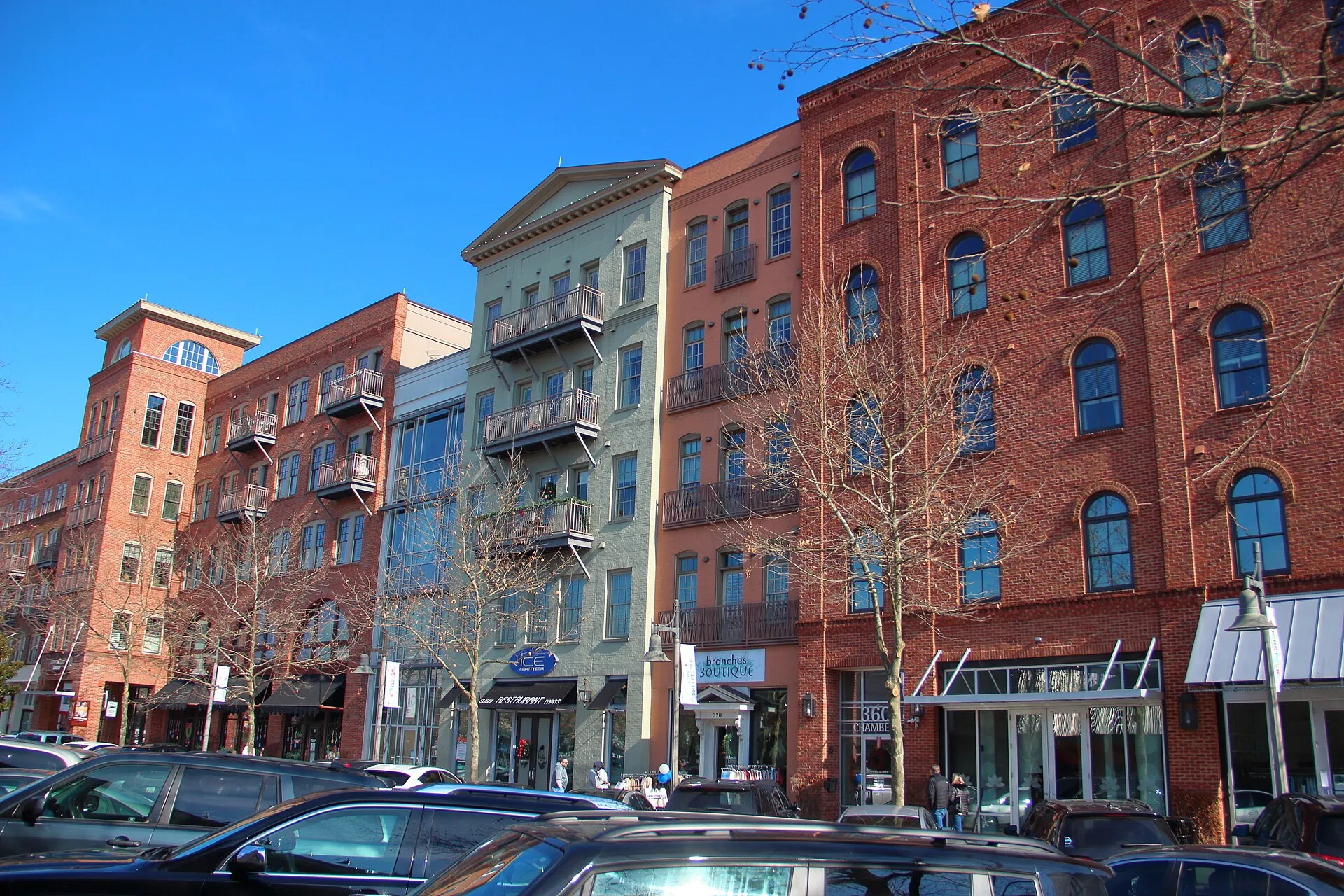
Woodstock's HOA and condominium landscape reflects rapid, subdivision-driven growth: from roughly 4,300 residents in 1990 to just over 35,000 at the 2020 census, most of it built out through subdivision waves rather than infill. The Towne Lake area, launched in the late 1980s west of downtown toward Lake Allatoona, anchors that growth with golf-course neighborhoods like Eagle Watch — its Arnold Palmer-designed course opened in 1989 — and swim/tennis sections such as Deer Run, built mostly between 1993 and 1999. A few miles away, Bradshaw Farm brought a second golf-community wave to the Hickory Flat side of unincorporated Cherokee County in the mid-to-late 1990s. All of that ring of subdivisions surrounds a much older, much smaller downtown core: Woodstock incorporated in 1897 around its Louisville & Nashville rail depot, and that historic grid has spent the last two decades being rebuilt into the walkable Elm Street and Main Street district that now anchors the city's identity.
A community built around a 1989 golf course carries a different reserve list than a swim/tennis section platted in 1996, and neither resembles the small mixed-use association tucked into the revitalized downtown blocks near Elm Street. National reserve-study templates tend to flatten those differences, assigning generic useful lives to pool decks, clubhouse roofs, and detention ponds regardless of when they were built or how Cherokee County's clay soils and afternoon storms have treated them since. Apex Reserve Group is based in Irvine, California, but a team member who lives and works in the Atlanta area walks every Woodstock property in person, so the study reflects your actual pool equipment, your actual asphalt, and your actual clubhouse roof rather than a national average.
Why Woodstock Associations Need Current Reserve Studies
Woodstock's master-planned communities are old enough now that their original infrastructure is aging out in waves. Eagle Watch's golf course and clubhouse date to 1989; Deer Run's original pools, tennis courts, and clubhouses were built mostly between 1993 and 1999; Bradshaw Farm's original golf holes, pools, and clubhouse date to the mid-1990s, with its third nine added in 2001. That means the pool decking, asphalt, roofing, and mechanical systems installed at construction are now 25 to 35 years old — well past a single replacement cycle and, in a number of cases, into a second. A board relying on the original developer's budget, or on a reserve study drafted a decade ago, is almost certainly underestimating what a clubhouse roof replacement or pool resurfacing will cost today. Meanwhile, Cherokee County's heavy tree canopy sheds debris onto roofs and gutters year-round, and the area's dense red clay soils put continuous pressure on retaining walls, detention pond berms, and pool decks in ways a generic national study won't flag. A current, locally inspected reserve study catches both problems: components reaching the end of their life on schedule, and components wearing out faster than the textbook says because of how Woodstock actually ages a building.
From Towne Lake to Downtown: Woodstock's Association Landscape
Woodstock's HOA stock splits fairly cleanly along its growth history. The Towne Lake footprint — a master-planned area that started in the late 1980s and now stretches from inside Woodstock's city limits into unincorporated Cherokee County toward the Kennesaw and Cobb County line — carries the area's biggest amenity packages: two golf courses, a scattering of swim/tennis centers serving individual sections like Deer Run, Wyngate, and Rose Creek, and a mix of single-family and townhome product built mostly in the 1990s. Bradshaw Farm, a separate golf community in the unincorporated Hickory Flat area of the county, follows a similar pattern on its own roughly 650-acre footprint with its own golf clubhouse, pools, and tennis courts. Eagle Watch's property owners association, layered on top of the golf course itself, maintains three pools and its own lighted tennis and pickleball courts for more than 1,300 homes. Downtown Woodstock is a different animal entirely: a compact historic core built around the old L&N rail depot, revitalized since the mid-2000s into the Elm Street Cultural Arts Village and Main Street commercial district, where the handful of association-governed properties are small mixed-use or townhome buildings with far shorter component lists than the golf-course communities a few miles out. A reserve study for a three-story mixed-use building downtown has almost nothing in common with one for a 1990s golf community, and we scope each one accordingly.
What Georgia Law and Your Lenders Expect
Georgia has no statute requiring HOAs or condominium associations to obtain a reserve study, and that includes every association in Woodstock and the rest of Cherokee County. What actually governs the question is a layered set of obligations that boards often underestimate. First, your own declaration and bylaws control: many Cherokee County declarations recorded during the 1990s and 2000s subdivision boom include language committing the association to maintain adequate reserves or periodically assess capital needs, and a board that ignores its own recorded documents is exposed regardless of what state law says. Second, the Georgia Condominium Act (O.C.G.A. § 44-3-111) does require a developer to itemize reserve allocations for deferred maintenance and depreciation in the disclosure package — but only on the first sale of a unit for residential occupancy, not on resales between existing owners, and Georgia has no separate statutory resale-disclosure regime for condos. Because most of Woodstock's condo stock is now 25 to 35 years past that first sale, nearly every real transaction is a resale the Act doesn't reach, so an underfunded reserve doesn't automatically surface in a state-mandated package; a buyer's attorney has to know to ask for the budget and reserve figures directly, and a board without a current study is poorly positioned to answer that request credibly. Cherokee County HOAs may separately have opted into the Georgia Property Owners' Association Act by recording that election in their declaration; opting in adds statutory lien and enforcement authority but still does not itself require a reserve study. Third, and often overlooked, Georgia's common law imposes fiduciary duties of care and loyalty on HOA and condo board members, and a board that fails to plan for a foreseeable expense like a clubhouse roof or golf-course irrigation replacement can face personal exposure for that neglect. Finally, lenders now do some of the enforcing that the state doesn't: Fannie Mae and Freddie Mac condo underwriting generally looks for reserve contributions at roughly 10 percent of the annual budget, or a current reserve study funded at the recommended level, before approving a project for conventional financing — and post-Surfside scrutiny of deferred maintenance has made that review noticeably tighter. That threshold is set to rise further: for loan applications dated on or after January 4, 2027, Fannie Mae and Freddie Mac are raising the minimum to roughly 15 percent of budget unless the association can show a reserve study completed within the prior three years at the recommended funding level. For a Towne Lake-era golf community or a downtown Woodstock condo building alike, that makes a current reserve study less a legal formality and more a practical requirement for keeping units financeable.
Our Reserve Study Services in Woodstock
Full Reserve Study — A ground-up on-site inspection of every reserve component, from pools, clubhouses, and golf-course infrastructure to roofing, asphalt, and stormwater systems, paired with a 30-year funding plan built around Woodstock's construction eras and climate. Typical delivery: 3 to 4 weeks.
Reserve Study Update With Site Visit — A return visit to re-inspect conditions and adjust remaining useful life estimates, particularly valuable for Towne Lake-era and Bradshaw Farm-era communities whose original components are now decades old. Typical delivery: 2 to 3 weeks.
Off-Site Annual Update — A remote refresh of your funding plan between site visits, adjusting for inflation, completed projects, and any changes to your association's finances. Typical delivery: 1 to 2 weeks.
Woodstock Communities in Our Service Area
We provide reserve studies to HOA and condominium associations throughout Woodstock and the Cherokee County communities that share its ZIP codes, including the Towne Lake master-planned area and its individual sections — Eagle Watch, Deer Run, Wyngate, Rose Creek, Parkview, The Arbors, The Fairways, and Towne Lake Hills — as well as Bradshaw Farm on the Hickory Flat side of the county, Kings Ridge Estates, and the small mixed-use and townhome associations in downtown Woodstock's revitalized Elm Street and Main Street district. We also serve associations in the unincorporated stretches of Cherokee County that carry a Woodstock mailing address but sit outside the city's actual limits, along with any newer HOA or condo community forming as the area continues to grow.