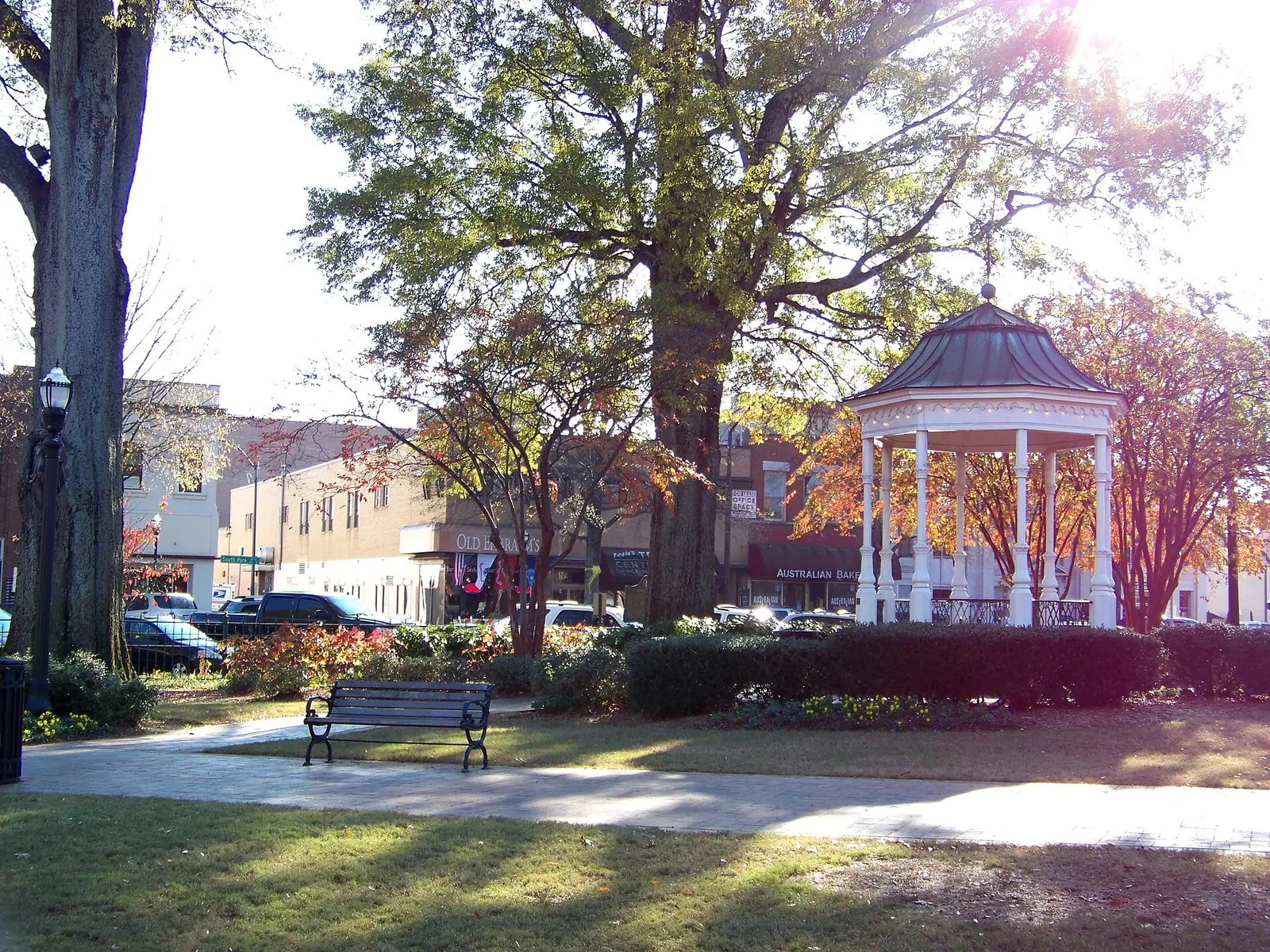
Marietta has anchored Cobb County government almost since the county was carved out in 1832 — the seat was platted in 1833, incorporated as a village in 1834, and chartered as a city in 1852 — and its roughly 61,000 residents live amid housing from nearly every decade since. The blocks around Glover Park and the Square hold five National Register historic districts, from Whitlock Avenue to the century-old streetscapes of Church and Cherokee Streets. The association-governed stock came in later waves: condominium and townhome communities of the Cedar Canyon (1973-74, 136 homes) and Wynnes Ridge (1981) generation along the Powers Ferry corridor southeast of downtown; late-1980s townhomes such as Mulberry Farms (1986-88) off Johnson Ferry Road in unincorporated East Cobb, where the Marietta mailing address runs well past the city limits; and a 2010s-to-present wave of walkable infill, from North Square (2017-2019) north of the Square near Kennestone Hospital to Mountain Walk facing Kennesaw Mountain National Battlefield Park — the latter, like much of East Cobb, a Marietta-addressed community outside the city limits.
Communities that different do not wear out on the same schedule, and a reserve study copied from a national template pretends they do. A 1974 complex deep into its second generation of roofs, a 1988 townhome community with original timber walls under fifty feet of oak canopy, and a five-year-old rowhouse project saving toward its first paint cycle need three different component inventories — and every line in them needs a useful life set for Georgia heat, humidity, and clay rather than a continental average. Apex Reserve Group runs its practice from Irvine, California, and the person who walks your Marietta property is a team member who lives and works in metro Atlanta — so the analysis carries the discipline of a specialist firm while the inspection reflects what is actually standing on your ground.
Why Marietta Associations Need Current Reserve Studies
Consider what the calendar has already done to Marietta's condominium belt. A community completed in 1974 has crossed the fifty-year mark: whatever was replaced in the 1990s is coming due again, and items that rarely appear in a first-cycle budget — pool shells, sanitary lines, timber retaining structures, clubhouse framing — are now live questions. The 1980s cohort is entering the same territory, and the newest townhomes near the Square face the mirror-image risk: every roof, coat of paint, and run of pavement was installed in the same year, so every one of them matures in the same short window. On top of that age math sits the local physics. Humid subtropical summers cook shingles and blister coatings; the shade of mature oaks and pines keeps siding, decks, and fences damp and feeds mildew; moisture swings in Piedmont clay unsettle driveways, curbs, and walls — the region's kaolin-heavy soils are only modestly expansive, but pavements and thin slabs register even modest movement; stormwater detention ponds — association property in many Cobb communities — silt in quietly for decades and then demand a dredging project few boards have ever budgeted for; and one hailstorm or ice event can subtract years from every roof on the property simultaneously. A funding plan is only as good as the last time someone stood on the property and reconciled it with what the components actually look like. That reconciliation is the study we deliver.
The Square, the Historic Districts, and the Powers Ferry Corridor: Marietta's Association Geography
Marietta reads in rings. Innermost is the historic core: Glover Park at the center of the Square — land the city's first mayor, John Glover, gave to the city on the condition it remain a park — ringed by the Northwest Marietta, Whitlock Avenue, Church-Cherokee Street, Washington Avenue, and Atlanta Frasier Street National Register districts, with Kennesaw Avenue named the city's first locally designated historic district in 2013. Those streets are mostly single-family and predate the HOA era, but new association stock is rising around and beyond them: North Square's 90 townhomes went up between 2017 and 2019 off Church Street Extension near WellStar Kennestone Hospital — about a mile, a five-minute drive, north of the Square — and Mountain Walk's 54 townhomes face Kennesaw Mountain National Battlefield Park, whose nearly 3,000 protected acres pin down the city's northwest flank; note that Mountain Walk, roughly three miles from the Square and zoned to Cobb County schools, is another Marietta address that sits outside the city limits. The second ring is the 1970s-80s condominium corridor along Powers Ferry and Terrell Mill Roads on the southeast side, convenient to I-75 and the Cumberland employment core — Cedar Canyon (1973-74) and Wynnes Ridge (1981) are the type specimens, townhome-scale communities with pools, tennis courts, and clubhouses now four and five decades into service. The outermost ring is not in the city at all: East Cobb along Johnson Ferry and Roswell Roads is unincorporated Cobb County wearing a Marietta address — Mulberry Farms' 100 townhomes (1986-88) and the large Chimney Springs subdivision among many — the same address-versus-boundary split that decides whether a household is zoned to Marietta City Schools — independent since 1892 and today the county's only city district — or to Cobb County schools. We inspect on both sides of that line.
What Georgia Law and Your Lenders Expect
Georgia's legislature has never told associations how to fund reserves. No state statute requires a reserve study, prescribes a study interval, or sets a minimum funding level. The rules that actually reach a Marietta board live elsewhere. Your recorded declaration and bylaws come first: many commit the association to maintaining reserves for repair and replacement of the common elements, and a board that skips an obligation written into its own documents has no good answer when owners ask why. The statutes come second. A Marietta condominium takes its framework from the Georgia Condominium Act — O.C.G.A. Title 44, Chapter 3 — while a homeowners association falls under the Georgia Property Owners' Association Act only if the community affirmatively elected into it. Neither law orders a study, but both leave directors holding fiduciary obligations, and a board that watches a 1981-vintage roof line sail past its useful life with nothing set aside has written the plaintiff's brief itself. The third pressure is mortgage underwriting, and for the Powers Ferry-era stock it is the sharpest. Fannie Mae, Freddie Mac, and FHA project reviews have long looked for about a tenth of the association's annual budget routed to reserves — or a current, compliant reserve study that supports a different figure — and the bar is rising: Fannie Mae's Lender Letter LL-2026-03 (March 2026), matched by Freddie Mac, lifts that minimum to 15 percent for loan applications dated on or after January 4, 2027, and narrows the alternative to a reserve study completed within the last three years and funded at its recommended level. After the 2021 Surfside collapse those reviews also began interrogating deferred maintenance and unfunded repairs far more aggressively. A fifty-year-old condominium community that cannot produce a recent study risks something quieter than a lawsuit: buyers whose loans will not close, and a resale market that prices that uncertainty in.
Our Reserve Study Services in Marietta
Full Reserve Study — The complete engagement for a first study or a badly dated one: our Atlanta-area team member inventories and photographs every common element on the property, and we build a 30-year funding model around what that inspection found, including percent-funded math and side-by-side contribution scenarios. Typical delivery: 3 to 4 weeks.
Reserve Study Update With Site Visit — For associations with an existing study: a return inspection that re-benchmarks component conditions and replacement costs against the current Atlanta construction market; most boards schedule one every three to five years, and sooner after storm damage. Typical delivery: 2 to 3 weeks.
Off-Site Annual Update — A desk refresh for the seasons between inspections: completed projects, actual reserve balances, interest, and inflation flow into the model so each budget year starts from live numbers rather than stale projections. Typical delivery: 1 to 2 weeks.
Marietta Communities We Serve
Our service area covers every corner of the city and the Marietta-addressed communities beyond it: the neighborhoods around the Square and Glover Park; the Kennesaw Avenue, Forest Hills, Church-Cherokee, Whitlock Avenue, and Washington Avenue historic areas; the west side out Whitlock Avenue and Burnt Hickory Road toward Kennesaw Mountain; the Powers Ferry and Terrell Mill corridors, including condominium communities of the Cedar Canyon and Wynnes Ridge generation; the Delk Road corridor near I-75; and unincorporated East Cobb along Johnson Ferry and Roswell Roads — Mulberry Farms, Chimney Springs, and their neighbors — where associations carry Marietta addresses outside the city line.