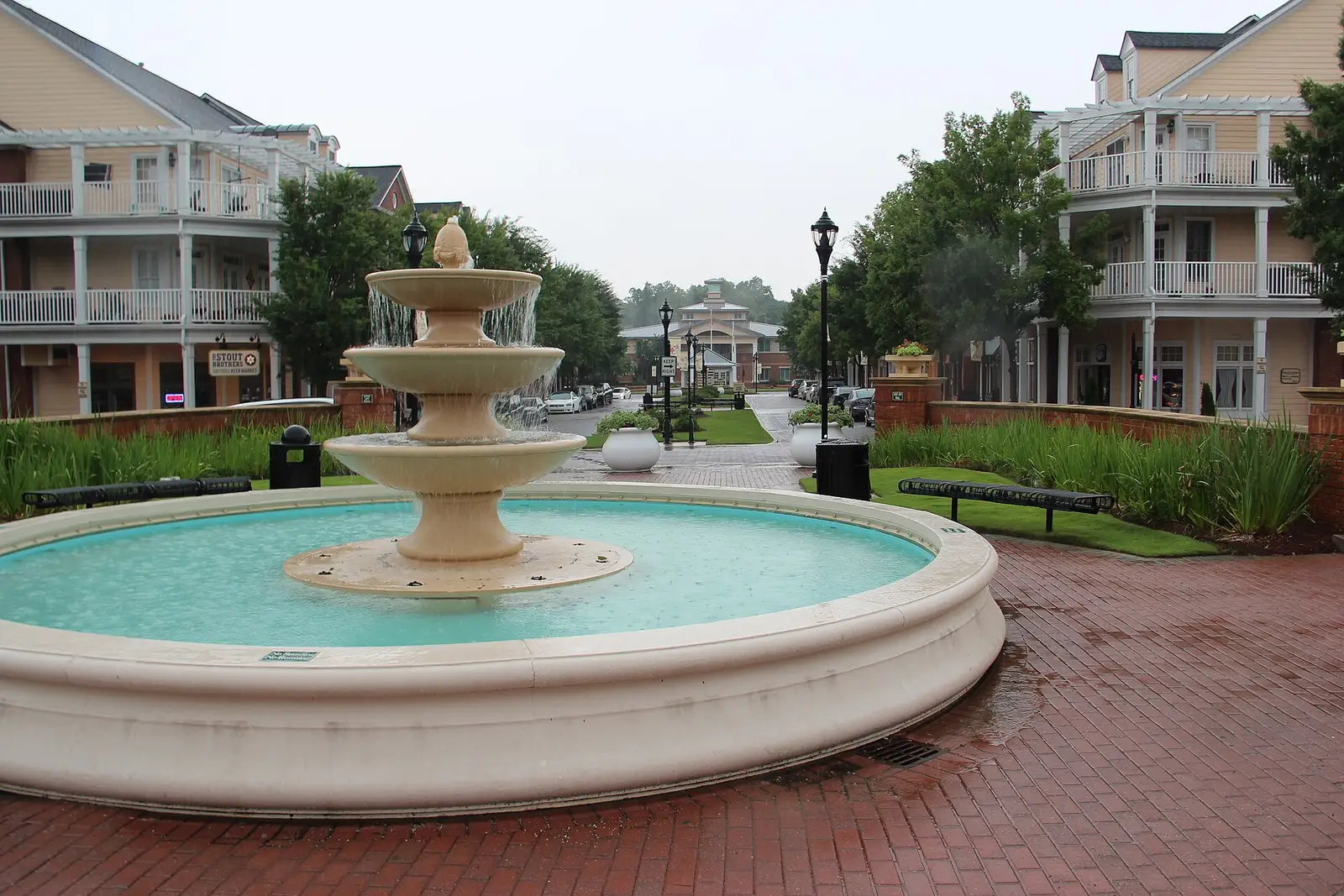
Smyrna bet early on walkable density, and you can read that bet in its housing stock. When the city launched the downtown redevelopment that became Market Village in 1991, it accelerated a townhome and condominium boom that reshaped the city's housing stock — and association-governed living here reaches back at least to the 456-unit Hillsdale condominiums of 1983 near Windy Hill Road. The gated Vinings Forest went up off Atlanta Road in 1997–1999; John Wieland's Vinings Estates spread across the city's southwest edge from the late 1990s into the 2000s; Ivy Walk rose at Atlanta Road and Cumberland Parkway between 2005 and 2007, with the 24-townhome Gates at Ivy Walk following beside it in 2016–2017; West Village added flats, shops, and townhomes from 2006 through 2014; and the Belmont redevelopment replaced the 1954 Belmont Hills Shopping Center, with Beazer's Belmont North townhomes arriving in 2019–2021. The Jonquil City — incorporated in 1872 and home to roughly 56,000 residents — is metro Atlanta's proof that a suburb can grow up rather than out, and more than four decades of that growth is governed by associations.
Each construction era carries its own reserve profile, and a template study treats them all alike. A 1983 condominium community with a lake and forty-year-old building envelopes, a late-1990s townhome enclave into its second roof conversation, and a four-story flat building from the 2010s share a climate and almost nothing else. Apex Reserve Group runs its analysis from Irvine, California, and sends an Atlanta-based member of our team to walk every Smyrna property firsthand — so the component inventory reflects how buildings actually weather Georgia heat, humidity, and clay, not a national average.
Why Smyrna Associations Need Current Reserve Studies
Smyrna's association-governed housing landed mostly in two concentrated waves — the late-1990s townhome push and the mid-2000s mixed-use boom — which means components across whole neighborhoods reach end of life together rather than one building at a time. A community finished in 1999 is deep into second-generation replacements; one finished in 2007 faces roofing, repainting, deck rebuilds, and private-street resurfacing in a single compressed window. Georgia's humid subtropical climate shortens those timelines further: long cooking summers break down coatings and sealants, trapped moisture feeds mildew and rot on shaded siding and fence lines, hailstorms and the odd ice event can strip years from shingle roofs, and expansive clay soils work retaining walls, sidewalks, and pool decks out of level. Many Smyrna communities also own infrastructure that rarely surfaces in a casual budget review — stormwater detention ponds, private alleys, monument entries, gates, and street trees under a heavy canopy. A current study built on a real inspection converts all of that from a future emergency into a scheduled, funded line item, which is the difference between steady dues and a special assessment nobody saw coming.
From Market Village to the Vinings Line: Smyrna's Association Stock
Downtown, the Market Village district the city began assembling in 1991 anchors a ring of village-scale townhome associations that maintain alleys, party walls, and streetscape rather than acres of clubhouse lawn. South along Atlanta Road, the corridor runs from the gated Vinings Forest (1997–1999) to Ivy Walk at Cumberland Parkway — John Wieland's 2005–2007 townhome-and-condominium village, which also appears in listings as One Ivy Walk — where residences mix with street-front retail and office space — commercial-grade components inside a residential budget — and the 24-unit Gates at Ivy Walk (2016–2017) adds four-level townhomes next door. West Village (2006–2014) pairs fee-simple townhomes with single-level flats in four-story buildings, putting elevators and interior corridors on the component list. Near Windy Hill Road, two eras sit almost side by side: the gated Hillsdale community — roughly 456 two-story condominiums from 1983, with a lake, lighted tennis courts, and a clubhouse — carries replacement questions its neighbors will not face for decades, while the Belmont redevelopment turned the site of the 1954 Belmont Hills Shopping Center into new homes and shops, joined by the Beazer-built Belmont North townhomes in 2019–2021. On the southwest side, Vinings Estates — John Wieland's master-planned community built from the late 1990s into the 2000s — straddles the municipal line between Smyrna and the City of Mableton, the Cobb County city incorporated in 2023, with a resort-scale amenity load of three pools and eight tennis courts, and the Silver Comet Trail's Mavell Road trailhead anchors that end of the city. Just east of the limits, the Cumberland district — including Truist Park and The Battery Atlanta, which sit in unincorporated Cobb County rather than inside Smyrna — keeps redevelopment pressure flowing toward the Spring Road corridor. No two of these settings share a component list, and a study worth adopting begins from the one your community actually owns.
What Georgia Law and Your Lenders Expect
Georgia's legislature has never told associations to commission reserve studies, and no state agency audits reserve balances. Three quieter forces do the work a mandate would. The first is the paperwork your community recorded: covenants and bylaws across Smyrna's boom-era communities frequently direct the board to budget reserves for capital repair, and ignoring your own covenants requires no statute to become a liability. The second is the framework of Georgia community-association law: condominiums organize under the Georgia Condominium Act (O.C.G.A. Title 44, Chapter 3), while many townhome HOAs have elected coverage under the 1994 Georgia Property Owners' Association Act. Neither statute requires a reserve study — but directors under both owe fiduciary duties, and a board that watches a twenty-five-year-old roof approach failure while budgeting nothing for it is walking into the liability those duties define. The third force is lending. Condominium project review by FHA and the GSEs — Fannie Mae and Freddie Mac — generally expects reserve contributions of at least ten percent of the annual budget, a ratio Fannie Mae measures against budgeted assessment income rather than the whole operating budget, or a credible current study that justifies a smaller contribution. That floor is moving: Fannie Mae and Freddie Mac have announced an increase to fifteen percent effective January 4, 2027, and under the new rules a reserve study can substitute only if it is no more than three years old and the budget funds the study's highest recommended level. Reviewers have also pressed far harder on deferred maintenance and unfunded repairs since the Surfside collapse. For Smyrna this is concrete, not theoretical: the city's for-sale stock leans heavily on townhomes and condominium flats whose buyers borrow through exactly these channels. A community whose financing dries up at project review has lost value as surely as if the roofs themselves had failed.
Our Reserve Study Services in Smyrna
Full Reserve Study — A ground-up engagement in which our Atlanta-area team member examines each shared asset — roofing, cladding, decks, pavement, pools, gates, fencing, detention infrastructure — and we construct the component inventory, condition baseline, and thirty-year funding model from those field observations. The right choice for a community without a usable prior study, or one that has just completed a major project. Typical delivery: 3 to 4 weeks.
Reserve Study Update With Site Visit — We come back out, re-examine the components, log completed replacements and new wear, and re-run the funding math at today's prices. Best kept on a three-to-five-year rhythm. Typical delivery: 2 to 3 weeks.
Off-Site Annual Update — Between site visits, we bring the plan current remotely — reserve balances, contribution levels, inflation and interest assumptions, finished projects — so every budget vote rests on current figures rather than a stale report. Typical delivery: 1 to 2 weeks.
Smyrna Communities We Serve
Our service area takes in the entire city and its unincorporated edges: downtown Smyrna and the Market Village district; the Atlanta Road corridor including Vinings Forest, Ivy Walk — whose addresses also appear in listings as One Ivy Walk — and Gates at Ivy Walk; West Village; Belmont, Belmont North, and Hillsdale near Windy Hill Road; the south-side neighborhoods around the Silver Comet Trail's Mavell Road trailhead; Vinings Estates and the communities along the Smyrna–Mableton line; Mosaic at Vinings and Heritage at Vinings; the Spring Road corridor approaching Cumberland; and the adjacent unincorporated Cobb County areas of Vinings and the Cumberland–Battery district. Wherever your association sits in or around the Jonquil City, our Atlanta-area reserve analyst can reach it.