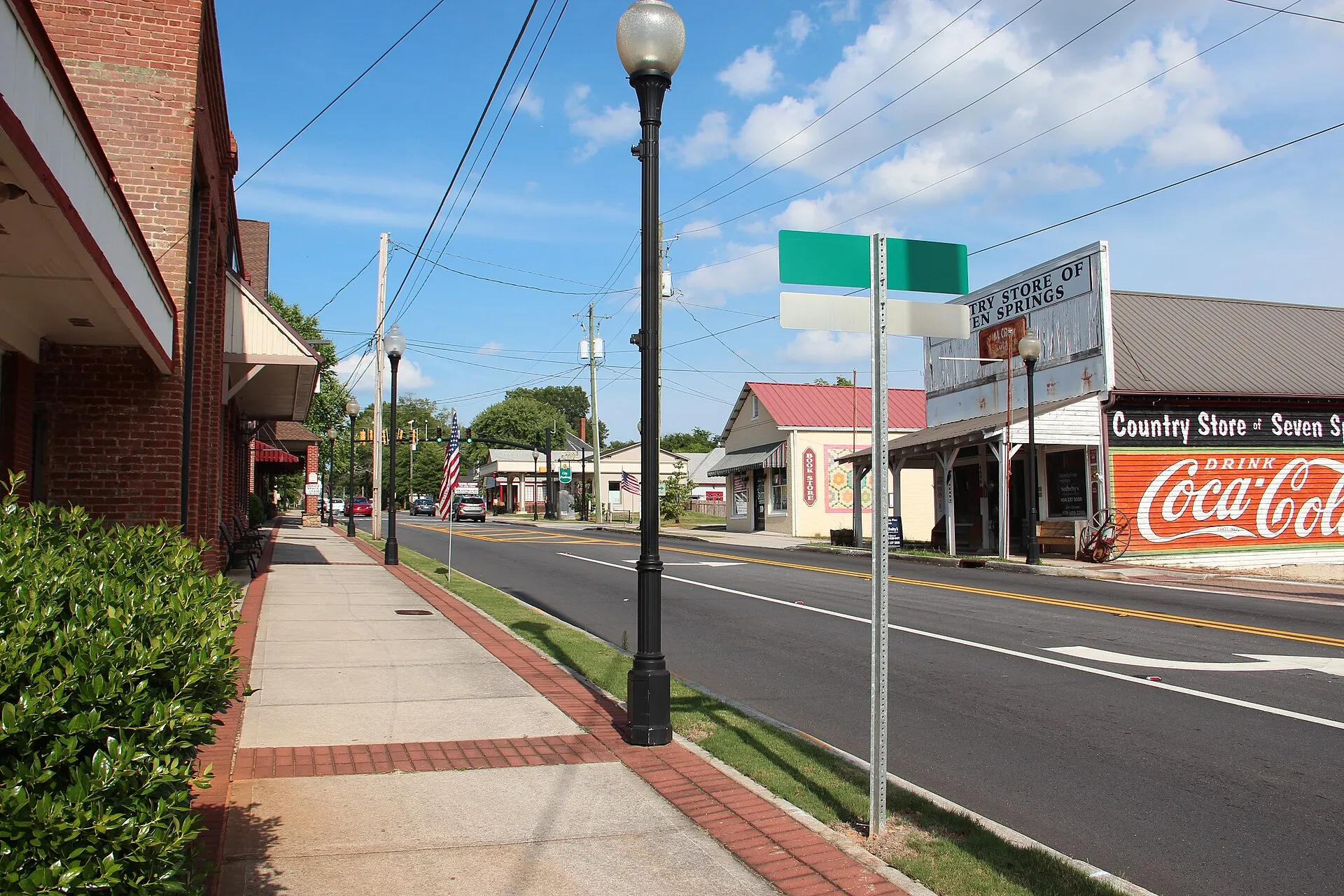
Powder Springs — incorporated as Springville in 1838 and renamed in 1859 for seven mineral springs whose water turns the surrounding sand black like gunpowder — added most of its association-governed housing in three distinct pushes. Country Walk led the first, growing past 450 homes between 1987 and 2001 around a clubhouse, lake, pool, and tennis campus, with the roughly 140-home Wyndham Woods following in the 1990s. The second push came at the turn of the millennium: Brown's Farm delivered 207 homes in 1999, Broadlands was established that same year, and Oakwind (2000-2004) and Brown's Crossing filled in the early 2000s. The third has been quieter and more specialized — Springbrook Estates carried single-family building from the late 2000s into the 2020s, Silver Springs Village went up in two age-restricted phases between 2003 and the late 2010s, Creekwood added gated 55-plus villas, and Concord Oaks is bringing new townhomes to market now. Downtown, meanwhile, the city put $4.1 million into Thurman Springs Park and cleared the way for the 226-unit Springside development, pulling genuine reinvestment into the historic core.
Almost none of that history survives contact with a template reserve study. A thirty-five-year-old swim-and-tennis campus, a subdivision still adding homes, and a brand-new townhome association do not share component lists, useful lives, or funding curves — and all three sit under a humid subtropical climate that ages what associations own faster than the standard tables admit. Apex Reserve Group's home office is in Irvine, California, and the Powder Springs fieldwork belongs to a team member living in metro Atlanta who handles these inspections in person — so the numbers in your study start from the condition of your components rather than from an average of everyone else's.
Why Powder Springs Associations Need Current Reserve Studies
Start with the arithmetic. An association whose amenities came online in the early 1990s has already replaced its clubhouse roof and pool finish at least once, resurfaced its courts several times, and is now staring at second-generation projects that cost more than the originals did. Communities from the 2000s building years carry the opposite exposure: a first replacement wave in which shingles, pool equipment, play structures, and paving — all installed within months of one another — come due within a few budget cycles of one another too. Then the weather compounds the math. Long, wet summers swell and split caulk joints, feed mildew across siding and shaded fence runs, and rot decks and pergolas outward from the fasteners; asphalt shingles give up years to the heat; expansive clay lifts sidewalk panels and leans against retaining walls; and the hardwood canopy that helps sell houses in Country Walk or Brown's Farm also drops limbs on roofs, packs gutters, and drives roots beneath private drives. Detention ponds deeded to the association silt up quietly for a decade, then hand the board a dredging project all at once — and a stray hailstorm or ice event can reshuffle even a disciplined schedule overnight. One more local reality: Powder Springs prices consistently below the Cobb County median, dues are set accordingly, and a surprise special assessment therefore lands harder here than it would in East Cobb. A current reserve study converts that surprise into a schedule.
From Country Walk to Concord Oaks: Powder Springs' Association Landscape
The Silver Comet Trail is the through-line. The rail-trail crosses Powder Springs on its run between Smyrna and the Alabama line; the paved Wildhorse Trail descends about a mile and a half from Wild Horse Creek Park on Macedonia Road to join it at Carter Road; and a downtown loop along Marietta and Dillard Streets connects Town Square to the corridor at the Dillard Street trailhead. Around that spine sit three generations of associations. The 1987-2001 build-out of Country Walk — more than 450 homes with a clubhouse, lake, swim team, and tennis program — anchors the large-amenity era alongside Wyndham Woods, Brown's Farm, and Brown's Crossing. Oakwind's 2000-2004 sections and Broadlands — established in 1999 with a pool-and-tennis package — represent the turn-of-the-millennium round. The newest layer is more varied: Springbrook Estates kept building into the 2020s behind a lap pool and lighted courts, Silver Springs Village and the gated Creekwood serve the 55-plus market, and Dream Finders' Concord Oaks is selling new townhomes now. Downtown has changed fastest of all — Thurman Springs Park and its Hardy Family Automotive Amphitheater celebrated a grand opening in May 2021, the downtown program around the park earned the city and its Downtown Development Authority the Atlanta Regional Commission's 2020 Great Place Award, and Springside's eight buildings added roughly 226 residences to the old commercial core after a summer 2022 groundbreaking. One caution for boards: the 30127 ZIP code stretches well past the municipal line, so plenty of Powder Springs-addressed associations actually sit in unincorporated west Cobb — a distinction that changes which government issues permits, but not who pays for the pool.
What Georgia Law and Your Lenders Expect
Nothing in Georgia's code compels an HOA or condominium board to buy a reserve study, and no statute puts a floor under the reserve account. That absence is often misread as permission to coast, and it should not be. The first source of obligation is the document set recorded when your subdivision was platted: declarations and bylaws from Powder Springs' 1990s and 2000s building years often instruct boards to fund repair and replacement reserves, and covenant obligations do not evaporate just because the General Assembly stayed quiet. The second is the statutory frame around those documents. Condominiums here are creatures of the Georgia Condominium Act — Title 44, Chapter 3 of the O.C.G.A. — while many townhome and single-family HOAs have recorded an election into the Property Owners' Association Act, Georgia's opt-in HOA statute; neither statute prescribes a study or a funding target, but directors still owe their members fiduciary care, and letting a 1990s clubhouse roof or a silting pond decline with nothing budgeted for either is how a board risks writing a gross-negligence or bad-faith claim against itself. The third source is money on the buyer's side of the closing table. Project reviewers at Freddie Mac, Fannie Mae, and FHA generally want condominiums and many attached townhomes to show about 10 percent of assessment income steered into reserves — or a professional reserve study, recent enough to trust, that backs the association's actual funding level — and reviewers have grown far more aggressive about deferred maintenance since the Surfside, Florida collapse in 2021. Most Powder Springs associations are single-family swim-and-tennis HOAs where covenants and fiduciary duty do the pushing; but as Concord Oaks and the next round of attached product sell through, lender files will start deciding how easily those homes resell — and a stale or missing study is exactly the kind of red flag that stalls a closing.
Our Reserve Study Services in Powder Springs
Full Reserve Study — The from-scratch engagement for a community starting fresh or starting over: our metro-Atlanta inspector walks every association-owned component on foot — clubhouse, pool and deck, courts, playgrounds, fencing, entry monuments, private streets, retaining walls, detention ponds — and we model thirty years of replacements against your actual balances and contribution rate. Typical delivery: 3 to 4 weeks.
Reserve Study Update With Site Visit — For associations with a study already on the shelf: we come back out on a three-to-five-year rhythm, re-rate each component against what Georgia summers have actually done to it, fold in completed projects, and re-run the funding plan at current prices. Typical delivery: 2 to 3 weeks.
Off-Site Annual Update — Between site-visit years, we true up the numbers remotely — reserve balance, interest, inflation, finished work — so the board walks into each budget season current rather than coasting on old assumptions. Typical delivery: 1 to 2 weeks.
Powder Springs Communities We Serve
Our service area covers the city of Powder Springs and the unincorporated west Cobb neighborhoods sharing its 30127 ZIP code — including Country Walk, Wyndham Woods, Brown's Farm, Brown's Crossing, Oakwind, Broadlands, Springbrook Estates, Silver Springs Village, Creekwood, Concord Oaks, the blocks around Town Square and Thurman Springs Park, and the subdivisions strung along the Silver Comet and Wildhorse trail corridors. From a 450-home swim-and-tennis association to a gated 55-plus enclave to a townhome community still under builder warranty, if it answers to a Powder Springs address, it sits inside our coverage.