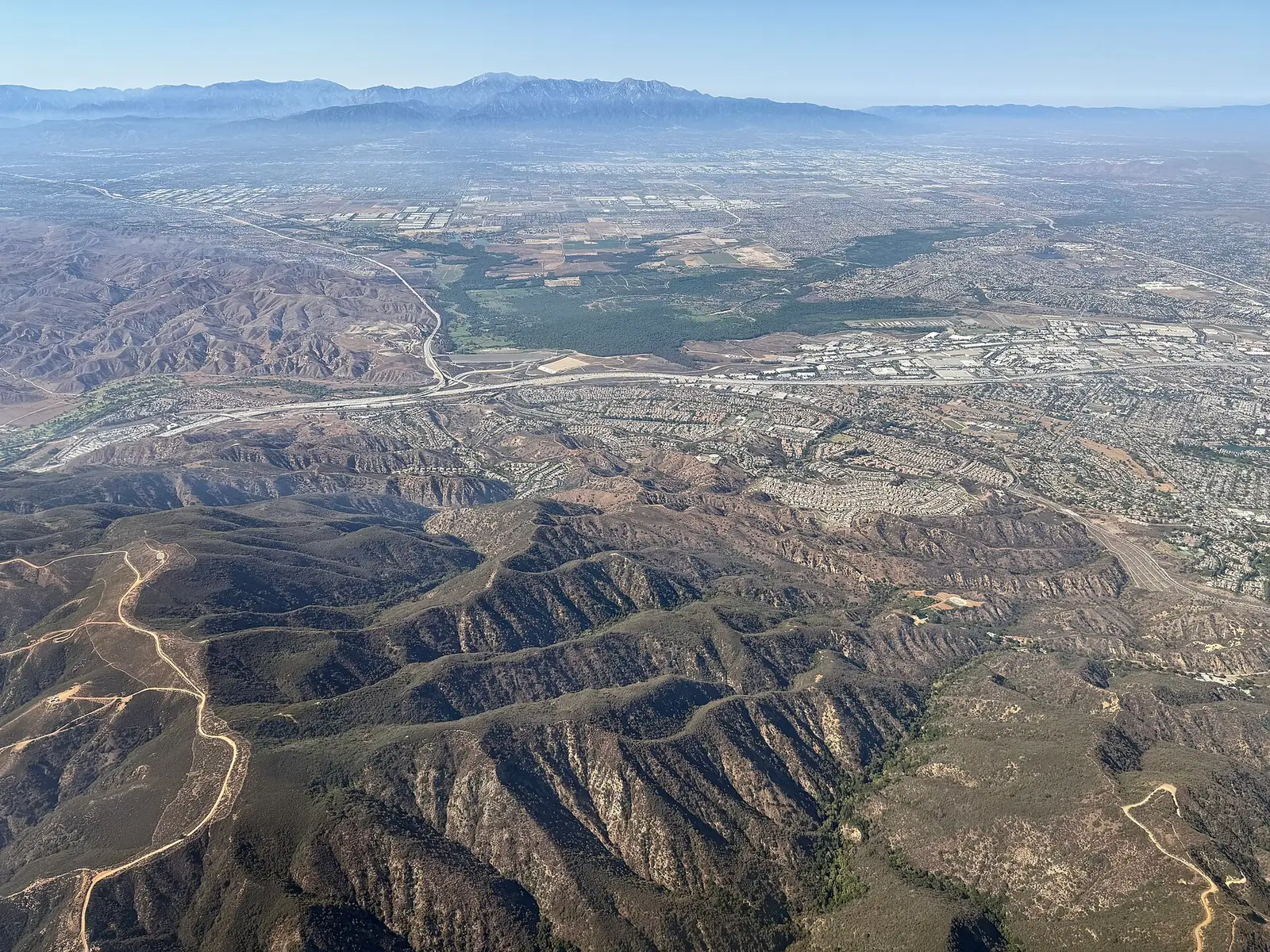
Corona is two cities wearing one name. At its center sits the 1886 citrus colony ringed by Grand Boulevard — the circular drive, 2.75 miles around, that earned Corona the "Circle City" nickname and carried international road races in 1913, 1914, and 1916. The blocks inside and around that circle hold the city's oldest housing, and many of central Corona's attached townhome and condominium associations date to the 1980s, when a commuter boom more than tripled the population between 1980 and 2000. The second Corona climbs the foothills: Sierra del Oro rose near the mouth of Santa Ana Canyon through the 1980s and 1990s, Corona Hills filled the city's northeast corner, and the early 2000s brought the golf-oriented master plans of South Corona — Eagle Glen around its 1999 course, Mountain Gate in the foothills below the Cleveland National Forest, and Dos Lagos, a 534-acre mixed-use plan built around two lakes.
Those two Coronas age on different clocks, and a template reserve study serves neither well. A forty-year-old townhome association near the circle is deep into second-generation replacements of roofs, plumbing, and paving, while a 2005 master plan is just now hitting its first major cycle — with slopes, monumentation, gates, and private streets that never appear on a generic component list. Apex Reserve Group, based in Irvine, builds each Corona study around the community's actual construction era and inventory, and around the exposures particular to this valley: Santa Ana winds accelerating through the canyon and a wildland fire edge along the Santa Ana Mountains.
Why Corona Associations Need Current Reserve Studies
Corona's environment tests common-area components from two directions, and its housing stock spans four decades of construction that respond differently to each. The first pressure is wind. The Santa Ana winds are literally named for the canyon at the city's western edge, where northeast gusts compress and accelerate on their way toward Orange County — and the communities closest to the canyon mouth feel it most. Recurring wind events loosen tile and shingle roofing, rack wood fencing, take down mature trees, and scour paint and coatings on exposed elevations, so useful lives borrowed from calmer markets run long. The second pressure is the wildland edge. West and south Corona back up to the Santa Ana Mountains and the Cleveland National Forest; the 2018 Holy Fire burned more than 23,000 acres in the forest and placed portions of the Corona area under evacuation orders. Hillside associations carry slope maintenance, drainage, erosion control, and perimeter fencing obligations that flatland communities never budget for. Layer on inland summer heat — highs average in the low-to-mid 90s and can push past 100 during the hottest stretches, driving thermal cycling in stucco, asphalt, and sealants — and the case for a current, inspection-based study is simply about accuracy: funding plans should reflect how components behave here, not somewhere milder.
Inside the Circle and Up the Foothills: Corona's Association Landscape
Start at the middle. The historic core inside and around Grand Boulevard is dominated by older single-family blocks, but central Corona also holds attached condominium and townhome associations dating to the 1980s — communities now working through their second full round of roofing, paving, and exterior projects, many of them small and self-managed. To the northeast, Corona Hills is the city's largest neighborhood by land area, built out from the late 1980s into the early 2000s near the 91/15 interchange and near Cresta Verde Golf Course, which occupies the grounds of the 1920s Parkridge Country Club. West Corona belongs to Sierra del Oro, whose foothill tracts — including the Dominguez Ranch enclave of the late 1980s and early 1990s — sit closest to Santa Ana Canyon and take the region's strongest wind exposure. South Corona is master-plan country: Mountain Gate and its early-2000s subdivisions such as Brentridge, Eagle Glen wrapped around its 1999 golf course, and Dos Lagos, a mixed-use plan from the mid-2000s whose Matthew Dye-designed course dates to 2007. Just beyond the city line, the hillside community of El Cerrito — an unincorporated Riverside County area mostly surrounded by the city — and unincorporated Temescal Valley communities such as The Retreat — whose Champions Club course has since closed — share the same corridor and the same exposures, and we serve them as well. Each of these settings produces a distinct component inventory, and the study should be built from yours.
What California Law Requires
The Davis-Stirling Act sets the baseline for every Corona association. Civil Code Section 5550 requires a reserve study grounded in a diligent visual site inspection at least once every three years, with the board reviewing and adjusting the study annually in between. Civil Code Section 5300 then requires the reserve funding picture — current balances, funding percentage, and assessment outlook — to be disclosed in the annual budget report that goes to every member. For condominium projects, SB 326 added a structural requirement: elevated wood-framed balconies, decks, and walkways must be inspected by a licensed structural or civil engineer, or architect, and the statutory deadline for the first inspection, January 1, 2025, has already passed. The law's reach in Corona is uneven by design. Most of the newer South Corona master plans are detached planned developments where SB 326 generally does not apply, while the city's condominium stock — including the attached communities of central Corona and condo-form townhomes elsewhere — falls squarely within it. Where an SB 326 report exists, we reconcile it with the reserve study, because structural findings frequently reset the remaining useful life of decks, railings, and walkway surfaces.
Our Reserve Study Services in Corona
Full Reserve Study — A ground-up study with an on-site inspection, a complete component inventory, and a 30-year funding plan calibrated to your community's construction era and its wind, heat, and fire-edge exposure. Typical delivery: 3 to 4 weeks. Reserve Study Update With Site Visit — A re-inspection and refresh of your existing study — the format Section 5550 expects at least every three years, and the right check on components that Corona's wind events age unevenly. Typical delivery: 2 to 3 weeks. Off-Site Annual Update — A remote recalibration of balances, contributions, inflation, and completed projects in the years between site visits, keeping your annual disclosures accurate. Typical delivery: 1 to 2 weeks.
Corona Communities We Serve
We prepare reserve studies for associations throughout the city, including the historic Grand Boulevard circle and downtown, Central Corona, Corona Hills, Sierra del Oro, Dominguez Ranch, South Corona, Mountain Gate, Brentridge at Mountain Gate, Eagle Glen, and Dos Lagos, along with neighboring unincorporated communities — the hillside El Cerrito area, mostly surrounded by the city, and Temescal Valley communities such as The Retreat.