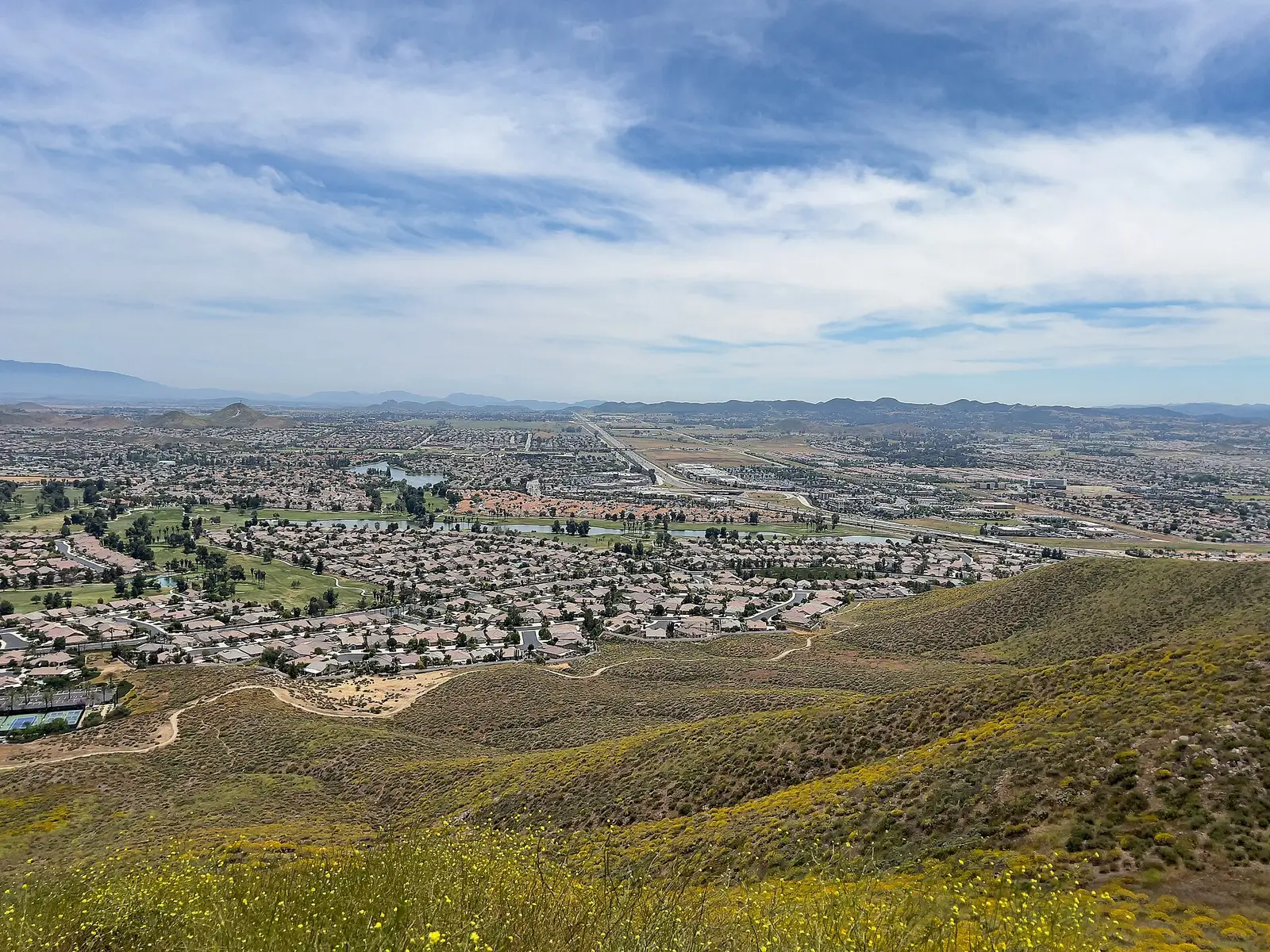
Menifee is a study in bookends. The city itself is one of California's youngest — incorporated on October 1, 2008, when voters joined Sun City, Quail Valley, and Romoland into a single municipality — yet at its center sits one of the earliest active-retirement communities in the country. Del Webb opened his first California Sun City in June 1962, and its roughly 4,700 homes, built through 1981 by Webb and later the Presley Company, still surround the pools, lawn bowling greens, and meeting halls of the Sun City Civic Association. Every era since has added a layer around that 1960s core: Menifee Lakes and its man-made North and South Lakes beginning in 1989, the guard-gated 55-plus Oasis at the turn of the 2000s, and the post-cityhood master plans — Heritage Lake wrapped around a 25-acre lake, Audie Murphy Ranch along Salt Creek, and newer single-family neighborhoods such as Talavera.
A sixty-year spread in construction dates means there is no single "Menifee reserve study." The Civic Association budgets for amenity buildings older than the city that now surrounds them; Menifee Lakes and The Oasis are working through their first full replacement cycles; Heritage Lake and Audie Murphy Ranch are young enough that underfunding can hide behind assets that still look new. What every one of them shares is an inland valley climate — long, hot, dry summers, intense UV, and wide day-to-night temperature swings — that grinds away at asphalt, roofing, coatings, and pool decks. Apex Reserve Group, an Irvine-based reserve study firm, builds each Menifee study around the community's actual era, component list, and exposure instead of a borrowed template.
Why Menifee Associations Need Current Reserve Studies
Menifee's associations sit at opposite ends of the funding curve, and each end carries its own risk. At one end, Sun City's amenity core dates to the 1960s — the Civic Association's recreation buildings, pools, and grounds have been through multiple replacement cycles already, and every remaining original element needs a defensible remaining-life estimate rather than a table value. At the other end, communities built after 2005 face a different trap: when clubhouses, splash parks, and streetscapes are only one or two decades old, boards tend to fund as if nothing will ever wear out, and the first wave of simultaneous replacements arrives against a reserve balance built for a quieter forecast. Menifee's climate compresses those timelines. Summer heat routinely pushes past 100 degrees, UV exposure is intense, and nights cool sharply — a thermal cycle that oxidizes asphalt paving, embrittles sealants, fades and chalks exterior paint, and shortens the honest life of shingle and tile underlayment, shade structures, playground surfacing, and pool plaster. Communities built around water features add lake-specific components — aeration, pumps, dredging, and shoreline hardscape — that generic component libraries rarely price correctly. A current study with an on-site inspection replaces guesswork with observed condition.
Sun City to Salt Creek: A Tour of Menifee's Association Landscape
Start in the northwest quadrant, where the original Sun City grid holds detached homes from 1962 through 1981. Most owners there maintain their own roofs and exteriors, so the Sun City Civic Association's reserve study is dominated by shared assets: recreation buildings, swimming pools, lawn bowling greens, and the grounds that have anchored the community since the Kennedy administration. East of Interstate 215, Menifee Lakes spans roughly 2,000 acres begun in 1989, where neighborhood sub-associations sit alongside the Menifee Lakes Master Association — the governing documents dictate which tier budgets for the man-made lakes and the common landscaping, and a reserve study has to follow that split — with the 36-hole Menifee Lakes Country Club threading through the plan. Beside it, The Oasis — about 1,150 detached homes built by Ryland Homes between 1999 and 2005 — is a guard-gated 55-plus community whose 22,500-square-foot clubhouse, gates, and guardhouse form the heart of its component list. North, in the former Romoland area, Heritage Lake surrounds a 25-acre lake with paddle boating, catch-and-release fishing, a splash park, and tree-lined trails, with homes built from about 2005 into the 2020s under the Heritage Lake Master Association. Southwest along Salt Creek, Audie Murphy Ranch — a roughly 1,100-acre Brookfield Residential master plan — links its neighborhoods by trails and paseos to amenity centers including the Ranch House, The Plunge, Spirit Park, and Sports Park. Newer KB Home neighborhoods such as Talavera round out the picture with leaner, park-centered component lists.
What California Law Requires
California's Davis-Stirling Act sets the baseline for every Menifee association. Civil Code Section 5550 obligates the board to obtain a reserve study based on a diligent visual site inspection at least once every three years, and to review and update the study annually in between. Civil Code Section 5300 then requires the resulting reserve figures — funding status, assessment outlook, and planned major repairs — to be disclosed to owners in the annual budget report. Separately, SB 326 requires condominium associations to have elevated wood-framed balconies, decks, and walkways inspected by a licensed structural or civil engineer, or architect; the deadline for the first inspection was January 1, 2025, and it has already passed. Because Menifee's association stock is overwhelmingly detached single-family planned development, SB 326 touches a smaller share of the city than it does in coastal condo markets — but any Menifee condominium with elevated wood-framed exterior elements that has not yet completed its first inspection is out of compliance and should schedule one now. For every association, condo or not, the three-year inspection clock and the annual disclosure cycle run continuously, and an out-of-date study puts the board's budget disclosures on shaky ground.
Our Reserve Study Services in Menifee
Full Reserve Study — A complete component inventory, on-site condition assessment, and 30-year funding projection built around what your community actually owns, whether that is a 1960s recreation complex in Sun City or a lake, trail, and pool network in Heritage Lake. Typical delivery: 3 to 4 weeks. Reserve Study Update With Site Visit — The periodic on-site refresh Civil Code Section 5550 anticipates, revisiting component conditions that Menifee's heat and UV exposure can change faster than a spreadsheet assumes. Typical delivery: 2 to 3 weeks. Off-Site Annual Update — A desk-based revision of your funding plan and disclosure figures for the years between inspections, keeping the annual budget report accurate and compliant. Typical delivery: 1 to 2 weeks.
Menifee Communities We Serve
We prepare reserve studies throughout the city, including Sun City and the Sun City Civic Association, The Oasis, Menifee Lakes, Heritage Lake, Audie Murphy Ranch, Talavera, Quail Valley, Romoland, and the newer single-family and master-planned associations across central and southern Menifee, as well as communities in the surrounding southwest Riverside County area.