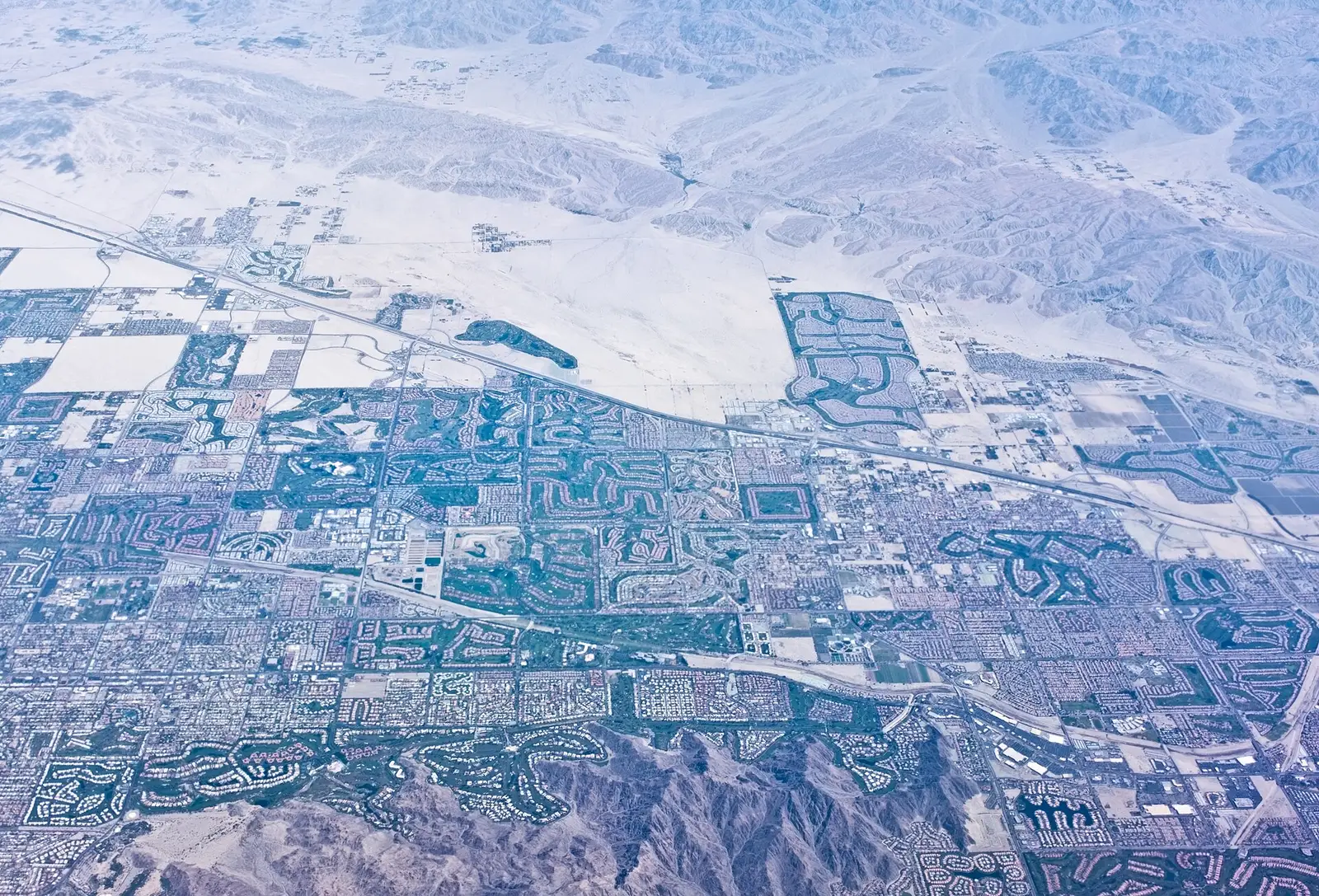
Palm Desert is a city shaped by homeowners associations. Incorporated in 1973, it grew up around private country clubs whose housing stock is overwhelmingly attached condominiums: Marrakesh Country Club broke ground in 1967 with 364 Hollywood Regency condos designed by John Elgin Woolf, Ironwood Country Club opened in 1974 in the Santa Rosa foothills with more than a thousand residences spread across multiple sub-associations, and the Sunrise Company built roughly 1,200 condos at Monterey Country Club between 1978 and 1982. The 1980s added The Lakes Country Club (902 homes, 1983 to 1986), the 1,274-condo Palm Valley Country Club (built from 1984 to 1991), and Desert Falls Country Club along the Country Club Drive corridor, while Bighorn Golf Club brought custom estate homes to the city's southern edge in the 1990s. Between the fairways sit the El Paseo shopping district, the McCallum Theatre, and a growing north side anchored by the Cal State San Bernardino Palm Desert Campus.
A reserve study written from a generic template misreads almost everything about this stock. Summer highs here regularly push past 110 degrees, and the combination of relentless UV, thermal cycling, and blowing sand ages roofs, coatings, asphalt, and pool equipment on a schedule inland-suburban useful-life tables never anticipated. Layer on seasonal occupancy — many owners are gone from May through October, when the desert is hardest on buildings — and amenity inventories that can include dozens of pools per association, and the need for local calibration is obvious. Apex Reserve Group, based in Irvine, prepares reserve studies for Palm Desert associations built around your actual component inventory, your construction era, and the desert environment doing the aging.
Why Palm Desert Associations Need Current Reserve Studies
Most of Palm Desert's condominium stock was built between the late 1960s and the late 1980s, which puts these communities forty to sixty years into their component lives — deep into second and third replacement cycles for roofing, exterior paint and stucco coatings, pool plaster and equipment, tennis and pickleball surfaces, and private streets. The desert accelerates all of it. Intense UV breaks down roofing membranes, sealants, and paint; daily thermal swings expand and contract stucco, concrete flatwork, and asphalt until they crack; triple-digit heat shortens the service life of air-conditioning condensers, pool heaters, and pumps that run hardest exactly when nobody is watching. Seasonal occupancy compounds the problem: with a large share of owners away all summer, deterioration can go unreported for months, and boards that convene mostly in season have a narrow window each year to inspect, bid, and approve major work. An amenity-heavy 1980s club community may be maintaining thirty or more pools and spas, miles of interior streets, guard gates, lakes, and irrigation systems simultaneously — a component load few reserve templates contemplate. A current study with a recent site inspection tells your board what is actually wearing out, in what order, and what monthly contribution keeps the plan solvent without a special assessment.
From Marrakesh to Country Club Drive: Palm Desert's Association Landscape
South Palm Desert holds the city's oldest association stock. Marrakesh Country Club's 364 condos were built in phases from its 1967 groundbreaking through 1978, Shadow Mountain's surrounding residences went up between 1950 and 1979 — among them the Shadow Mountain Club's Fairway Cottages of 1961 to 1963, designed by the modernist firm Wexler and Harrison — and Ironwood Country Club has anchored the Santa Rosa foothills since 1974 with condos, attached homes, and custom estates governed through more than a dozen sub-associations. Nearby, Bighorn Golf Club is a 1990s-era estate community where the components at issue are gates, streets, and common landscape rather than shared building envelopes. Central Palm Desert includes Chaparral Country Club, a gated community of 625 condos established in 1980, and Portola Country Club, a gated 55-plus manufactured-home community built around its own golf course. The Country Club Drive corridor in the city's north-central section carries the big 1980s condo associations — Monterey Country Club, The Lakes Country Club, Palm Valley Country Club, and Desert Falls Country Club — each a gated community of roughly 900 to 1,300 homes with extensive shared amenities, mostly attached condominiums, though Desert Falls also takes in townhomes and detached single-family houses. West of Washington Street, between Fred Waring Drive and Hovley Lane East, the non-gated Palm Desert Country Club neighborhood surrounds one of the valley's earliest golf courses, first developed around 1960. Each of these settings produces a different component list, and the study has to start from yours.
What California Law Requires
California's Davis-Stirling Act sets the baseline. Civil Code Section 5550 obligates most common interest developments to obtain a reserve study based on a diligent visual site inspection at least once every three years, and to review and update the study annually in between. Civil Code Section 5300 then requires the reserve funding picture — current balances, funding percentage, and the assessment outlook — to be disclosed to owners in the annual budget report. For condominium associations, SB 326 added a structural layer: elevated wood-framed balconies, decks, stairways, and walkways must be inspected by a licensed structural engineer or architect — a pool of qualified inspectors that a 2024 amendment, AB 2114, widened to include licensed civil engineers — and the first inspection was due by January 1, 2025 — a deadline that has already passed. The law targets condominium projects, not detached single-family planned developments, and its reach in Palm Desert varies by community: much of the country club stock is single-story attached housing with few elevated elements, while two-story condo buildings and raised wood-framed walkways fall squarely within scope. Where an SB 326 inspection has been performed, its findings belong in the reserve study, because observed structural condition routinely changes the remaining life assigned to decks, railings, and walkway framing.
Our Reserve Study Services in Palm Desert
Full Reserve Study — A ground-up component inventory, on-site condition assessment, and 30-year funding plan, with useful lives calibrated to desert UV, heat, and thermal cycling rather than temperate-climate defaults. Typical delivery: 3 to 4 weeks.
Reserve Study Update With Site Visit — A fresh field inspection and revised funding plan, recommended at least every third year and especially valuable where summer vacancy means conditions change faster than boards can observe them. Typical delivery: 2 to 3 weeks.
Off-Site Annual Update — A remote refresh of balances, interest, inflation, and project timing in the intervening years, keeping your Civil Code disclosures accurate without a site visit. Typical delivery: 1 to 2 weeks.
Palm Desert Communities We Serve
We serve associations throughout the city, including Marrakesh Country Club, Ironwood Country Club, Bighorn Golf Club, the Shadow Mountain area, Chaparral Country Club, Portola Country Club, Monterey Country Club, The Lakes Country Club, Palm Valley Country Club, Desert Falls Country Club, the Palm Desert Country Club neighborhood, condominium and townhome associations near El Paseo and in north Palm Desert around the university district, and nearby communities in unincorporated Riverside County such as Sun City Palm Desert.