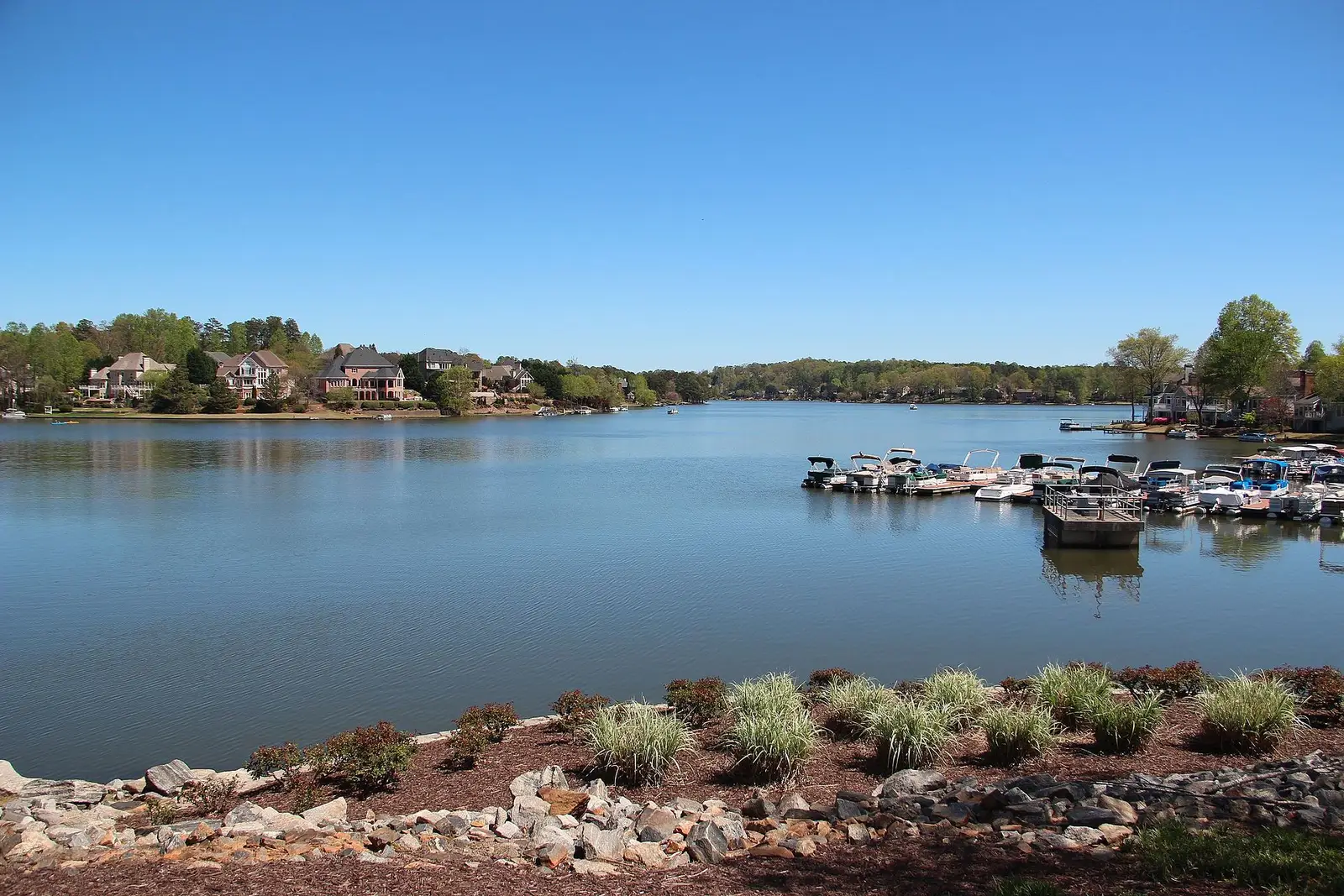
Alpharetta was chartered on December 11, 1858, and spent its first seven decades as the quiet seat of the old Milton County, which merged into Fulton County effective January 1, 1932. Its association era arrived with Georgia 400. Mobil Land Development launched the 3,400-acre Windward master plan in the mid-1980s, arranging more than twenty neighborhoods around the 195-acre Lake Windward — the 36-hole Golf Club of Georgia followed in the early 1990s — and through the 1990s and early 2000s the swim-and-tennis subdivision — Glen Abbey, Park Brooke, Pennbrooke, and dozens of their neighbors — became the city's signature housing form. Then the center of gravity shifted again: Avalon opened its first phase in October 2014, City Hall and the Town Green debuted in 2015, the six-block Alpharetta City Center followed in 2018, and communities such as the gated townhome neighborhoods of Academy Park and Atley, along with Foundry's mix of townhomes and single-family homes beside Avalon, now place association-governed homes within walking distance of downtown.
Those three generations of communities age in completely different ways, and a template-driven reserve study treats them as if they were the same property. A Windward-era neighborhood is deep into its second replacement cycle; a 1998 clubhouse with hard-used tennis courts is entering its first; a 2021 townhome enclave is still running on a developer budget that seldom captures the full component list the association actually owns. Apex Reserve Group, headquartered in Irvine, California, prepares reserve studies for Georgia associations, and a team member who lives and works in metro Atlanta handles every site inspection — so the component list comes from a walk of your actual grounds rather than an industry lookup table.
Why Alpharetta Associations Need Current Reserve Studies
Alpharetta's growth came in concentrated waves, and that is precisely what makes reserve planning here unforgiving. When a subdivision goes up in a single construction push — as nearly every 1990s swim-and-tennis neighborhood here did — every shingle roof, pool shell, court surface, and stretch of private asphalt reaches the end of its useful life within a few years of the others. The bill does not arrive as one manageable project; it arrives as a cluster. Windward-era communities built in the late 1980s are now roughly four decades old, with entrance monuments, irrigation systems, retaining walls, and amenity buildings on their second or third round of major work. Meanwhile Georgia's humid subtropical climate quietly compresses the schedule: long, wet summers degrade paint films and sealants well ahead of what national useful-life tables assume, wood decks and fence lines rot from the fastener holes outward, mildew creeps across siding kept in shade by the tree canopy, and the region's red clay soils heave and settle beneath pavement and retaining structures. Add an occasional hailstorm or winter ice event and a detention pond slowly filling with silt, and a funding plan written five or more years ago is almost certainly out of date. A study built on a fresh walk-through converts that cluster of looming costs into a level, predictable contribution — before it becomes a special assessment vote.
Windward, Swim-and-Tennis Streets, and the New Downtown: Alpharetta's Association Map
Windward anchors the east side of Georgia 400 — a 3,400-acre master-planned community begun in the mid-1980s, with more than twenty distinct neighborhoods, a 195-acre private lake reserved for residents and their guests, and the 36-hole Golf Club of Georgia, opened in the early 1990s, at its core. Communities at that scale typically layer sub-association budgets beneath a master association responsible for parks, lake amenities, monumentation, and miles of common landscape, and the reserve study has to respect who owns what. Just across the city line sits Country Club of the South, the roughly 900-acre gated community surrounding Jack Nicklaus's 1987 course — often grouped with Alpharetta, but actually within Johns Creek, which incorporated in December 2006. West and south of Windward, the swim-and-tennis belt fills the map: Glen Abbey, built from the late 1990s into the early 2000s with a large clubhouse, aquatic center, and courts that field active ALTA and USTA teams; Park Brooke off Kimball Bridge Road and Old Milton Parkway; Pennbrooke and its mid-1990s contemporaries. These associations carry amenity-heavy component lists relative to their size — clubhouse roofs and HVAC, pool decks and plaster, court resurfacing, playgrounds, private streets, and detention ponds. Closest to downtown and along the North Point corridor, the newest generation is vertical and walkable: Academy Park, the gated John Wieland townhome community built through the 2000s with its own pool, courts, and fitness center; Atley, with a segment of the Alpha Loop trail running through the neighborhood toward the Big Creek Greenway; Ecco Park near the North Point district; Foundry, a mix of townhomes and single-family homes between Avalon and City Center; and Serenade, the gated Ashton Woods community off Encore Parkway near Ameris Bank Amphitheatre. Attached housing shifts the reserve burden toward building envelopes — roofs, gutters, siding, decks, and party-wall waterproofing the association usually maintains.
What Georgia Law and Your Lenders Expect
No Georgia statute compels an association to obtain a reserve study, and none sets a minimum reserve balance. The pressure on an Alpharetta board arrives through other channels. Start with your recorded covenants: declarations and bylaws across North Fulton frequently direct boards to fund capital reserves or evaluate long-term repair needs, and neglecting an obligation written into your community's own documents is a self-inflicted legal problem. Behind that sits the state framework. Condominium regimes operate under the Georgia Condominium Act, O.C.G.A. Title 44, Chapter 3, which makes the budgets shown to purchasers itemize reserve line items for deferred maintenance yet stops short of demanding a study, while HOAs fall under the Georgia Property Owners' Association Act only where the declaration elects that coverage. What both statutes carry regardless is fiduciary weight: a director who watches a roof, a private street, or a retaining wall approach the end of its life and sets aside nothing for it risks crossing from protected business judgment into the gross negligence or bad faith that can defeat a board's presumption of good-faith decision-making under Georgia law, and a professionally documented funding plan is a strong rebuttal. Then comes the mortgage market. Fannie Mae, Freddie Mac, and FHA project reviewers typically want about 10 percent of a condominium's budgeted assessment income flowing into reserves unless a recent professional study justifies another number, and the post-Surfside questionnaires dig hard into deferred maintenance — unaddressed structural deficiencies can strip a project of conforming-loan eligibility altogether. In Alpharetta that risk lands squarely on the condominium-titled townhomes and flats near downtown, the City Center blocks, and Avalon, where financing friction translates into slower sales and softer prices. A study dated inside the last three years gives a board a ready answer.
Our Reserve Study Services in Alpharetta
Full Reserve Study — Our Atlanta-area team member inspects every common element on your property — building exteriors, amenity centers, pools and courts, private streets, fencing, retaining walls, and stormwater ponds — and we construct the component inventory, condition assessment, and 30-year funding model from what the inspection actually finds. Typical delivery: 3 to 4 weeks.
Reserve Study Update With Site Visit — A re-inspection on a 3-to-5-year cycle that captures completed projects, new components, and the wear that hot, humid summers and shifting clay place on components between full studies. Typical delivery: 2 to 3 weeks.
Off-Site Annual Update — A remote refresh of the numbers in intervening years — reserve balance, interest, inflation, and revised project timing — so the funding plan stays accurate without waiting for the next inspection. Typical delivery: 1 to 2 weeks.
Alpharetta Communities We Serve
We work with associations across Alpharetta, including Windward and its more than twenty neighborhoods around Lake Windward, Glen Abbey, Park Brooke, Pennbrooke, Academy Park, Atley, Ecco Park, Foundry, Serenade, and the townhome and condominium communities around downtown Alpharetta, the City Center blocks, Avalon, the North Point district, the Windward Parkway corridor, and the Kimball Bridge Road area — as well as associations in neighboring Milton, Roswell, and Johns Creek, including communities such as Country Club of the South.