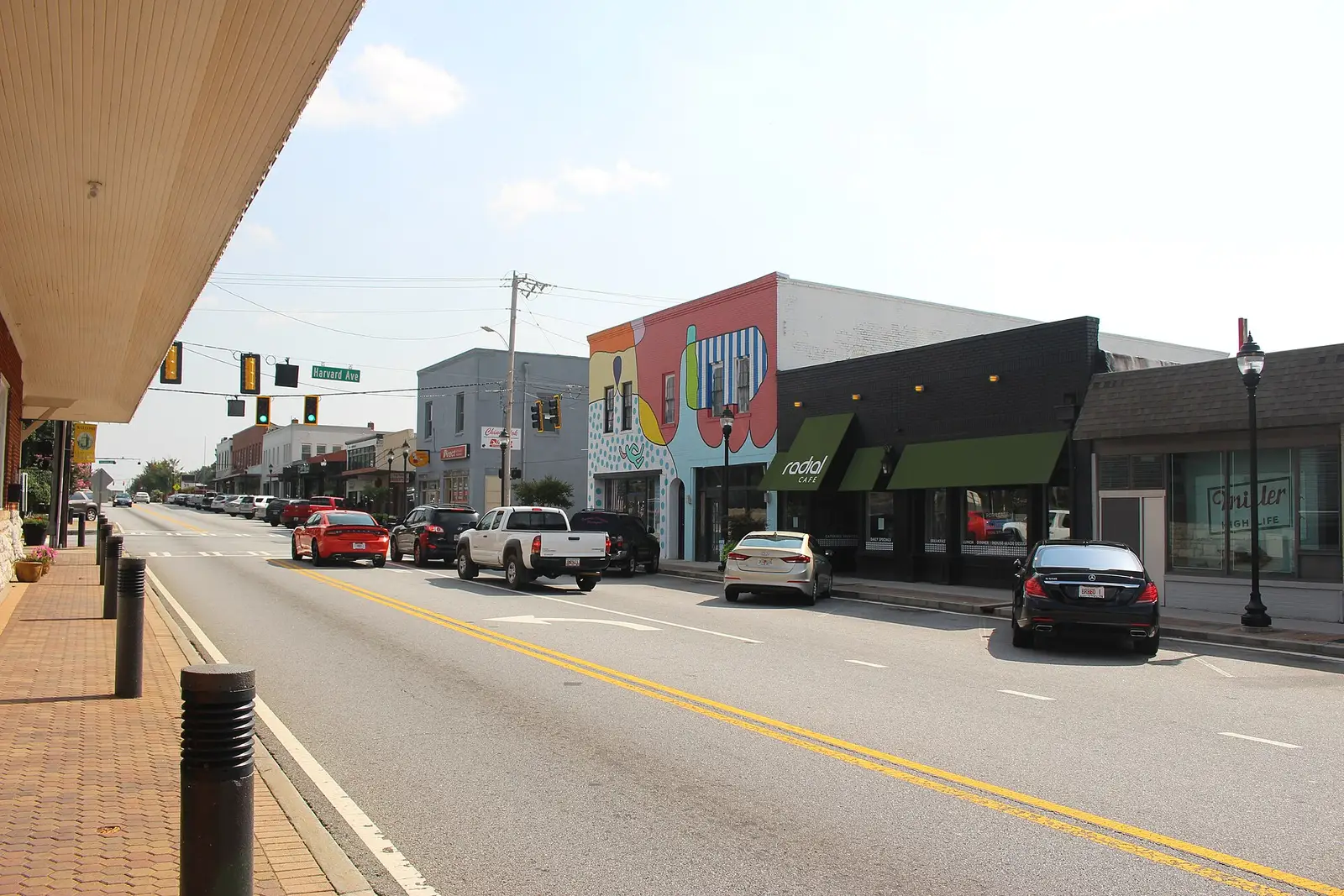
College Park is one of metro Atlanta's original railroad towns — founded in 1890 as Atlantic City, a depot stop on the Atlanta and West Point line, incorporated as Manchester in 1891, and renamed College Park in 1896 for Cox College and the Georgia Military Academy that became Woodward Academy. Its housing tells that story in two distinct chapters. The 606-acre College Park Historic District, Georgia's fourth-largest urban historic district on the National Register, preserves 853 documented resources built between 1882 and 1946, with Craftsman bungalows and Queen Anne houses lining Ivy League–named avenues like Harvard and Princeton as well as resident-named streets like Walker Avenue. Then, after decades of airport noise-land buyouts hollowed out the blocks nearest Hartsfield-Jackson, a second chapter began: the ION loft condominiums at 1805 Harvard Avenue facing the MARTA station, the seventeen-unit Temple Square townhomes completed in 2020 as the first project in the city's transit-oriented development district, Princeton Village's townhomes and cottage homes built from 2006 to 2021, new single-family construction at Hawthorne Station, and 120 townhomes planned inside Six West, the 311-acre redevelopment taking shape on former noise land near downtown.
That two-chapter history is precisely where a generic reserve study goes wrong. College Park's associations are mostly compact — a loft building near the storefronts, seventeen townhomes sharing a gathering square, a few dozen homes around a private drive and detention pond — so a single mispriced roof line or retaining wall can distort the whole funding plan, and national useful-life templates fit neither a downtown building with pre-war neighbors nor a fiber-cement townhome block barely past its builder warranty. Apex Reserve Group is an Irvine, California firm, and we pair our home-office analysts with an inspection specialist who lives and works in metro Atlanta — someone who walks your College Park property in person, photographs real conditions, and builds the component inventory around what your association actually maintains.
Why College Park Associations Need Current Reserve Studies
College Park's construction timeline is unusually polarized, and that shapes reserve planning here more than anything else. Airport noise acquisitions from the 1980s through the early 2000s removed roughly 320 acres of houses, churches, and small commercial buildings near downtown, and the city lost close to a third of its residents during the 2000s. The result is that association-governed housing clusters at two extremes: a walkable core whose surrounding fabric predates 1946, and condominium or townhome communities built after roughly 2005. Both ends of that spectrum are hitting capital-expense milestones right now. Downtown loft and condo buildings carry the envelope, mechanical, and waterproofing questions that come with urban infill construction, while communities like Princeton Village — whose earliest phases date to 2006 — are reaching the age where original shingle roofs, exterior repaints, asphalt, and fence lines all start competing for the same dollars within a few budget cycles. And because most College Park associations are small, there is no large membership base to absorb a surprise: one re-roofing or repaving contract can equal a full year of assessment income, so an unplanned expense converts almost directly into a special assessment. A current study sequences those overlapping projects, prices them at today's metro Atlanta construction costs, and tells your board exactly what contribution rate keeps the plan solvent without an emergency levy.
Main Street Lofts, Temple Square, and Princeton Village: College Park's Association Landscape
Start downtown, where the Main Street commercial corridor anchors the historic district and City Hall sits at 3667 Main Street. Association stock here is small and idiosyncratic: the artist-oriented ION lofts at 1805 Harvard Avenue sit directly across from one of MARTA's busiest rail stations, and a short walk away, Temple Square's seventeen townhomes at 1777 Temple Avenue — the first development delivered under the city's transit-oriented development zoning — share a paved gathering square near the Woodward Academy campus. The surrounding bungalow blocks exist in this condition because the College Park Historical Society organized in 1978 to fight airport expansion and won National Register protection for the neighborhood and the Main Street district. South and west, the picture flips to new construction: Princeton Village layered townhomes and detached cottages onto the Fulton County side of the city across fifteen years of phased building, and Hawthorne Station is adding 163 planned single-family homes with an HOA on the edge of downtown. Around the Georgia International Convention Center and Gateway Center Arena, the Gateway district is the city's hospitality-and-entertainment engine, and the adjacent Six West redevelopment — master-planned in 2019 across 311 acres of former noise land — calls for townhomes, single-family homes, and multifamily buildings that will eventually mean brand-new associations with young components and no funding history at all. Each of these settings demands a different component inventory, different useful-life assumptions, and a different funding strategy, which is why we build every College Park study from a site walk rather than a template.
What Georgia Law and Your Lenders Expect
No Georgia statute compels an association to commission a reserve study or to fund reserves at any particular level. What actually governs a College Park board is a three-layer framework. First, your own declaration and bylaws: many governing documents drafted for the communities built here since the mid-2000s contain reserve or budgeting provisions, and a board that ignores its own documents manufactures its own liability. Second, state law sets the backdrop even without a mandate — condominiums operate under the Georgia Condominium Act (O.C.G.A. Title 44, Chapter 3), and some newer HOAs have opted into the Georgia Property Owners' Association Act. Neither act orders a reserve study, but directors under both owe fiduciary duties to the membership, and a board that can see a roof assembly failing across a townhome community yet keeps assessments artificially flat is inviting exactly the kind of claim those duties exist to prevent. Third, and most immediately for College Park's condominium owners: the lending market. Fannie Mae, Freddie Mac, and FHA project reviews generally want to see about ten percent of the annual budget flowing to reserves — or a current, professionally prepared reserve study whose recommended funding the budget actually follows — and since the Surfside collapse those reviews have grown markedly tougher on deferred maintenance and unfunded structural repairs. In a building the size of ION or a community the size of Temple Square, a failed project review does not inconvenience one seller among hundreds — it can stall every sale at once. A defensible, current study is the cheapest way to keep every unit in your community mortgageable.
Our Reserve Study Services in College Park
Full Reserve Study — The complete baseline for a community that has never had a study or needs a fresh start: our metro Atlanta reserve analyst documents every common element on site, and we deliver a component-by-component condition record, a thirty-year capital projection, a percent funded assessment, and several contribution scenarios your board can weigh. Typical delivery: 3 to 4 weeks.
Reserve Study Update With Site Visit — We return to the property, verify how components have actually weathered Georgia's heat, humidity, and clay-soil movement since the last report, fold in finished projects, and recalibrate the funding plan — the right move every three to five years. Typical delivery: 2 to 3 weeks.
Off-Site Annual Update — A remote refresh for the years in between that rolls the plan forward for inflation, replacement-cost changes, completed work, and current account balances, so the figures your board budgets from stay usable. Typical delivery: 1 to 2 weeks.
College Park Communities We Serve
We serve associations across both the Fulton County and Clayton County sections of the city, including Historic College Park and the Main Street corridor, the ION lofts on Harvard Avenue, the Temple Square townhomes on Temple Avenue, Princeton Village, Hawthorne Station, the Virginia Avenue corridor, the Gateway district around the Georgia International Convention Center and Gateway Center Arena, and the communities that will emerge within the Six West redevelopment. We also work with condo and townhome associations that carry College Park mailing addresses but sit in neighboring South Fulton or East Point — a distinction that matters for jurisdiction and services, and one our local reserve analyst already knows how to navigate.