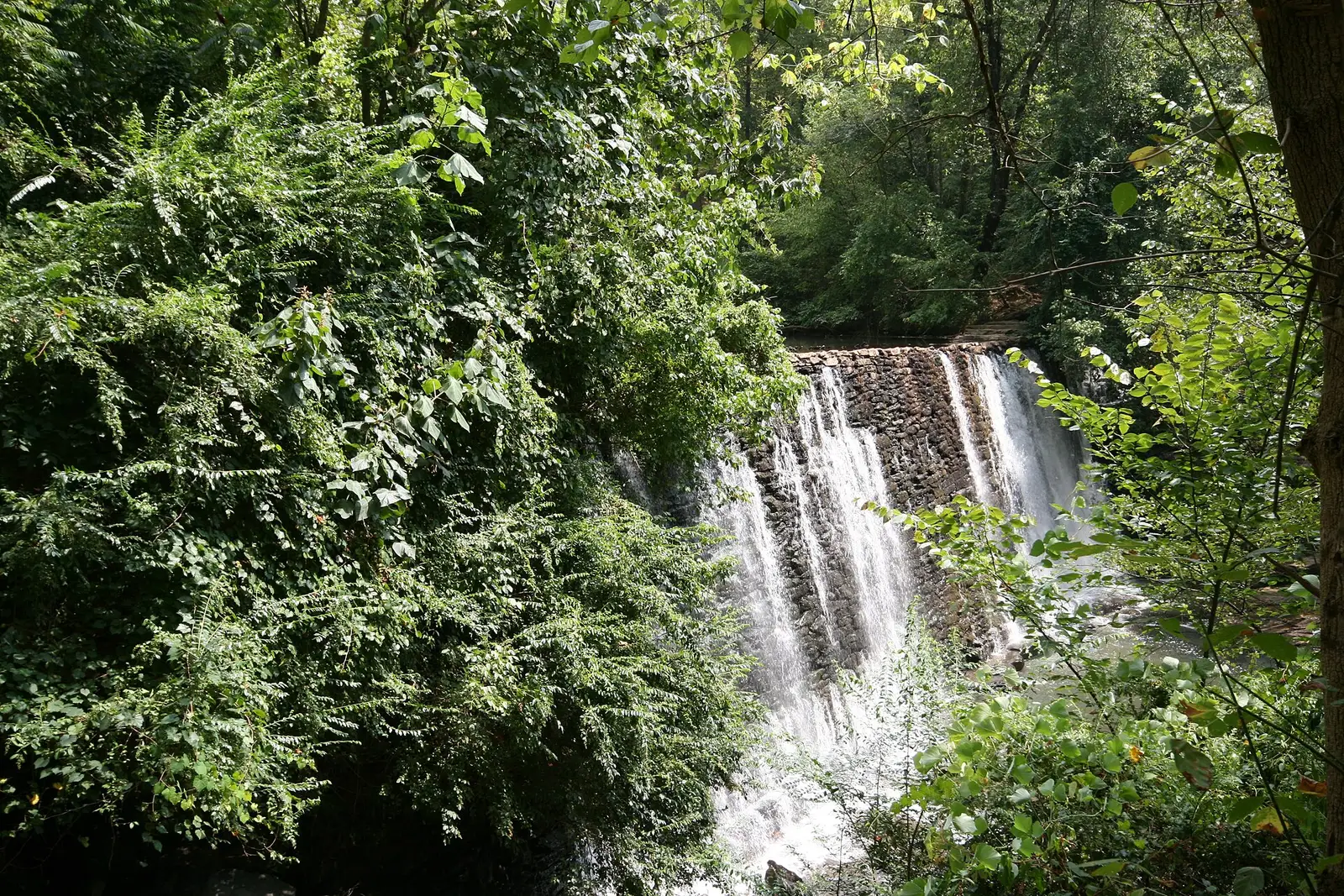
Roswell is a city of associations. Georgia's ninth-largest city — 92,883 residents at the 2020 Census — grew from Roswell King's 1830s cotton-mill settlement on Vickery Creek (the Roswell Manufacturing Company was chartered in 1839) into a suburb whose signature housing arrived in the swim-and-tennis wave of the 1970s and 1980s. Martin's Landing, begun in 1977, spreads nearly 2,000 homes, townhomes, and condominiums across 1,030 wooded acres between the Chattahoochee River and 53-acre Martin Lake. Horseshoe Bend wraps roughly 1,200 homes around a country club, opened in 1974, on a bend of the river. Willow Springs built out about 700 homes around the Country Club of Roswell in East Roswell, most in the 1970s and 1980s with construction continuing into later decades, and development at Brookfield Country Club was under way in the early 1970s. Later decades added a different layer: gated John Wieland townhomes at Heritage at Roswell in the 2000s, condominiums like Roswell Landings within walking distance of Canton Street, and infill townhome projects now rising along Holcomb Bridge Road near GA-400.
A reserve study written from a template cannot tell those communities apart, and it shows in the numbers. Fifty years of pool decks, tennis courts, clubhouse roofs, private streets, and lakefront amenities produce a component inventory — and a replacement calendar — that has nothing in common with a townhome community delivered in the last decade, where the first big bills are still ahead. Apex Reserve Group is headquartered in Irvine, California, and serves Georgia through a team member based in metro Atlanta: every Roswell engagement that includes a site visit is inspected in person, so remaining-useful-life estimates reflect how your property is actually weathering, not what a national table says it should be doing.
Why Roswell Associations Need Current Reserve Studies
Two clocks run against Roswell boards at once. The first is age. Communities from the city's 1970s and 1980s building boom are past the point where components fail one at a time; in a neighborhood's fifth decade, pool replastering, court resurfacing, clubhouse mechanical systems, street overlays, retaining walls, wood footbridges, and pond dredging tend to arrive in clusters, and an association funding off last year's budget plus a rounding error meets them with a special assessment. The second clock is climate. Roswell's humid subtropical summers chalk paint, embrittle sealants, and cook asphalt and shingle roofs; the heavy tree canopy that makes these neighborhoods desirable also keeps shaded elevations damp, feeding mildew and rot in siding, decks, and fences; the region's clay soils shift under pavement and retaining walls as moisture comes and goes; and a single hail or ice-storm event can subtract years from a roof's expected service overnight. A current reserve study puts observed condition — not assumptions — under the funding plan, so the board can smooth contributions over decades instead of shocking owners when the projects converge.
From Martin Lake to Holcomb Bridge Road: Roswell's Association Landscape
Along the Chattahoochee, Martin's Landing operates at a scale few Georgia associations match: twelve sub-communities of single-family homes, patio homes, townhomes, and condominiums share three pools, fifteen tennis courts, a river lodge, trail networks, and the grounds around Martin Lake — an inventory closer to a parks department's than a typical HOA's. Horseshoe Bend pairs river frontage with golf-course living; its community association has governed the roughly 1,200-home neighborhood since 1988, and housing there runs from 1977 cluster homes to much newer construction, so components of very different ages sit inside a single budget. In East Roswell, Willow Springs covers about 650 acres between Haynes Bridge and Old Alabama roads, and Brookfield Country Club — begun as Brookfield West in the early 1970s, with a golf course dating to 1972 — anchors more than 725 households. The historic core is different terrain: smaller condominium and townhome associations near Canton Street and the old mill village, including Roswell Landings, where walkability is the amenity and buildings rather than grounds dominate the reserve schedule. Along Holcomb Bridge Road and the GA-400 interchange, the newest stock is arriving — the East Village redevelopment is adding 74 townhomes on a former shopping-center site — while in northwest Roswell, recent communities such as the Towns at Old Mill, 40 townhomes off Houze Road completed between 2019 and 2022, are still years from their first big replacement cycle. On the west side, the gated Heritage at Roswell maintains its own 2000s-era clubhouse, pools, and lighted tennis courts. Each band of the city calls for a differently built study, which is why ours begin with the property instead of a template.
What Georgia Law and Your Lenders Expect
Begin with what the Georgia Code does not say: no statute requires an association here to commission a reserve study or to hold reserves at any particular level. Three sources of obligation operate instead. First, your own governing documents — many Roswell declarations and bylaws direct the board to maintain reserves or budget for capital repairs, and a board that ignores its documents has no statute to hide behind. Second, the statutory backdrop: condominiums are governed by the Georgia Condominium Act (O.C.G.A. Title 44, Chapter 3), and some subdivision HOAs have opted into the Georgia Property Owners' Association Act. Neither act mandates a reserve study, but neither dilutes a director's fiduciary obligations — a board that can see private streets, roofs, or pool equipment approaching the end of service and makes no financial plan for replacement risks assembling a gross-negligence or bad-faith claim against itself. Third, and most immediately felt in a sale: lender project review. FHA, Fannie Mae, and Freddie Mac guidelines generally look for reserve contributions of roughly 10 percent of the annual budget, or a current reserve study justifying a lower figure, and post-Surfside underwriting has grown pointed about deferred maintenance — significant unfunded structural repairs can make an entire condominium ineligible for agency-backed loans. Fannie Mae and Freddie Mac have also announced that the minimum reserve allocation rises to 15 percent for loan applications dated on or after January 4, 2027. In Roswell, that pressure lands squarely on the condominium and townhome stock near the historic district and the GA-400 corridor, and on older attached housing such as the mid-1980s Landings Townhomes inside Martin's Landing: when a buyer's lender asks for the reserve study and the answer is silence, every unit in the community becomes harder to sell.
Our Reserve Study Services in Roswell
Full Reserve Study — A ground-up engagement: our Atlanta-area reserve analyst walks the property and documents every association-maintained component, from pool decks and tennis courts to private streets, stormwater ponds, and building exteriors, and we build a thirty-year funding forecast around observed condition rather than book defaults. Typical delivery: 3 to 4 weeks.
Reserve Study Update With Site Visit — A re-inspection for associations with an existing study, recommended every three to five years; we verify which projects were completed, re-rate component condition after Georgia's summers have had their say, and recalibrate the funding plan. Typical delivery: 2 to 3 weeks.
Off-Site Annual Update — A between-visit refresh of the numbers — current reserve balance, completed work, interest and inflation assumptions, and revised contribution recommendations — keeping the plan credible for your board and for lender questionnaires. Typical delivery: 1 to 2 weeks.
Roswell Communities We Serve
Our Roswell service area covers associations across the city, from communities like Martin's Landing and its twelve sub-communities, the Landings Townhomes, Horseshoe Bend, Willow Springs and the Country Club of Roswell, Brookfield Country Club, Heritage at Roswell, Roswell Landings, and the Towns at Old Mill, to townhome and condominium communities along Holcomb Bridge Road and the GA-400 corridor in East Roswell, associations in Historic Roswell and around the Canton Street district, neighborhoods off Hardscrabble Road and Highway 92 in west Roswell, and swim-and-tennis subdivisions throughout Roswell.