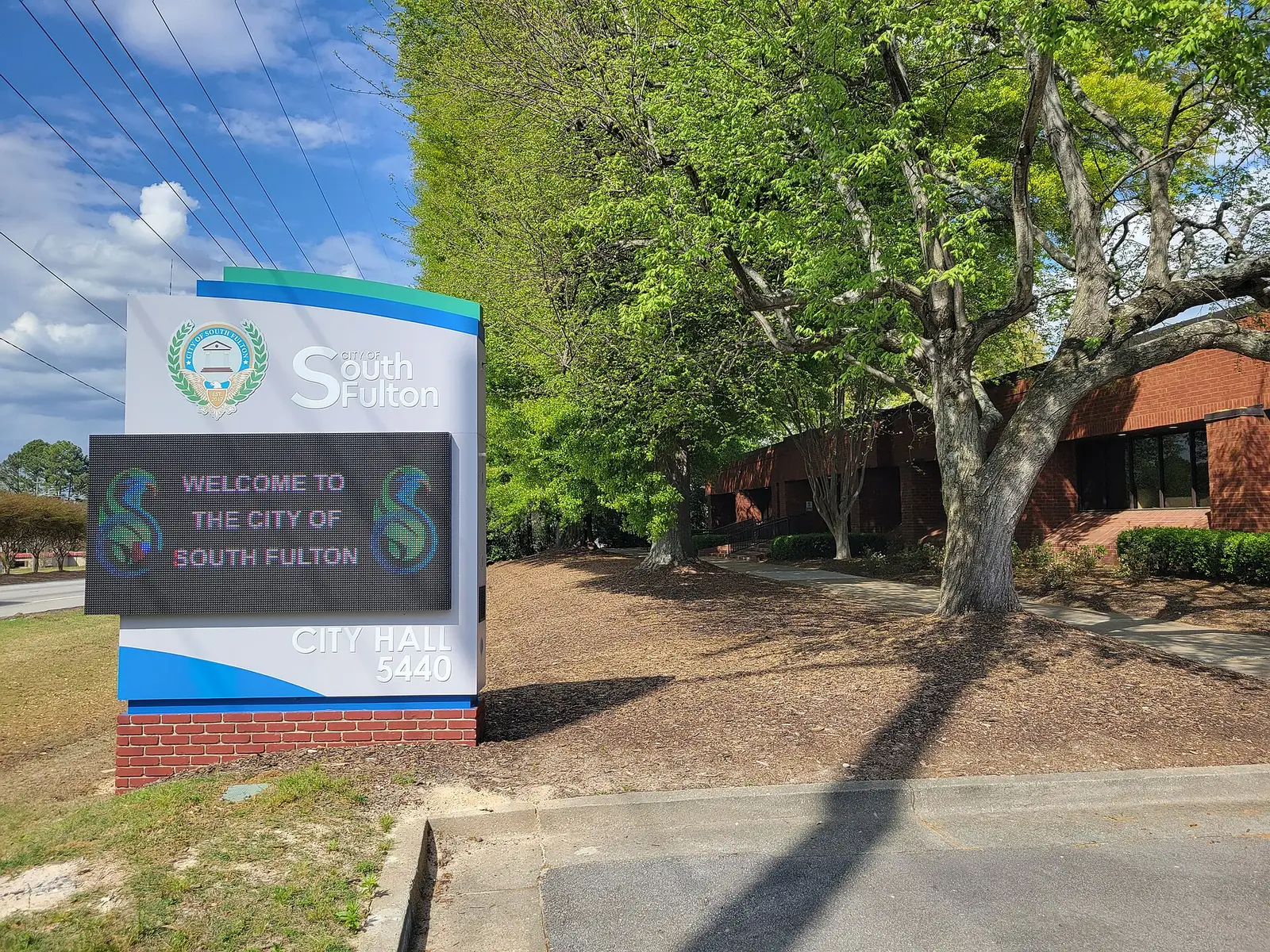
South Fulton is a young city sitting on top of a mature HOA landscape. Incorporated on May 1, 2017 out of what had been unincorporated southwest Fulton County, it counted 107,436 residents at the 2020 census — Georgia's eighth-largest city, and the one with the highest share of Black residents of any U.S. city above 100,000 people. Its housing stock, though, is decades older than its charter. Large single-family subdivisions filled in the Cliftondale area through the 2000s, led by Walden Park, with its pool, tennis courts, clubhouse, and access to a nine-hole golf course, while just beyond Cliftondale on the Fairburn line, the French-inspired Le Jardin master plan is still delivering new homes today; the 176-home Wolf Creek community wraps around Wolf Creek Golf Club, in play since 2001, with Canaan Ridge beside the course; and toward the Fairburn line, The Lakes at Cedar Grove built out mostly between 2005 and 2020 around five lakes, a junior Olympic pool, and a lakeside clubhouse. The builders never left: D.R. Horton is selling at the Enclave at Stonewall Tell and Butner Estates, DRB Homes at Camp Creek Village near Camp Creek Parkway and Butner Road, and Rockhaven Homes at the Sandtown Falls townhomes.
That mix defeats a template reserve study. A 2004 swim-and-tennis subdivision whose association owns lakes and dams shares almost no components with a just-delivered townhome community responsible for private streets and building exteriors — and neither is described honestly by national useful-life tables that ignore Georgia's heat, humidity, and red-clay soils. Apex Reserve Group is headquartered in Irvine, California, where our analysts build the funding models; the fieldwork in South Fulton is done by our team member based in metro Atlanta, who walks your property in person instead of estimating it from an aerial photo.
Why South Fulton Associations Need Current Reserve Studies
The defining fact about South Fulton's association stock is timing. Subdivisions that closed their first homes between the late 1990s and the late 2000s are now 15 to 25 years old — the exact window when expensive components stop being theoretical. Clubhouse roofs, pool plaster and pump equipment, court resurfacing, perimeter wood fencing, entry monuments and their irrigation and lighting, and the first full mill-and-overlay of any private streets all tend to arrive within a few budget cycles of each other. Walden Park's 2000s-era homes in Cliftondale and the earliest phases at The Lakes at Cedar Grove sit squarely inside that window today. Many of these boards are still working from the developer's original budget, which was set to make dues look attractive at the sales office, not to fund a second roof. There is also a component class that is easy to miss until it fails: HOA-owned detention ponds and lake infrastructure. Outlet structures, spillways, dredging cycles, and shoreline stabilization carry real price tags, and in a city with as much amenity water as this one, leaving them out of the study means the funding plan is fiction. A current study with a fresh site inspection converts all of it into dated, priced line items your board can actually plan around.
Cliftondale, Camp Creek, Sandtown, Cedar Grove: A Map of South Fulton's Associations
Cliftondale is the city's signature growth story — large, mostly brick-fronted subdivisions that spread through the 2000s, including Walden Park, whose amenity list runs from pool and tennis courts to a clubhouse and access to a nine-hole golf course. Adjacent to Cliftondale on the Fairburn line sits the French-inspired Le Jardin, whose gated Giverny section rings two lakes while the Tapestry side carries indoor and outdoor pools and a tennis center — a master plan that began delivering homes in the mid-2000s and is still building new phases today, so its associations face baseline-study questions as much as replacement cycles. The Camp Creek Parkway corridor has been building west ever since Camp Creek Marketplace opened in 2003 at the I-285 interchange in neighboring East Point, with Camp Creek Village and Butner Estates carrying the wave into the 2020s, while several miles southeast, near Old National Highway and Flat Shoals Road, Century Communities' Parkview Estates has been adding homes since 2007 — associations here range from boards budgeting a third repainting to boards that should establish a baseline study before the developer hands over the books. On the city's northern edge, Sandtown ranks among Fulton County's oldest communities — Cascade Road follows the route of the old Sandtown Road trail — and its wooded neighborhoods pair heavy tree canopy with new attached housing like the Sandtown Falls townhomes; shaded siding holds mildew, gutters take constant debris, and roots work on the flatwork. The 176-home Wolf Creek community, wrapped around Wolf Creek Golf Club since the course opened in 2001, and Benchmark's adjacent Canaan Ridge bring golf-course living to the city's west side. To the south, near Cedar Grove and the Fairburn line, The Lakes at Cedar Grove maintains roughly 123 acres of recreational ground — five lakes with a fishing dock, a junior Olympic pool with a slide, lighted tennis courts, trails, and a clubhouse — a portfolio closer to a small parks department than to a typical subdivision HOA. Red Oak, Welcome All, Stonewall Tell, and the city's other legacy communities round out a landscape where no two associations should ever receive the same component inventory.
What Georgia Law and Your Lenders Expect
Georgia has no statute ordering an association to commission a reserve study, so the starting point is always your own recorded declaration and bylaws — many South Fulton governing documents call for reserve funding or periodic capital planning, and a board that ignores its own documents has created its own liability. At the statutory level, condominiums operate under the Georgia Condominium Act (O.C.G.A. Title 44, Chapter 3), while HOAs may opt in to the Georgia Property Owners' Association Act by electing it in the declaration; neither act mandates a reserve study. What both frameworks do impose is fiduciary responsibility: directors must exercise ordinary care with association money, and a board that watches a clubhouse roof or a dam spillway age toward failure without setting anything aside risks inviting the gross negligence or bad faith claim that fiduciary standards exist to punish. The more immediate pressure is lending. FHA, Fannie Mae, and Freddie Mac condo project review generally looks for about 10 percent of the annual budget flowing to reserves — or a compliant reserve study justifying the funding level — and since the 2021 Surfside collapse, reviewers scrutinize deferred maintenance and unfunded repairs far more aggressively. The agencies have announced that the reserve benchmark climbs to 15 percent for full condo project reviews starting in January 2027 unless the association can produce a study conducted or updated within the past three years and budgets at the study's highest recommended funding level — baseline funding does not qualify, and lenders begin applying the stricter reserve-study standard as early as August 2026. For South Fulton's growing stock of attached housing, including new townhome product along Camp Creek Parkway and in Sandtown, an association that cannot answer a lender questionnaire cleanly is quietly shrinking the pool of buyers who can finance a purchase in it.
Our Reserve Study Services in South Fulton
Full Reserve Study — Our Atlanta-based team member inventories every common element on site — roofing, paving, pools, courts, clubhouses, gates, fencing, monuments, lakes and detention infrastructure — and we deliver a 30-year funding model with percent funded analysis and contribution scenarios your board can vote on. Typical delivery: 3 to 4 weeks.
Reserve Study Update With Site Visit — We return to the property, re-rate each component's condition against the prior study, capture completed projects and storm damage, and recalibrate the funding plan; most South Fulton boards should schedule this every three to five years. Typical delivery: 2 to 3 weeks.
Off-Site Annual Update — In the years between inspections, we refresh the numbers remotely — current reserve balances, inflation, interest earnings, and finished work — so the plan stays accurate instead of drifting. Typical delivery: 1 to 2 weeks.
South Fulton Communities We Serve
We prepare reserve studies for single-family HOAs, townhome associations, and condominiums across the city, including Cliftondale, Sandtown, Ben Hill, Cedar Grove, Red Oak, Stonewall Tell, Welcome All, Fife, Enon, Boat Rock, Cooks Crossing, Peters Woods, and the South Fulton portion of Campbellton, along with subdivisions such as Walden Park, Wolf Creek, Canaan Ridge, The Lakes at Cedar Grove, Parkview Estates, Camp Creek Village, Butner Estates, Enclave at Stonewall Tell, Summit at Stonewall Tell, and Sandtown Falls, plus Le Jardin on the Fairburn line. We also serve neighboring Union City, Fairburn, College Park, and East Point associations.