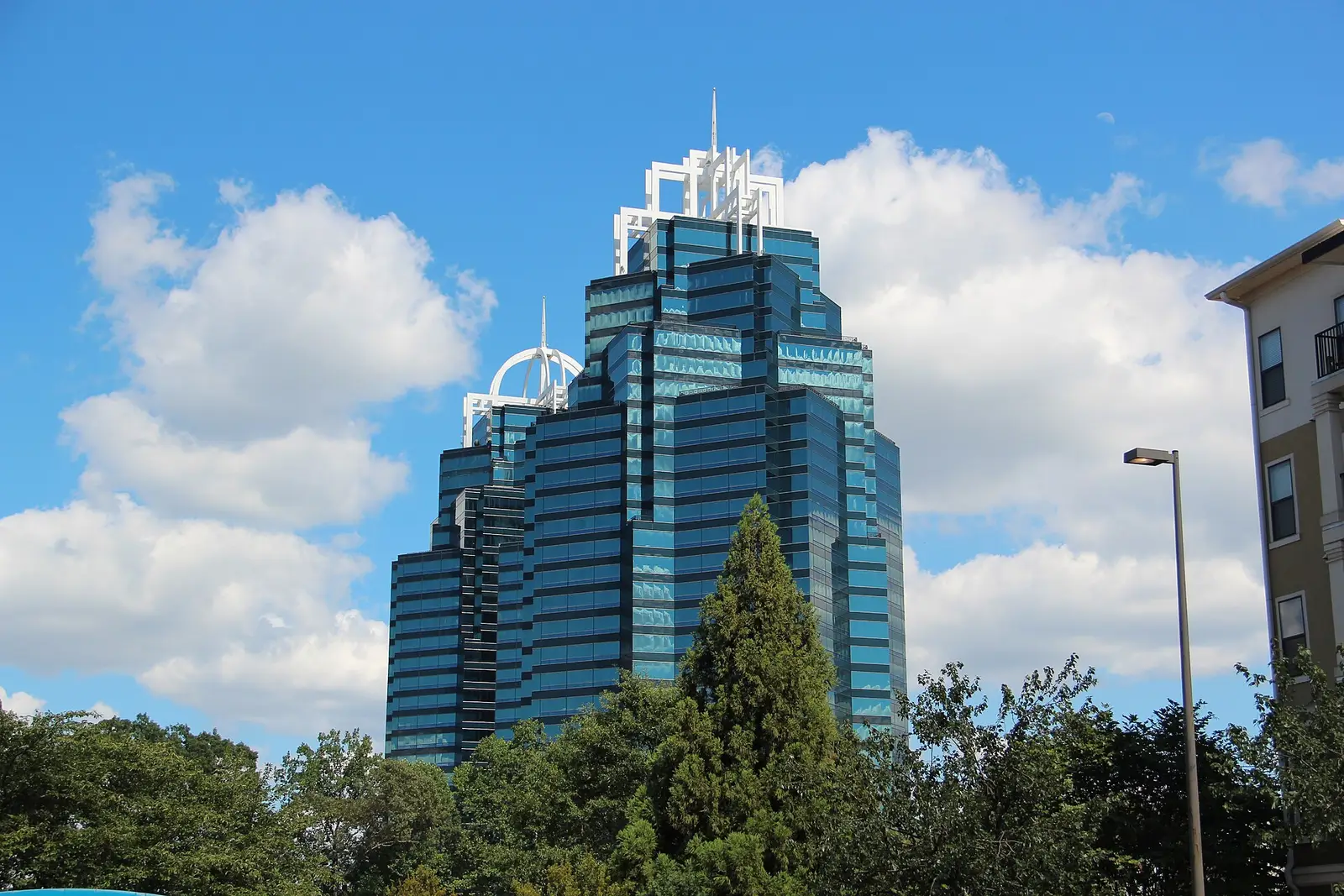
Sandy Springs has only been a city since December 1, 2005 — the first new city in Georgia in roughly half a century, and the one whose incorporation touched off the cityhood wave that produced Johns Creek, Milton, Dunwoody, and Chattahoochee Hills — yet much of its condominium stock predates its charter by decades. Along the Roswell Road corridor, communities such as Foxcroft and Highgate at Sandy Springs began as 1960s and early-1970s apartment complexes: Foxcroft went condo in the late 1970s, while Highgate and nearby Avalon made the change during the mid-2000s conversion rush. On the east side, the 24-story Park Towers (1991) on Hammond Drive and the roughly 300-unit Mount Vernon Towers (1987) anchor a high-rise cluster beside Perimeter Center and the Pill Hill hospital district, and Ashton Woods' Aria added hundreds of new townhomes and condominiums off Abernathy Road between 2017 and 2024. Add the gated One River Place and the golf-and-river neighborhood of Huntcliff along the Chattahoochee, and a city that was home to 108,080 people in the 2020 census — trailing only Atlanta among Fulton County cities in that count — holds association housing from every decade since the 1960s.
That spread is precisely where template-driven reserve studies fail. A 1971 building still running its original sanitary lines and wood balcony framing, a 1991 tower planning elevator modernization and garage-deck restoration, and a gated river community with pools, guardhouses, and private stormwater systems share little beyond a mailing address. Apex Reserve Group's home office is in Irvine, California; the Sandy Springs fieldwork belongs to the team member we station in metro Atlanta — someone who can stand on your property, see how Georgia's heat, humidity, clay, and tree cover are actually treating it, and build the study from what is physically there instead of from a template.
Why Sandy Springs Associations Need Current Reserve Studies
Sandy Springs' best-known condominium buildings predate the city government itself. Foxcroft's structures went up in the 1960s, Highgate's in 1971, Avalon's first phase in 1970 — properties now past fifty, which drags the second and in places third round of replacements into the funding window: sanitary laterals, water piping, electrical service equipment, retaining walls, and balcony framing, not merely roofs and paint. The conversion history compounds it. When these complexes were sold off as condominiums, converters set opening budgets lean enough to move units, so reserve contributions in some communities started low and stayed low for years. Newer stock is not exempt either: at Aria, built out off Abernathy Road between 2017 and 2024, hundreds of homes will reach their first roofing, painting, and paving cycles within a short span of one another, and the contribution schedule needs to be set before that cluster of expenses arrives, not after. Then there is the climate — long cooling seasons that work HVAC equipment hard, ultraviolet and thermal cycling that age shingles and sealants, humidity that breeds mildew and rot on shaded wood, Piedmont clay that moves beneath pavement and retaining walls, and detention ponds that many associations, not the city, are responsible for maintaining. National useful-life tables were not written with any of that in mind. A current study — one whose numbers come from walking this property, not averaging others — is how a board turns those variables back into a defensible budget.
Roswell Road, Perimeter Center, and the River: Sandy Springs' Association Landscape
The city's oldest attached housing lines Roswell Road: garden-style communities such as Foxcroft — 1960s construction that became condominiums as the 1970s closed — and Highgate at Sandy Springs, a 1971 property whose condominium conversion began in 2005. Near Roswell Road and Dunwoody Place, Avalon's two phases, from 1970 and 1985, followed the same rental-to-ownership path in 2007 and 2008. The east side reads entirely differently. Around Perimeter Center, the Hammond Drive–Glenridge corridor, and the Pill Hill medical campus — Northside Hospital, Emory Saint Joseph's, and Children's Healthcare of Atlanta's Scottish Rite — the reserve conversation turns vertical: Park Towers, finished in 1991 and sold unit by unit as condominiums starting in 1999, and the age-55-plus Mount Vernon Towers of 1987 plan around elevators, cooling towers, garage decks, and building envelopes rather than pitched roofs and siding. In the middle sits City Springs, the fourteen-acre civic district opened in 2018, which has pulled newer mixed-use and townhome development toward Mount Vernon Highway and Johnson Ferry Road, with Aria's 2017–2024 build-out just east off Abernathy Road. And the city's western and northern edge is the Chattahoochee itself: One River Place's gated condominiums, brownstones, and garden homes sit just inside I-285 with direct river access, while Huntcliff wraps a golf course inside a four-and-a-half-mile bend of the river farther north. No two of those portfolios budget alike; the inventory behind your study should be assembled on your grounds, not averaged from a citywide template.
What Georgia Law and Your Lenders Expect
Boards sometimes arrive convinced that Georgia "requires" a reserve study. It does not — no statute in this state compels one, and none dictates how much a board must save. What binds you sits in three other places. Start with the papers your community recorded: declarations and bylaws from the conversion era and the 2000s frequently commit the board to budgeting for repair and replacement of the common elements, and ignoring your own recorded documents writes the other side's brief. The statutory layer comes second. Condominiums take their framework from the Georgia Condominium Act — Chapter 3 of Title 44, O.C.G.A. — while subdivisions that recorded an election under the Property Owners' Association Act sit under that statute instead. Reserve studies appear in neither; what does appear is the fiduciary standard, and a director slate that lets a fifty-year-old sewer line or a spalling garage deck slide with nothing set aside has assembled the evidence for a breach claim all by itself. The third pressure is the one owners feel at resale: lenders. Fannie Mae's condo review — and Freddie Mac's and FHA's — generally expects roughly one dollar in ten of the operating budget earmarked for reserves — or a recent professional study that supports a smaller number — and after Surfside in 2021 those reviews began pressing deferred-maintenance and unfunded-repair findings much harder; both conventional agencies have signaled a stiffer benchmark arriving in 2027 for communities without a recent study. For a city whose signature condo stock is 1960s and 1970s construction converted decades ago, none of this is abstract: it decides whether a buyer's mortgage closes.
Our Reserve Study Services in Sandy Springs
Full Reserve Study — Everything from scratch: an in-person inventory of each structure, amenity, and site element, compiled on-site by our Atlanta-area team member, then a 30-year capital forecast with multiple contribution scenarios and percent-funded math. Right for a first study or one that has drifted badly. Typical delivery: 3 to 4 weeks.
Reserve Study Update With Site Visit — We come back out, re-walk the grounds, and true up the plan against what actually happened: projects finished, deterioration found, current Atlanta-market construction pricing. Most boards commission one every three or four years. Typical delivery: 2 to 3 weeks.
Off-Site Annual Update — Covers the seasons between site walks: we roll actual spending, interest, inflation, and fund balances into the projection remotely, so the budget your treasurer signs never drifts from the facts. Typical delivery: 1 to 2 weeks.
Sandy Springs Communities We Serve
Our coverage runs the length of the city: Foxcroft, Highgate at Sandy Springs, and Avalon on the Roswell Road corridor; Park Towers, Mount Vernon Towers, The Regent at Glenridge, and Serrano around Perimeter Center and Hammond Drive; Aria off Abernathy Road; One River Place and the river-facing neighborhoods of Riverside, North Riverside, and Huntcliff; the townhomes and condos filling in around City Springs; and North Springs, the Dunwoody Panhandle, and the midcentury Glenridge Hammond area — along with every other association neighborhood in Sandy Springs.