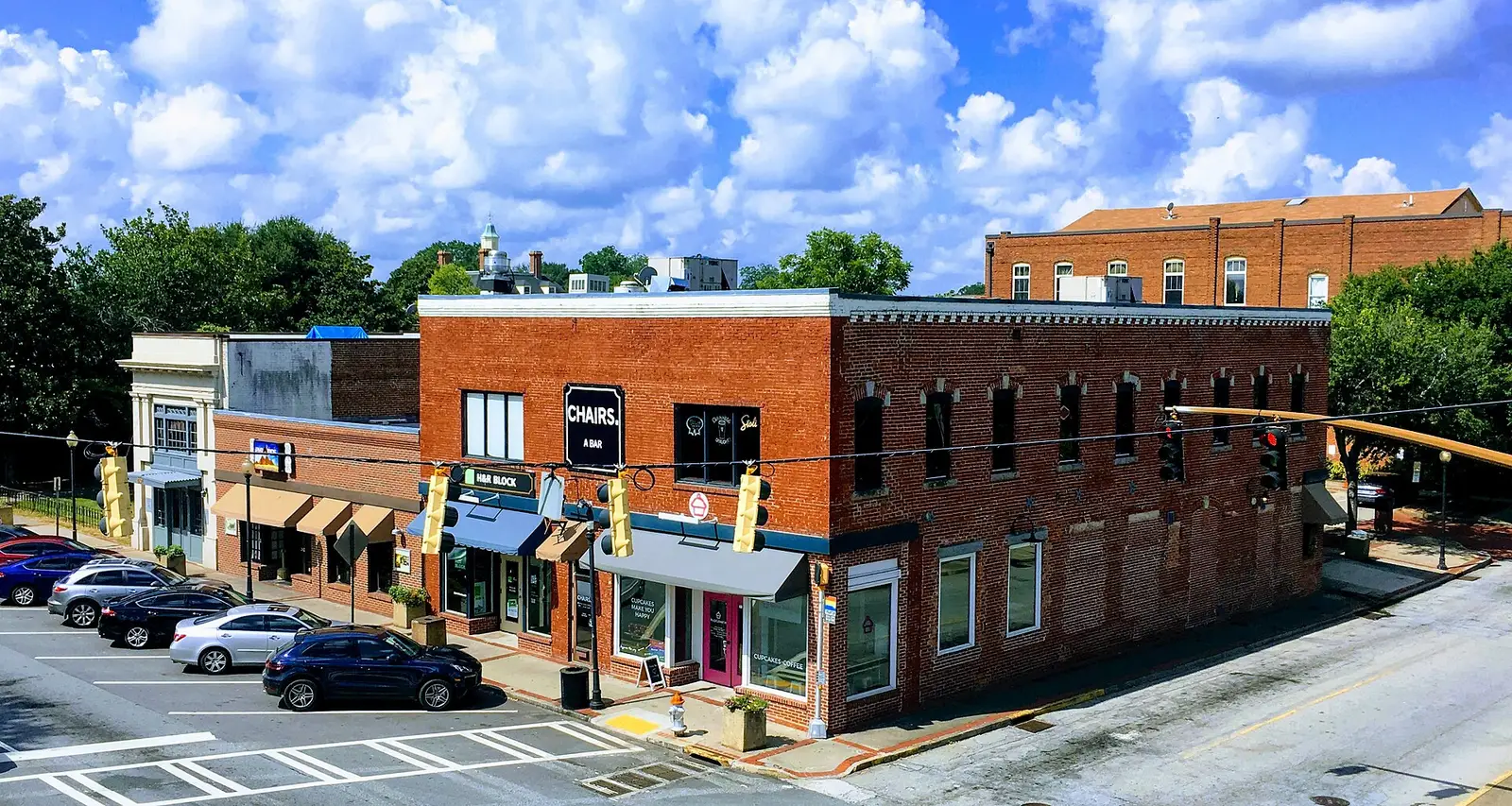
East Point grew up around the railroad — the city takes its name from its position at the eastern end of the Atlanta & West Point line, where a settlement of sixteen families formed in 1870 and a city charter followed in 1887. That long history shows in the housing. Jefferson Park alone holds roughly 1,100 homes, from clapboard houses of the 1920s to brick bungalows of the 1940s and 1950s, and neighboring Colonial Hills, Conley Hills, Frog Hollow, and Center Park carry similar midcentury stock, flanked by small condominium buildings and townhouse pockets. On the city's west side, the corridor that formed after Camp Creek Marketplace opened in 2003 drew a newer generation of HOA-governed construction — led by the Villages of East Point, a townhome community built between 2006 and 2021 with its own pool and clubhouse — while downtown, transit-oriented projects around the East Point MARTA station are queued to add the association stock of the next decade.
Most of these associations are small: a few dozen townhomes, a modest condominium, one pool rather than five. Small associations are exactly the ones a templated reserve study serves worst, because national useful-life averages ignore Georgia's heat and humidity, its red clay soils, and the mature tree canopy that shades — and drops limbs on — East Point's older streets. Apex Reserve Group is headquartered in Irvine, California, and our team member based in the Atlanta area performs the on-site inspections here, so East Point boards get a funding plan grounded in what their components actually look like rather than what a spreadsheet assumes.
Why East Point Associations Need Current Reserve Studies
East Point's association stock is aging from both ends. The townhome communities that followed Camp Creek Marketplace's 2003 opening are now ten to twenty years old — precisely when the first big bills arrive, as construction-era shingle roofs, original HVAC condensers, pool plaster, private-street asphalt, and first full repaints all tend to cluster in years fifteen through twenty-five. At the other end, small associations and converted buildings in the city's midcentury neighborhoods carry line items that never appear in a template written for new construction: cast-iron drain lines, dated electrical service, and mature-tree roots working on flatwork and sewer laterals.
The climate compresses both timelines. Long, humid summers break down paint and sealants faster than national tables assume; wood decks, stairs, and fencing take on rot and mildew; asphalt softens in August heat and then cracks through winter freeze-thaw. The region's dense red clay drains poorly, holding water when saturated and pulling away in drought, and that moisture cycling — along with scattered pockets of genuinely expansive soil — works against foundations, retaining walls, and buried storm lines — and many communities own their stormwater detention ponds outright, a component boards routinely forget until a maintenance notice arrives. Hail and the occasional ice storm add sudden roof and tree damage on top of the steady wear. A study current within the last few years, built from an actual walk of the property, is the difference between funding these realities gradually and funding them through a special assessment no one voted for.
From Jefferson Park to Camp Creek Parkway: East Point's Association Landscape
The east side of the city holds its history. Jefferson Park, Colonial Hills, Conley Hills, Frog Hollow, Center Park, and Semmes Park are dominated by single-family bungalows and brick ranches built from the 1920s through the 1960s, but scattered among them are the small associations this stock produces — modest condominium buildings, compact townhouse pockets, and conversions of older multifamily properties. Communities like these rarely have professional management, and their reserve components — one shared roof, a parking court, aging drainage under mature oaks — call for a study scaled to their size rather than big-community boilerplate.
Downtown, the blocks around the East Point MARTA station, served by the Red and Gold lines, are in the middle of a deliberate revitalization: the city completed a transit-oriented development plan for the corridor in 2012, and projects such as The Commons, a nine-acre, $111 million mixed-use redevelopment near the station that broke ground in December 2023, signal where the next wave of association-governed housing will sit. West of downtown, the Camp Creek Parkway and Washington Road corridors carry the city's newest HOA stock, led by the Villages of East Point — built in phases from 2006 to 2021 with a pool and clubhouse — and the adjoining Bayberry at the Villages of East Point, an 85-unit condominium community with a clubhouse, fitness center, and playground. Those amenity packages are exactly the components that dominate a townhome association's thirty-year cost curve: pool equipment and plaster, clubhouse roofing and HVAC, private streets, monument fencing, and detention ponds.
What Georgia Law and Your Lenders Expect
Start with what Georgia law does not say: nothing in the state code obligates an association to obtain a reserve study, and nothing prescribes a minimum reserve balance. What binds an East Point board comes from three directions instead. First, your own governing documents — recorded covenants frequently commit boards to reserve budgeting or scheduled capital reviews, and a board that ignores its recorded documents has already created its own liability. Second, the statutory backdrop: condominiums organized under the Georgia Condominium Act (O.C.G.A. Title 44, Chapter 3) and homeowner associations that have opted into the Georgia Property Owners' Association Act operate under statutes that say nothing about reserve studies directly — but directors under either framework owe fiduciary duties to the association, and a board that watches a twenty-year-old roof fail while budgeting nothing for it is not a board exercising ordinary care. Third, and most immediate for East Point: lenders. FHA condominium review and the Fannie Mae and Freddie Mac project standards generally look for roughly ten percent of the annual budget flowing to reserves, or a professional reserve study demonstrating adequacy — and agency guidance announced in 2026 raises that floor to fifteen percent in January 2027 unless the association holds a study completed within the past three years and funds at its recommended level. Since the Surfside collapse, project review also probes deferred maintenance directly, and documented unfunded repairs can sink a community's eligibility regardless of its reserve line. In a market like East Point's, where affordability draws first-time buyers who depend on FHA and conventional financing, an association that fails project review has quietly shrunk its own resale market.
Our Reserve Study Services in East Point
Full Reserve Study — Our Atlanta-area reserve analyst walks every common component on your property, from midcentury rooflines near Jefferson Park to Camp Creek-corridor amenity centers, and we build a thirty-year funding model with percent-funded analysis around what was actually observed. Typical delivery: 3 to 4 weeks.
Reserve Study Update With Site Visit — A refreshed inspection and revised funding plan every three to five years — now effectively the required cadence for communities relying on a reserve study to satisfy Fannie Mae and Freddie Mac review. Typical delivery: 2 to 3 weeks.
Off-Site Annual Update — A between-visits recalibration of your plan for completed projects, current balances, and cost inflation, keeping the study usable for budgeting and lender questionnaires. Typical delivery: 1 to 2 weeks.
East Point Communities We Serve
We prepare reserve studies for associations across the city, including Jefferson Park, Colonial Hills, Conley Hills, Frog Hollow, Center Park, Semmes Park, the downtown blocks around the East Point MARTA station, and the Washington Road and Camp Creek Parkway corridors — including the Villages of East Point townhomes and the Bayberry at the Villages of East Point condominiums — along with condominium and townhome associations throughout East Point and the neighboring south Fulton cities.