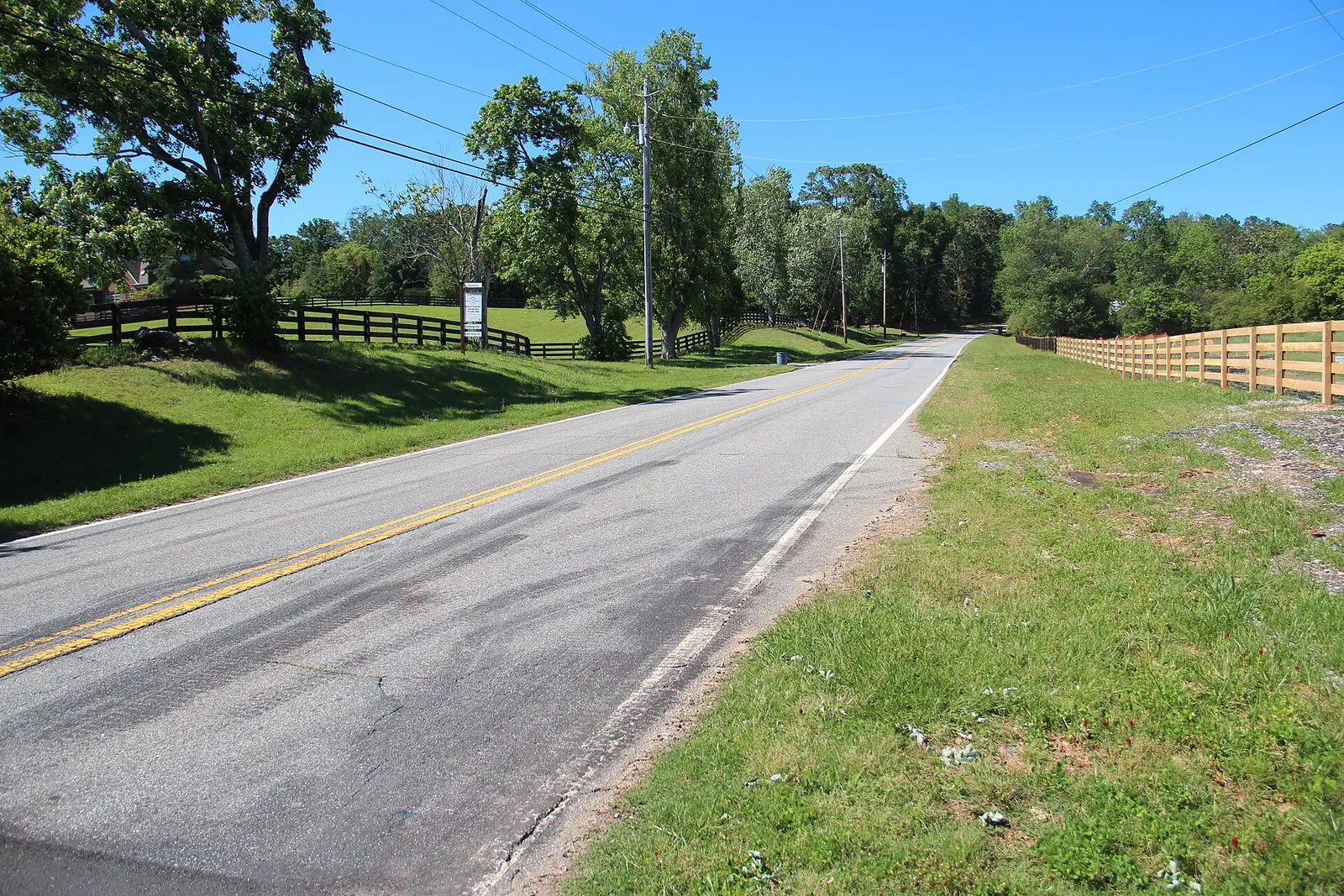
Milton is among metro Atlanta's youngest cities — incorporated December 1, 2006, on land that once formed Milton County — but its neighborhoods span three distinct generations. Across the north, along Birmingham Highway, Freemanville Road, and Hopewell Road, horse country persists: pastures, barns, and estate associations that may govern little more than an entry feature, shared fencing, and a stormwater pond. Through the city's midsection run the gated golf communities that anchor its market — White Columns, built largely in the late 1990s and early 2000s around a Tom Fazio course; Crooked Creek, 640 homes and more than seven miles of private roads developed from the mid-1990s into the 2000s; and The Manor, a guard-gated community of roughly 800 acres around a Tom Watson-designed course, with newer sections still building out. And in the southwest corner, the Crabapple district is deliberately urbanizing under a form-based code and has added townhome projects such as Braeburn, Milton Towns, and Lakeside at Crabapple near the City Hall that opened there in 2017.
No single reserve template fits that range. A 640-home community repaving its own street network operates like a small public-works department; a townhome row of nine or fourteen units shares roofs and siding among a handful of owners; an equestrian-area HOA may hold one detention pond and a mile of board fencing. Apex Reserve Group runs its practice from Irvine, California, and keeps a team member in metro Atlanta who inspects Milton properties in person — so the component inventory behind your funding plan reflects what actually stands on your land, not a national average.
Why Milton Associations Need Current Reserve Studies
Milton's association-governed stock is concentrated in a narrow construction window. Subdivisions platted from the mid-1990s through the 2000s are now 20 to 30 years old — the stretch where expensive work arrives in clusters. Architectural shingle roofs on clubhouses and amenity buildings run out of service life, pools need replastering and new equipment, tennis courts crack along clay-soil seams, and privately maintained streets need milling and overlay rather than another round of crack seal. The climate compresses those timelines: long, humid summers break down exterior coatings and sealants, wood fencing and deck framing rot and mildew faster than national tables assume, and north Fulton's expansive red clay shifts beneath pavement, curbs, and retaining walls. Milton's heavy tree canopy — one of the city's defining assets — keeps roofs shaded, damp, and under constant debris load, and a single hail or ice storm can strip years from a roof in an afternoon. Boards budgeting from stale numbers discover the gap only when the bids come in; a study built on a recent site inspection prices this decade's projects at this decade's costs, while there is still time to adjust contributions gradually.
From Birmingham Horse Country to the Crabapple Town Center: Milton's Association Landscape
Milton's rural north keeps the pattern it inherited from the old county: multi-acre estates and working horse farms around the historic Birmingham Crossroads, with associations whose component lists are short but consequential — private drives, board fencing, entry monuments, and detention ponds that were never professionally inventoried. The gated golf tier sits closer to the city's core. White Columns and The Manor combine course frontage with amenity campuses: guardhouses, clubhouses, pool complexes, and tennis facilities that age as a portfolio rather than as isolated line items. Crooked Creek layers more than seven miles of private roads on top of a full swim-tennis-golf package built around the Iron Horse Golf Club, and gated Greystone, off Hopewell Road, adds a component few providers price correctly: a 17-acre private lake, ringed by homes built between 2001 and 2021 on lots of an acre and up. Around them, swim-tennis subdivisions carry the pool, clubhouse, and tennis-court packages common across north Fulton — Triple Crown from the mid-2000s build-out, Kingsley Estates established in 2013. Crabapple is the counterpoint: a form-based-code district where Braeburn's townhomes line Heritage Walk, Milton Towns fronts a shared green off Branyan Trail, and Taylor Morrison's Lakeside at Crabapple, now sold out, added attached homes on Cortland Road. Attached construction means shared building envelopes — roofs, siding, party walls — and a reserve profile closer to a condominium's than anything else in the city.
What Georgia Law and Your Lenders Expect
Georgia's legislature has never mandated reserve studies: no statute tells a Milton association to commission one, and none sets a minimum funding level. The rules that actually reach your board originate elsewhere. Governing documents lead the list — plenty of north Fulton declarations address reserves directly, and ignoring your own documents is indefensible once a major component fails. The statutes come next. Condominiums answer to the Georgia Condominium Act, found at Title 44, Chapter 3 of the O.C.G.A., while many single-family and townhome HOAs have opted into Georgia's Property Owners' Association Act. A reserve study is required by neither statute, yet both leave directors carrying fiduciary duties, and a board that lets a private street or clubhouse roof decay with no plan on paper invites precisely the claim those duties were written to head off. Then there is the lending market, which behaves like a regulator whether the legislature acts or not. Condominium project review at FHA, Freddie Mac, and Fannie Mae typically expects roughly a tenth of the yearly operating budget routed to reserves — or a compliant study that justifies a smaller allocation, one Fannie Mae expects to be no more than 36 months old. Post-Surfside, reviewers probe deferred maintenance far more aggressively than they once did. For Milton, the stakes concentrate in Crabapple's attached product: a community that fails project review quietly loses financed buyers for every home it contains.
Our Reserve Study Services in Milton
Full Reserve Study — The ground-up engagement: our Atlanta-area reserve analyst documents every association-owned component on site — gates, guardhouses, amenity buildings, pools, courts, fencing, private pavement, and ponds — and we model 30 years of replacements, test alternative contribution paths, and report where your percent funded stands. Typical delivery: 3 to 4 weeks.
Reserve Study Update With Site Visit — A fresh field review every few years that re-scores each component for how Georgia heat, moisture, and traffic have actually treated it, then re-times the funding plan before this decade's projects arrive unannounced. Typical delivery: 2 to 3 weeks.
Off-Site Annual Update — A desk-based renewal in the years between inspections: updated cost data, completed projects, and your real reserve balance replace the prior year's assumptions, so budget season starts from current numbers. Typical delivery: 1 to 2 weeks.
Milton Communities We Serve
We prepare reserve studies for associations across the city, including White Columns, The Manor Golf & Country Club, Crooked Creek, Greystone, Triple Crown, and Kingsley Estates; the townhome communities of the Crabapple district, among them Braeburn, Milton Towns, and Lakeside at Crabapple; the gated Henderson Landing townhomes and the Deerfield corridor along Georgia 9; estate and equestrian HOAs along Birmingham Highway, Freemanville Road, and Hopewell Road; and neighboring associations in Alpharetta, Roswell, and the rest of north Fulton County.