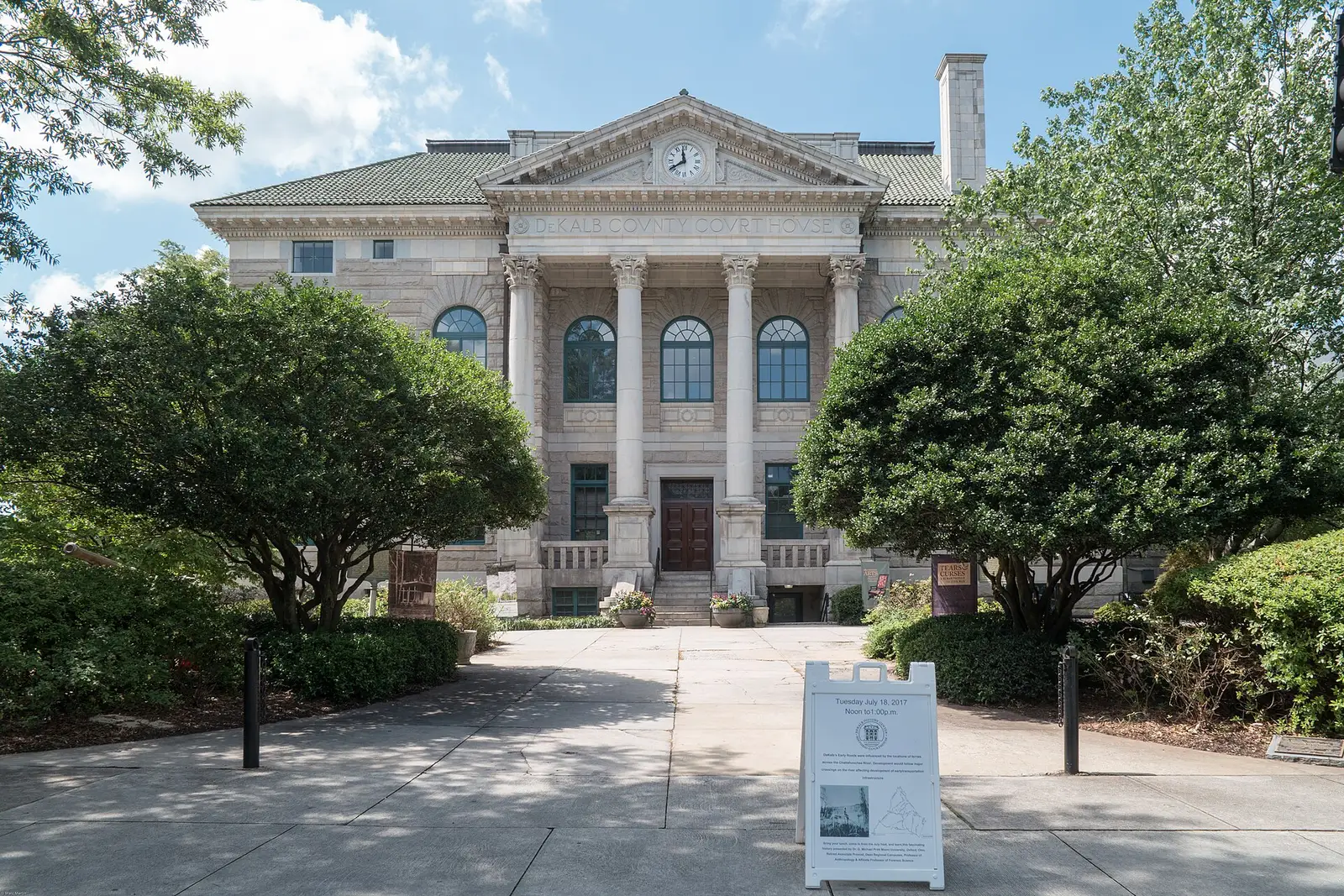
Decatur is a compact independent city of roughly 25,000 people set inside DeKalb County just east of Atlanta, and its association-governed housing is concentrated where the density is highest: around the courthouse square and the Decatur MARTA station. Mid-rise condominiums such as Towne Square, completed in 2000 on East Ponce de Leon Avenue, and the 168-unit Decatur Renaissance, finished in 2005 near East Ponce de Leon and North Candler, anchor a walkable downtown that keeps adding townhomes, lofts, and stacked-flat buildings. Wrapped around that core are the in-town bungalow neighborhoods that give Decatur its identity — Oakhurst, Winnona Park, and the MAK Historic District, where craftsman homes date from the early 1900s into the mid-twentieth century — along with the townhome and condominium pockets that have filled in among them.
Those two worlds age differently, and a template study serves neither well. A 105-unit downtown condominium with a parking deck, elevators, a courtyard pool, and a flat membrane roof carries a completely different component list than a cluster of 1990s townhomes with pitched shingle roofs, wood siding, and a shared stormwater pond — yet both sit under the same humid, tree-shaded Georgia sky that quietly shortens the life of coatings, decks, and roofing. Apex Reserve Group is based in Irvine, California, and works with Decatur boards through a team member who lives in the Atlanta area and performs the on-site inspections in person, so your funding plan reflects the components you actually own and the conditions actually aging them.
Why Decatur Associations Need Current Reserve Studies
Reserve planning in Decatur is driven less by any single mandate than by the age and setting of the buildings themselves. The condominiums that rose around the square during the early-2000s boom — Towne Square, Decatur Renaissance, and their neighbors — are now two decades old or more, which is precisely when the first big-ticket replacements arrive: membrane roofs, elevator equipment, parking-deck waterproofing, pool systems, and painted exterior envelopes. Older converted and small self-managed buildings tucked into the in-town neighborhoods carry their own catalog of aging plumbing, wood trim, and mechanical equipment. Layer on a humid climate, a dense tree canopy, and the red-clay soils that shift beneath retaining walls and pavement, and the case for a current, inspection-based study turns concrete. Without one, a board is guessing at replacement dates, and a wrong guess tends to surface as a special assessment nobody planned for. A study built from an actual site visit trades that guesswork for dated, priced projections your owners can budget around.
From the Courthouse Square to Oakhurst: Decatur's Association Landscape
Decatur packs a wide range of association types into roughly four and a half square miles. The heaviest reserve components sit downtown, within walking distance of the courthouse square and the underground MARTA station that opened in 1979: mid-rise condominiums like Towne Square and Decatur Renaissance, plus loft conversions and newer townhome rows, where boards answer for elevators, structured parking, shared roofs, and amenity courtyards. Radiating out from that core are the neighborhoods that define the city's character — Oakhurst in the southwest, Winnona Park in the southeast, and the MAK Historic District, Decatur's first locally designated historic district, named for its McDonough, Adams, and Kings Highway streets. These areas are dominated by craftsman bungalows from the opening decades of the twentieth century and are largely single-family, but townhome and small-condominium developments have infilled among and beside them, and those associations inherit a neighborhood culture that prizes historic character and resists teardowns. The practical upshot for a board is that component lists here vary sharply from one property to the next, and the study has to be built around the specific building rather than a regional average.
What Georgia Law and Your Lenders Expect
Georgia has no statute that orders an association to commission a reserve study or hold a set reserve balance, so the first place a Decatur board should look is its own recorded declaration and bylaws — many require adequate reserves or periodic capital planning, and a board that disregards its own governing documents exposes itself. Two state laws frame the backdrop. The Georgia Condominium Act (O.C.G.A. Title 44, Chapter 3) governs condominium associations and requires that capital and reserve contributions be held in segregated accounts and that a condominium seller's budget itemize reserves for deferred maintenance and depreciation, though it stops short of requiring a study. The Georgia Property Owners' Association Act, an opt-in law a community adopts by recording an election in its declaration, likewise strengthens an association's powers without mandating reserve studies. What both leave firmly in place is the board's fiduciary duty of care and good faith: knowingly deferring a foreseeable roof or deck replacement with no plan is exactly the kind of decision that invites owner claims. The sharper pressure in Decatur comes from lenders. FHA, Fannie Mae, and Freddie Mac all scrutinize condominium-project finances before backing a mortgage, generally looking for reserve contributions near ten percent of the operating budget or a recent, adequately funded reserve study in its place — and since the Surfside collapse, that review has zeroed in on deferred maintenance. Fannie Mae and Freddie Mac are raising the floor from ten to fifteen percent for loan applications dated on or after January 4, 2027, with a compliant reserve study as the accepted alternative. For a downtown Decatur condominium whose owners depend on conforming financing to buy and sell, that arithmetic is not academic — an underfunded reserve can stall the marketability of an entire building.
Our Reserve Study Services in Decatur
Full Reserve Study — A complete on-site inspection of every common-area component, a full 30-year funding plan, percent-funded analysis, and funding scenarios your board can weigh, built for a community that has never commissioned a study or needs a clean baseline. Typical delivery: 3 to 4 weeks.
Reserve Study Update With Site Visit — A return visit every three to five years to re-inspect components, record completed projects and new conditions, and reset the funding plan, well suited to Decatur's older buildings where a downtown roof or a shared deck can decline faster than a spreadsheet assumes. Typical delivery: 2 to 3 weeks.
Off-Site Annual Update — A remote refresh in the years between site visits that adjusts for inflation, finished projects, and your latest reserve balance so the plan and lender disclosures stay current. Typical delivery: 1 to 2 weeks.
Decatur Communities We Serve
Our service area covers associations throughout the City of Decatur and the in-town DeKalb County communities around it. Within the city, that includes the condominium, loft, and townhome communities clustered near the courthouse square and MARTA station — the mid-rise district anchored by landmark buildings such as Towne Square and Decatur Renaissance — along with associations in and around Oakhurst, Winnona Park, the MAK Historic District, Adair Park, the Clairemont and Great Lakes area, Lenox Place, and Glennwood Estates. Just outside the city limits, our service area also reaches associations in the unincorporated DeKalb neighborhoods that carry Decatur mailing addresses, such as North Decatur, Belvedere Park, and Scottdale, as well as the neighboring city of Avondale Estates. If your community sits in or around Decatur, we can inspect it and prepare its study.