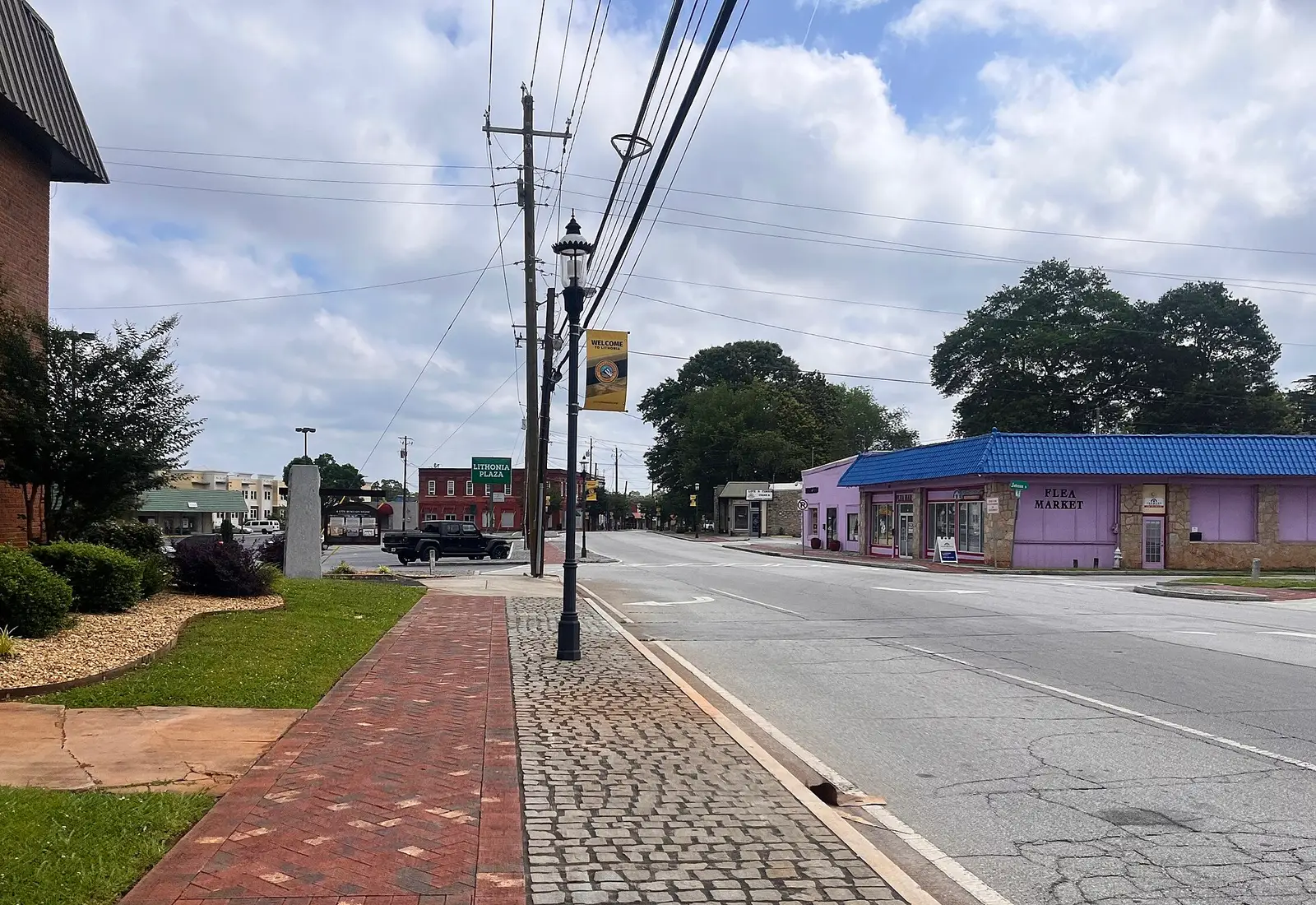
Most housing that carries a Lithonia address does not sit inside the small incorporated City of Lithonia at all. The city proper covers less than a square mile in eastern DeKalb County and counted 2,662 residents in the 2020 census; the association-governed neighborhoods that share its 30038 ZIP code sprawl for miles across unincorporated DeKalb and the City of Stonecrest, which incorporated only in 2017. Those subdivisions arrived in distinct waves. Cherokee Valley went up off Wellborn Road in the early 1980s; Panola Mill followed near Panola Road between 1987 and 1996; then a long townhome and condominium boom filled in the Fairington corridor — Fairington Station, Township, Enclave, and Village — through the 2000s and 2010s, while Legacy at Stoney Creek finished its final phase as recently as 2021.
A reserve study written from a national template misses what actually drives cost across this range of communities. A 1980s single-family neighborhood with only entrance signage, private streets, and a detention pond to maintain does not age the way a 2000s condominium regime with shared roofs, siding, and stormwater infrastructure does — and neither ages the way the humid Georgia Piedmont assumes on paper. Apex Reserve Group works from Irvine, California, and sends a team member based in metropolitan Atlanta to walk your property in person, measuring roofs, decks, ponds, and pavement against the heat, red clay, and tree canopy that are genuinely wearing them, not against an average pulled from some other market.
Why Lithonia Associations Need Current Reserve Studies
The Lithonia-area boards that suspect they are overdue for a reserve study tend to fall into two groups, and both are exposed. The early single-family subdivisions off Wellborn and Panola Roads are now roughly forty years old; their asphalt, entrance walls, wood fencing, and stormwater ponds have already cycled through a first replacement or are due for one, and communities that never set money aside are staring down a special assessment. The townhome and condominium communities built through the 2000s carry heavier shared obligations — roofs, exterior cladding, and drainage the association owns outright — and many are now passing the fifteen-to-twenty-year mark, the point at which original roofing, paint, and mechanical equipment reach the end of their service lives close together. A reserve study grounded in a fresh on-site inspection trades guesswork for dated, costed projections, so the board can step contributions up gradually instead of levying a lump sum after something has already failed.
From the Granite City Core to the Fairington and Stonecrest Subdivision Belt
It helps to separate two very different Lithonias. The incorporated city is a compact historic core — a 441-acre historic district whose brick and granite commercial storefronts are ringed by older residential streets, platted around the nineteenth-century railroad and quarry trade, where the name itself means 'place of stone' and local Tidal Grey granite once shipped out for landmarks such as the Brooklyn Bridge and the U.S. Naval Academy at Annapolis. Very little covenant-governed or multifamily housing sits within that footprint. The association-heavy 'Lithonia' is the broad 30038 mailing area fanning out around it: the Fairington corridor's townhome and condo communities near Fairington Parkway, older single-family neighborhoods like Cherokee Valley and Panola Mill, newer construction such as Legacy at Stoney Creek and the Parks of Stonecrest, and dozens more subdivisions that actually lie in unincorporated DeKalb or inside the City of Stonecrest rather than the city limits. Many of these communities sit near the Arabia Mountain National Heritage Area, whose granite outcrops and nature preserve shape the landscape on the eastern edge of the county.
What Georgia Law and Your Lenders Expect
Georgia has no statute that orders an association to commission a reserve study — no state law sets a schedule or a minimum reserve balance. The obligations that do apply come from three other directions. First, your own governing documents: many Lithonia-area declarations and bylaws require the board to fund or periodically study reserves, and a covenant like that is enforceable whether or not the state mandates anything. Second, the statutes that govern how these communities operate — condominiums fall under the Georgia Condominium Act (O.C.G.A. Title 44, Chapter 3), and homeowner associations may have opted into the Georgia Property Owners' Association Act. Neither one forces a reserve study, but both leave directors bound by fiduciary duties, and a board that ignores a roof or repaving bill it plainly saw coming invites personal-liability claims from its own owners. Third, and most immediately, lenders. FHA, Fannie Mae, and Freddie Mac condominium reviews generally look for roughly ten percent of the annual budget flowing to reserves, or a professional reserve study on file, and their attention to deferred maintenance tightened sharply after the 2021 Surfside collapse. Fannie Mae and Freddie Mac are raising that floor to fifteen percent for loan applications dated on or after January 4, 2027 — a shift that will land hardest on the Fairington condominium and townhome associations, because a project flagged as underfunded can lose conventional financing for every prospective buyer in the community.
Our Reserve Study Services in Lithonia
Full Reserve Study — A first complete inventory and on-site inspection of every common-area component your association owns, paired with a thirty-year funding plan and percent-funded analysis. The right starting point for a community that has never commissioned one or needs a clean baseline. Typical delivery: 3 to 4 weeks.
Reserve Study Update With Site Visit — A returning inspection, best scheduled every three to five years, that re-measures conditions, folds in completed projects, and resets the funding curve as your roofs, ponds, and pavement age. Typical delivery: 2 to 3 weeks.
Off-Site Annual Update — A between-visit refresh that adjusts the plan for inflation, recent spending, and your current reserve balance without a new site trip, keeping the study current from one year to the next. Typical delivery: 1 to 2 weeks.
Lithonia Communities We Serve
Our service area reaches across the Lithonia 30038 and 30058 ZIP codes and the surrounding southeastern DeKalb communities, whether your association sits inside the incorporated city, in unincorporated DeKalb County, or within the City of Stonecrest. That coverage includes the Fairington corridor — Fairington Station, Fairington Township, Fairington Enclave, Fairington Village, and Fairington Farms — along with Cherokee Valley, Panola Mill, Legacy at Stoney Creek, the Parks of Stonecrest, and the many townhome, condominium, and single-family neighborhoods strung along Panola Road, Wellborn Road, Marbut Road, and Fairington Parkway. If your community carries a Lithonia address, we can inspect it and build your study, from a compact self-managed townhome regime to a several-hundred-home covenant community.