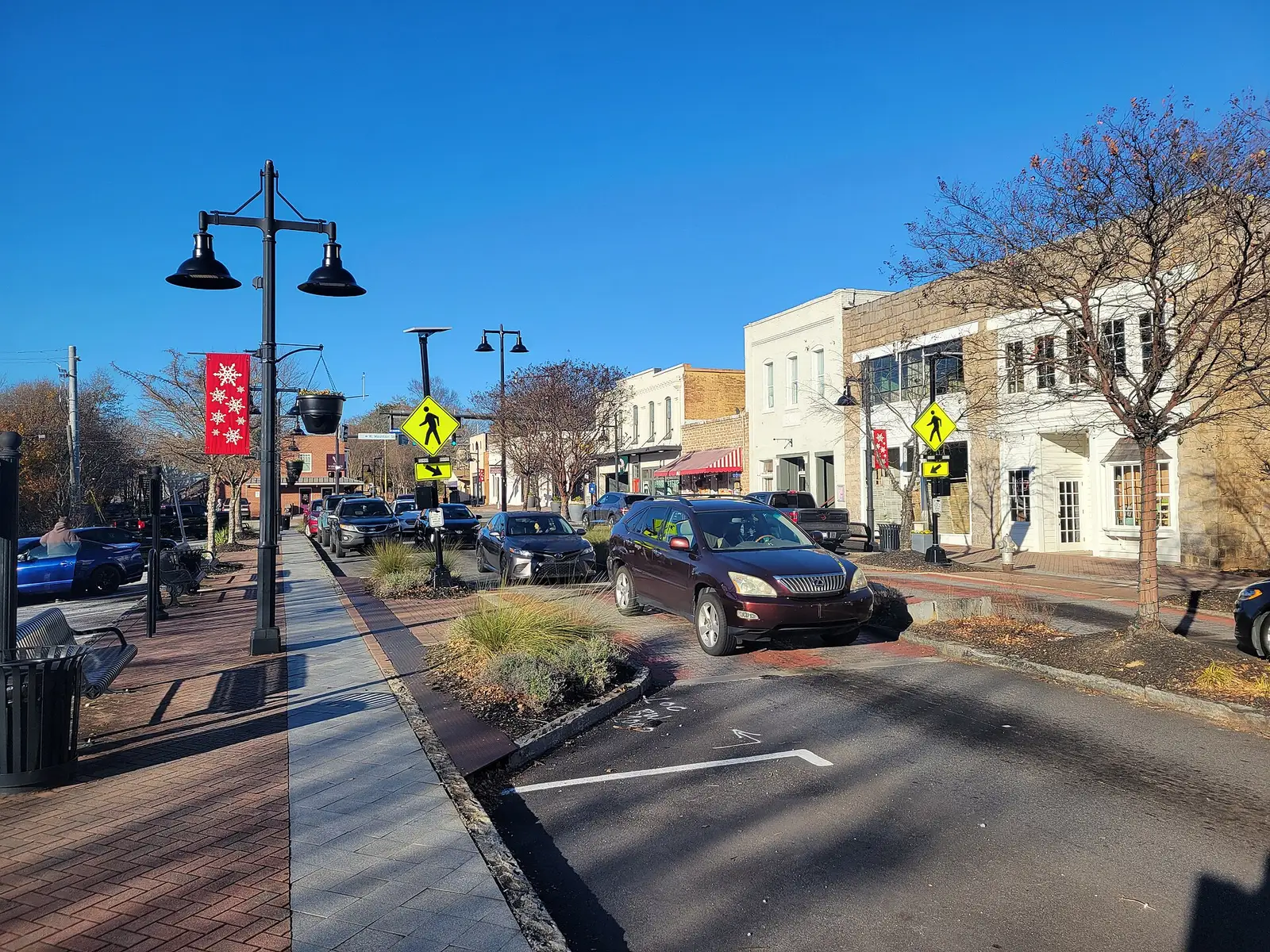
Stone Mountain is really two places that share one name, and the distinction shapes how a board should plan. The incorporated City of Stone Mountain — known locally as Stone Mountain Village — is a compact municipality of about 6,700 residents covering roughly 1.7 square miles in eastern DeKalb County, at the western foot of the mountain. The granite dome and the tourist attraction wrapped around it are not part of the city; they form the state-owned Stone Mountain Park, an adjacent property the State of Georgia purchased in 1958. Inside the city, housing is dominated by its historic core, where the Stone Mountain Historic District — listed on the National Register of Historic Places in 2000 as a rare surviving railroad town — is lined with late-nineteenth- and early-twentieth-century Victorian and Craftsman homes, and older residential enclaves such as Shermantown sit a short walk from Main Street. Most of the surrounding association-governed housing, though, lies outside the 1.7-square-mile city limits, in the unincorporated neighborhoods that share the Stone Mountain postal name: lake communities such as Water's Edge and townhome and condominium developments including Stone Mill and Stone Mountain West in unincorporated DeKalb County, along with single-family HOAs like Westheimer Estates just across the line in Gwinnett County, most built between the early 1970s and the 2000s.
Those two settings age very differently, which is why a template reserve study rarely serves a Stone Mountain association well. A century-old frame house in the Village, a 1970s garden condominium off Rockbridge Road, and a 1990s lakeside community with a clubhouse, pools, and shared shoreline have almost nothing in common on a component schedule — and all of them sit in a humid, tree-shaded Piedmont setting that wears on materials in ways national averages miss. Apex Reserve Group is based in Irvine, California, and prepares reserve studies for associations across metro Atlanta through a team member who lives in the area and performs the on-site inspections here in person. Your study reflects what your community actually is, when it was built, and how DeKalb County's climate and soils are aging it.
Why Stone Mountain Associations Need Current Reserve Studies
Two pressures make current reserve planning essential around Stone Mountain: the age of the housing stock and the local environment. Much of the association-governed housing in the postal Stone Mountain area went up between the early 1970s and the early 2000s, which puts these communities squarely in the window where original roofs, siding, asphalt, decks, and mechanical systems reach the end of their service lives at roughly the same time. The Piedmont climate compounds that timing. Long, humid summers and heavy rainfall drive mildew and rot on wood siding, trim, and decking; ultraviolet exposure and sustained heat fade and crack exterior coatings; and the region's dense tree canopy fills gutters, shades and shortens roof life, and drops limbs during ice storms and the occasional hail event. Underfoot, the red Piedmont clay that defines DeKalb County swells when saturated and shrinks in drought, stressing foundations, retaining walls, sidewalks, and pavement. Many local communities also own stormwater detention ponds, dams, and drainage structures that boards tend to overlook until a repair bill lands. A reserve study grounded in an on-site inspection replaces that guesswork with realistic replacement dates and a funding plan built to keep a special assessment off the table.
From the Historic Village to Water's Edge: The Stone Mountain Association Landscape
Within the city limits, the housing is mostly historic and single-family. The Stone Mountain Historic District holds Victorian- and Craftsman-era homes with wood siding, wraparound porches, and detailing that predates modern building materials, while neighborhoods like Shermantown — the historically African American community that freedmen and quarry workers settled on the village's southeastern edge after the Civil War — contribute their own older, more modest housing stock. The city's membership in the Main Street America program reflects how much of that early commercial fabric survives along Main Street and around its historic train depot. Formal community associations are comparatively scarce inside the 1.7-square-mile city; the bulk of HOA and condominium stock sits just beyond it, in unincorporated DeKalb County. There, Water's Edge spreads around a 140-acre private lake and is organized into distinct sections — among them Dockside, Harbor Pointe, The Reserve, Forest Cove, and Lakeside — each with amenities that can range from pools and tennis courts to shared shoreline. Nearby, townhome and condominium communities such as Stone Mill and Stone Mountain West and semi-attached enclaves such as Hairston Hill line the Rockbridge Road, Hairston Road, and Memorial Drive corridors, while single-family developments like Westheimer Estates sit just across the county line in Gwinnett. Some neighborhoods that still carry Stone Mountain mailing addresses, including the wooded 1960s estates of Smoke Rise, were folded into the newer City of Tucker when it incorporated in 2016 — a jurisdictional detail worth confirming, because it changes which local government a community answers to. Each of these building types calls for its own component inventory, and we build the study around the one your community actually has.
What Georgia Law and Your Lenders Expect
Georgia has no statute that requires a homeowner or condominium association to commission a reserve study, and no state agency sets a minimum reserve balance. What governs instead is a combination of three things. First, your own recorded declaration, bylaws, and covenants: many Stone Mountain-area governing documents call for reserves or periodic capital planning, and a board that disregards its own documents exposes its directors to claims. Second, Georgia's association statutes. The Georgia Condominium Act (O.C.G.A. Title 44, Chapter 3) directs condominium boards to provide for reserves in their annual budgets but stops short of mandating a formal study or any funding percentage, and the opt-in Georgia Property Owners' Association Act (O.C.G.A. Section 44-3-220 and following) — which applies only where a homeowner association has elected it in its recorded declaration — is likewise silent on reserve studies. Neither law lets a board off the hook, because directors owe the association a fiduciary duty of care, and knowingly leaving a foreseeable roof, paving, or detention-pond expense unfunded is hard to reconcile with that duty. Third, and increasingly the sharpest pressure, come the lenders. FHA, Fannie Mae, and Freddie Mac all scrutinize condominium reserves before backing a mortgage, generally expecting at least ten percent of the annual budget to go to reserves or a current reserve study that supports the funding level, and their attention to deferred maintenance has tightened considerably since the 2021 Surfside collapse. For loan applications dated on or after January 4, 2027, Fannie Mae and Freddie Mac raise that floor to fifteen percent unless a recent reserve study justifies a different level. For Stone Mountain's many established 1970s-to-1990s condominium and townhome communities, that lender math is often what keeps units financeable — and resalable — at all.
Our Reserve Study Services in Stone Mountain
Full Reserve Study — A complete on-site inspection of every common-area component, a full component inventory, and a 30-year funding plan with percent-funded analysis and funding scenarios, built for communities that have never had a study or need a fresh baseline. Typical delivery: 3 to 4 weeks.
Reserve Study Update With Site Visit — A return inspection that re-measures conditions, folds in completed projects, and resets the funding plan, best scheduled every three to five years as Piedmont weather and aging components shift the timeline. Typical delivery: 2 to 3 weeks.
Off-Site Annual Update — A remote refresh for the years between site visits that adjusts for inflation, recent spending, and current reserve balances so your plan and disclosures stay accurate. Typical delivery: 1 to 2 weeks.
Stone Mountain Communities We Serve
Our service area covers the City of Stone Mountain and the association-heavy unincorporated neighborhoods that share its postal name, most in eastern DeKalb County and some just over the line in Gwinnett County. Inside the Village, that includes the Stone Mountain Historic District, Main Street, and Shermantown. Beyond the city limits, our service area extends to Water's Edge — including its Dockside, Harbor Pointe, The Reserve, Forest Cove, and Lakeside sections — along with Stone Mill, Stone Mountain West, Westheimer Estates, Hairston Hill, and the townhome, condominium, and single-family communities strung along Rockbridge Road, Hairston Road, and the Memorial Drive corridor. Our coverage also reaches adjoining eastern DeKalb communities, including nearby Tucker, Clarkston, and Lithonia.