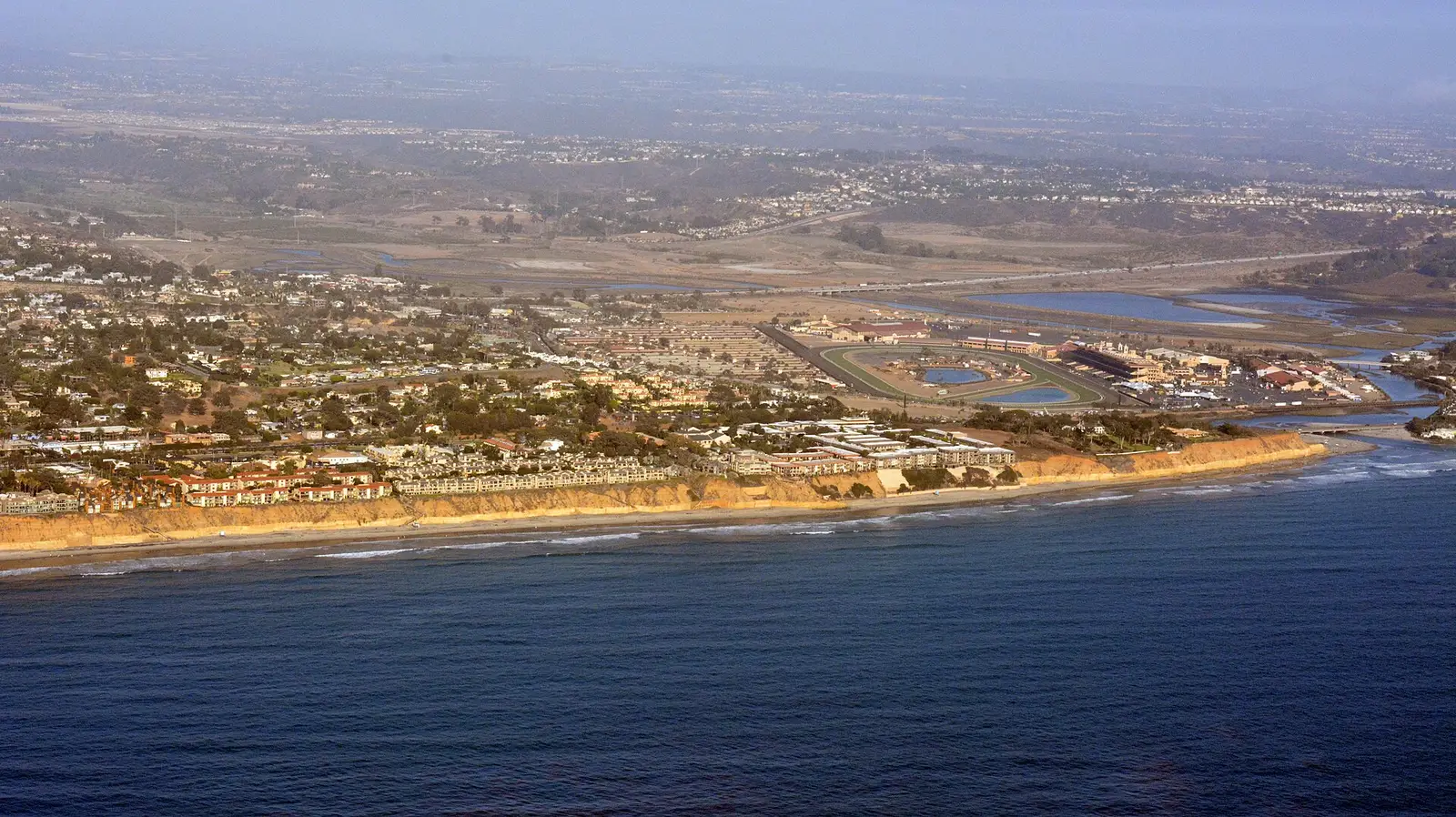
Del Mar holds substantial real estate value in just 1.7 square miles of coast and bluff. The city has governed itself since 1959 and counts fewer than four thousand residents, so its association-run housing is small in number but high in stakes. The Beach Colony, the narrow strip nearest the sand, blends early cottages, custom oceanfront homes, and clustered condominiums a block or two from the water. Above it, Olde Del Mar — the hillside Village along Camino Del Mar — holds the city's oldest fabric from the 1880s resort era, while Del Mar Terrace anchors the south end with homes that grew from a mid-century hillside enclave. Between them sit the planned communities that account for much of the city's HOA work: Del Mar Woods, a bluff-top complex of 126 units finished in 1975; the mid-1970s townhomes of Sea Village near Torrey Pines State Beach; and gated Playa Del Mar, built in 1988 where the Beach Colony meets the San Dieguito Lagoon.
That mix — few associations, each carrying real value, all within reach of salt air — is what makes an off-the-shelf reserve study a poor fit for Del Mar. A 1970s bluff-top condominium with wood balconies and a shared pool, a beachfront townhome fronting a tidal lagoon, and a hillside conversion in the Terrace share little beyond a zip code and the marine layer that weathers them. Standard useful-life tables written for inland tracts tend to overstate how long roofs, railings, coatings, and decks last within a few hundred yards of the Pacific. Apex Reserve Group works from Irvine and builds each Del Mar study around the building actually in front of us — its age, its construction, and the coastal exposure that drives its replacement schedule.
Why Del Mar Associations Need Current Reserve Studies
Two things shape reserve planning in Del Mar: the age of the stock and the ocean it sits beside. Much of the city's attached housing dates to the 1970s and 1980s, and the Village core is older still, so many associations are now cycling through second- and third-generation replacements of roofs, siding, waterproofing, and mechanical systems. The setting speeds all of it along. Del Mar's homes crowd a coastline where the bluffs stand roughly forty feet above the beach and the marine layer rolls in most mornings; salt-laden air corrodes metal railings, lifts coatings, and shortens the life of balcony decks and roof assemblies well ahead of the timelines inland tables assume. A reserve study built on those inland averages can read as adequately funded right up until a component fails early and the board reaches for a special assessment. A current study grounded in a real on-site inspection replaces that guesswork with replacement dates that reflect how this particular environment is aging your buildings.
From the Beach Colony to Del Mar Terrace: Mapping the City's Associations
The city reads as a chain of small, distinct neighborhoods, and each presents a different reserve profile. The Beach Colony, pressed against Del Mar City Beach, runs from historic cottages to custom oceanfront homes and a few clustered condominium and townhome projects — among them Playa Del Mar, the gated 1988 community fronting the San Dieguito Lagoon — where shared decks, seawalls, and relentless salt exposure dominate the component list. Olde Del Mar, the hillside Village around Camino Del Mar and the Del Mar Plaza, holds the oldest construction and the smallest, frequently self-managed associations. Toward the south end sit the planned communities that anchor much of the city's HOA work: Del Mar Woods, a bluff-top complex of 126 units from 1975 with a pool, spa, clubhouse, and tennis courts; and Sea Village, a mid-1970s townhome community a short walk from Torrey Pines State Beach. Del Mar Terrace, the southernmost neighborhood, steps down the slope above Los Peñasquitos Lagoon with ocean and lagoon views. No two of these carry the same component list, and we scope each study to the buildings in front of us.
What California Law Requires
Three parts of California law drive reserve work for common interest developments, and all three reach Del Mar. Civil Code Section 5550, the heart of the Davis-Stirling Act's reserve rules, directs most associations to ground its reserve study in a physical inspection of the major components no less than once every three years, and to revisit that study with an update each year in between. Civil Code Section 5300 then requires those reserve numbers — the balance on hand, the percent funded, and the plan to close the gap — to be disclosed in the annual budget report that reaches every member. Senate Bill 326 layers on a separate structural duty for condominium associations: a licensed inspection of exterior elevated elements such as balconies, decks, stairways, and walkways that rely on wood framing. That first inspection carried a deadline of January 1, 2025, which is now in the past, and Del Mar's two- and three-story condominiums from the 1970s and 1980s land squarely within its scope. When an inspector concludes that a deck or railing has less life left than a desktop estimate assumed, the finding feeds straight back into the reserve numbers.
Our Reserve Study Services in Del Mar
Full Reserve Study — A ground-up component inventory, a hands-on site visit, and a funding plan that projects thirty years out, with useful lives shortened for the salt air and bluff exposure of properties near the surf. Typical delivery: 3 to 4 weeks.
Reserve Study Update With Site Visit — A return inspection and reworked funding plan every three to five years, valuable for Del Mar's older condominium stock where real coastal wear tends to outrun what a desktop estimate predicted. Typical delivery: 2 to 3 weeks.
Off-Site Annual Update — A desk-based refresh in the off years, keeping the funding plan and mandated disclosures current between inspections. Typical delivery: 1 to 2 weeks.
Del Mar Communities We Serve
We prepare reserve studies for associations across the City of Del Mar, including the Beach Colony, Olde Del Mar and the Village, Del Mar Terrace, and the North Beach area near the San Dieguito River mouth, along with named communities such as Del Mar Woods, Sea Village, and Playa Del Mar. We also serve nearby associations that carry Del Mar addresses but sit just outside city limits, such as Casa Del Mar, the 1977 gated condominium community on Mango Drive in Del Mar Heights, part of the City of San Diego. Whether your association is a small self-managed building in the Village or a larger bluff-top condominium community with a pool and shared grounds, we tailor the study to your components and your stretch of coast.