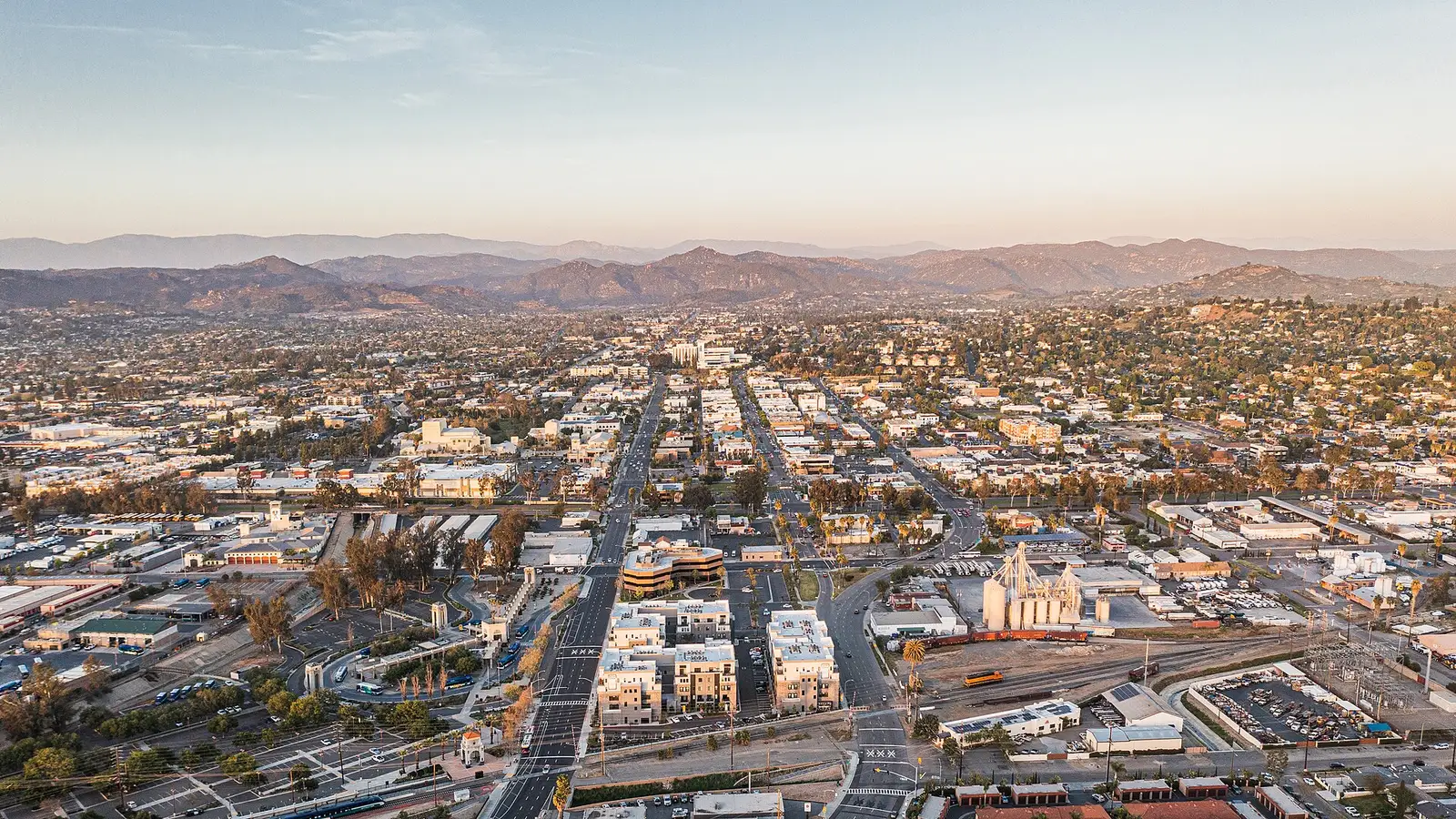
Escondido is one of the oldest cities in San Diego County — incorporated in 1888 — and its association-governed housing spans that entire arc. Downtown and the Old Escondido Historic District hold the city's earliest fabric, Victorian and Craftsman homes from the late 1800s and early 1900s, ringed by mid-century and 1970s condominium and townhome projects along the Grand Avenue corridor, among them the 172-unit Villa Grande, completed in 1973. Push north and east into the foothills and the character changes entirely: Hidden Meadows is a semi-rural, equestrian-minded master-planned community east of Interstate 15, while Rancho San Pasqual, built largely in the late 1990s, wraps a gated grid of Mediterranean-style homes around the former Eagle Crest golf course, now Dos Osos Golf Club, in the San Pasqual Valley. Southwest of downtown, the Vineyard and Vineyard Estates pair large custom homes with the Vineyard at Escondido golf course, while off Bear Valley Parkway near Dixon Lake in the northeastern foothills, Eureka Springs adds a newer layer of detached single-family homes — roughly 2,000 to 4,000 square feet, built by Lennar and Centex from about 2006 to 2010.
That range is why an off-the-shelf reserve study rarely fits an Escondido association. A gated golf community of detached custom homes, a downtown condo building with wood-framed balconies and shared roofs, and a hillside equestrian community with private roads and acres of slope landscaping face different components — and a very different climate — than a coastal HOA does. Escondido sits inland at roughly 646 feet, routinely running ten to fifteen degrees hotter than the San Diego coast in summer, and the thermometer reached 115 degrees in September 2020, so it is heat, ultraviolet exposure, and daily thermal cycling, not salt air, that drive component wear here. Apex Reserve Group, based in Irvine, prepares reserve studies built around what your association actually owns and how this hot, high-UV inland setting is aging it, rather than a template borrowed from the coast.
Why Escondido Associations Need Current Reserve Studies
Escondido's reserve challenges start with its building stock and its weather. A meaningful share of the city's attached housing — the condominium and townhome complexes around downtown and the Grand Avenue corridor — dates to the 1960s and 1970s, while even the master-planned communities from the 1990s are now deep into the replacement window for roofs, paint, and paving. Intense ultraviolet radiation and prolonged summer heat are hard on the components inland associations depend on: asphalt streets oxidize and crack, elastomeric and exterior coatings chalk and fade, composition roofs and sealants dry out and grow brittle, and pool decks and wood fencing weather faster than shaded, milder-climate averages predict. Useful-life tables calibrated for gentler conditions tend to run optimistic here, and an association that funds to those numbers is steadily accumulating a shortfall it cannot see. An up-to-date reserve study — one whose inspection genuinely weighs sun and heat exposure — is what lets a board defend its replacement timeline and set contributions that hold, instead of discovering the gap only when a special assessment becomes unavoidable.
From Old Escondido to the San Pasqual Valley: Escondido's Association Landscape
Downtown and Old Escondido anchor the city's oldest association stock. Around Grand Avenue and the historic core, mid-century and 1970s condominium and townhome buildings — Villa Grande among them — carry components most suburban studies underweight: shared roofs, common corridors and stairwells, aging plumbing, and the elevated wood-framed balconies and walkways that fall under California's structural-inspection law. North of the city, Hidden Meadows spreads across the foothills east of Interstate 15 as a semi-rural, equestrian community where private roads, greenbelts, trails, and slope landscaping dominate the reserve inventory rather than dense building envelopes. In the San Pasqual Valley to the southeast, Rancho San Pasqual is a gated community of roughly 600 late-1990s homes organized around the former Eagle Crest golf course, now Dos Osos Golf Club, with entry gates, private streets, and shared landscaping to fund. Southwest of downtown, the Vineyard and Vineyard Estates set large custom homes beside the Vineyard at Escondido golf course, and North Escondido adds a distinct layer of resident-owned senior communities such as Champagne Village and Citrus Gardens. Each pattern calls for its own component inventory, and we assemble the study around yours.
What California Law Requires
California's Davis-Stirling Act sets the baseline. Civil Code Section 5550 requires most common interest developments to commission a reserve study based on a physical, on-site inspection no less than once every three years, and to review and update that study in each year between inspections. Civil Code Section 5300 then requires the reserve findings — current reserves, percent funded, and the contribution plan — to be summarized in the annual budget report distributed to every owner. A third law, Senate Bill 326, reaches Escondido's condominium buildings specifically: it mandates a licensed structural engineer's, civil engineer's, or architect's inspection of exterior elevated elements such as balconies, decks, stairways, and walkways, and its first-inspection deadline of January 1, 2025 has already passed. That obligation lands squarely on the older attached condominium and townhome projects near downtown, where wood-framed elevated elements are common, while the master-planned communities of detached single-family homes generally fall outside its scope. Because a structural finding can shorten the useful life a reserve study assigns to a deck or railing, the two exercises are best read together.
Our Reserve Study Services in Escondido
Full Reserve Study — A comprehensive first study grounded in a full on-site inspection and a 30-year funding forecast, with component useful lives set for Escondido's heat, high UV, and day-to-night thermal cycling. Typical delivery: 3 to 4 weeks.
Reserve Study Update With Site Visit — A refreshed inspection and funding plan every three to five years, valuable where sun and heat move component condition faster than a desk projection assumes. Typical delivery: 2 to 3 weeks.
Off-Site Annual Update — A between-visit refresh completed remotely, keeping your contribution schedule and annual-budget-report disclosures accurate through the interim years. Typical delivery: 1 to 2 weeks.
Escondido Communities We Serve
We prepare reserve studies for associations across Escondido, including Downtown Escondido, the Old Escondido Historic District, the Grand Avenue condominium corridor, Hidden Meadows, Rancho San Pasqual, the Vineyard and Vineyard Estates, Eureka Springs, the East Grove area, the Ranchos at Vistamonte, Champagne Village, Citrus Gardens, Rancho Escondido, and associations throughout the San Pasqual Valley and the North County foothills.