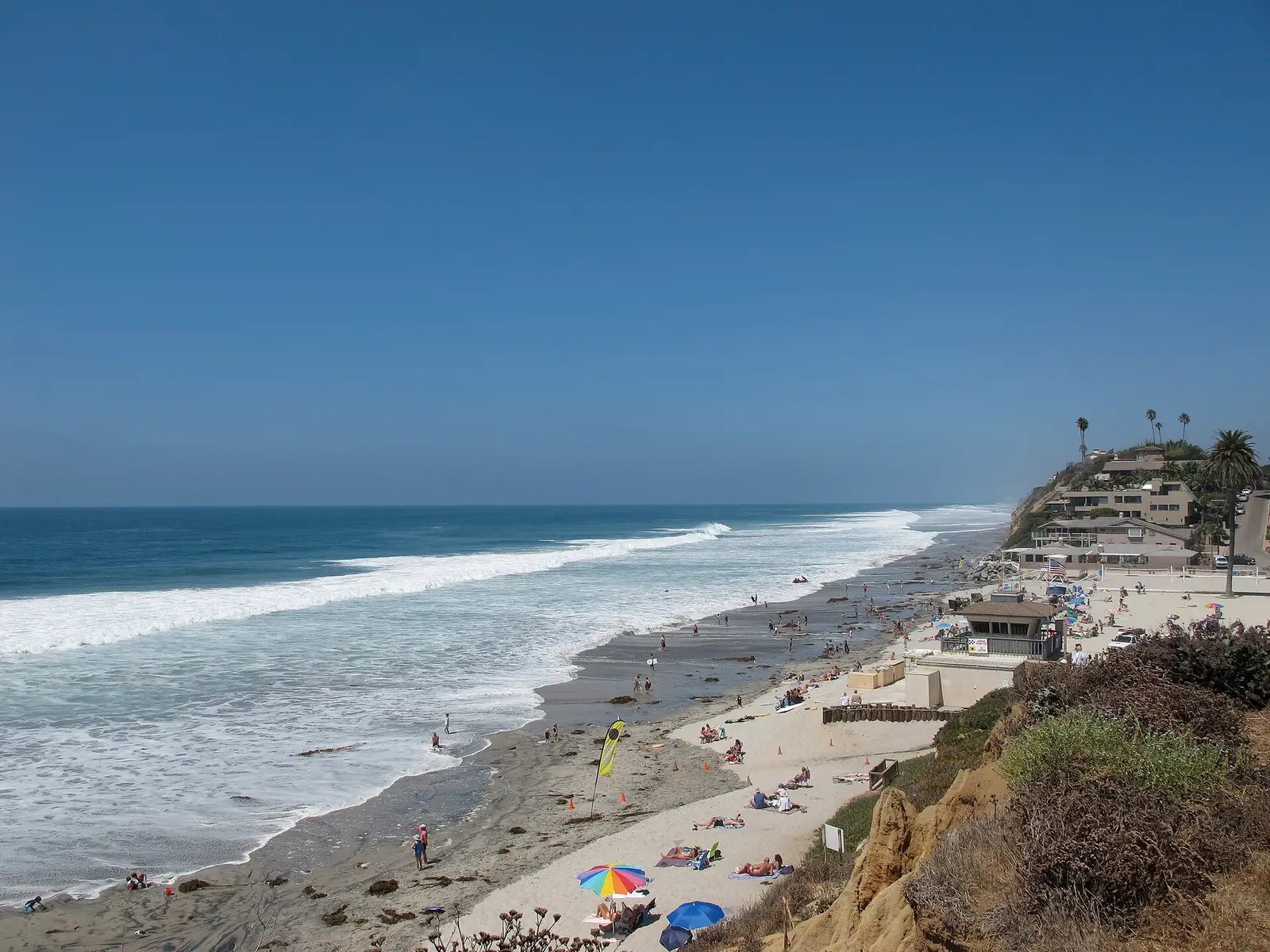
Encinitas came together as a city in 1986 from five communities that still read as distinct places — Old Encinitas, Leucadia, Cardiff-by-the-Sea, New Encinitas, and semi-rural Olivenhain — and its association-governed housing is just as mixed. Along the Historic Highway 101 corridor and the streets dropping toward the sand, early- and mid-20th-century beach cottages share the block with condominiums and townhomes built later in the same neighborhoods. Bluff-top developments such as Seabluffe in Leucadia stand directly above the sandstone cliffs. East of Interstate 5 the pattern flips: New Encinitas holds planned communities like Village Park, laid out in the 1970s and 1980s around a car-free greenbelt, and Encinitas Ranch, a master-planned area whose homes rose mostly between the late 1990s and the early 2000s beside a public golf course. Farther east, Olivenhain's larger-lot, equestrian subdivisions look after roads, trails, and open space more than shared building walls.
What ties those communities together is mostly the ZIP code and the Pacific weather that reaches all of them; almost nothing else does. A condominium a block from Moonlight Beach, a guard-gated townhome community on the Leucadia bluffs, a greenbelt tract from the 1970s built around a pool and tennis courts, and an Olivenhain association that answers for private lanes and horse trails each own a different component list and age at a different pace. Apex Reserve Group works out of Irvine and prepares each Encinitas reserve study around those specifics — the building's era, how it was framed, and whether salt air, the marine layer, or coastal-bluff exposure is wearing it down ahead of an inland schedule.
Why Encinitas Associations Need Current Reserve Studies
In Encinitas, two local realities do most of the work in a reserve plan. The first is age: the associations closest to the water, strung along Historic Highway 101 through Leucadia, Old Encinitas, and Cardiff-by-the-Sea, include beach cottages, mid-century buildings, and the condominiums and townhomes later built among them. The second is the marine setting itself — salt air and the fog residents call May Gray and June Gloom — which drives moisture and corrosion into roofs, exterior coatings, metal railings, wood balconies and stairs, and waterproofing membranes far sooner than useful-life tables written for dry inland tracts predict. An association that funds straight off those tables is quietly setting aside too little each year. Away from the beachfront, the newer communities of New Encinitas and Encinitas Ranch raise a different timing problem, as pools, private streets, clubhouses, and slope plantings installed in the same era now come due together. A reserve study grounded in an on-site inspection trades that guesswork for realistic replacement dates and a contribution plan built to keep a special assessment off the table.
From Beach-Condo Corridors to Olivenhain Estates: Encinitas's Association Landscape
The coastal strip holds the associations most sensitive to their environment. Through Leucadia, Old Encinitas, and Cardiff-by-the-Sea, condominium and townhome communities sit within a few blocks of the water, and bluff-top developments like Seabluffe near Neptune Avenue bring cliff-stability and beach-access components that inland studies rarely touch. Cardiff's Composer and Walking districts fold older cottages in with newer custom homes, with the Coastal Rail Trail running beside the rail corridor. Head east and the housing changes character: New Encinitas is planned-development country, where Village Park's 1970s and 1980s homes gather around an internal greenbelt with shared pools, a clubhouse, and tennis courts, and Park Encinitas serves an age-qualified community. Encinitas Ranch fans across the north and south mesas in six neighborhoods built largely from the late 1990s into the early 2000s under a Specific Plan adopted in the mid-1990s, ringing a public golf course. At the city's semi-rural eastern edge, Olivenhain — first settled as a German farming colony on the old Rancho Las Encinitas grant — is custom-home country on half-acre-to-multi-acre lots, where associations tend to maintain private roads, gates, trails, and slopes instead of roofs and elevators. No two of those patterns share the same component list, so we scope each study to the community in front of us.
What California Law Requires
California's common interest developments answer to the Davis-Stirling Act. Civil Code Section 5550 requires an association to commission a reserve study built on a physical, on-site inspection of its major components at least once every three years, and to review and refresh that study in each of the years between inspections. Civil Code Section 5300 then requires the reserve picture — the current funding status and the plan behind it — to be summarized in the annual budget report sent to every member. A third law lands squarely on much of Encinitas's coastal housing: Senate Bill 326 requires condominium associations to have a licensed architect, structural engineer, or civil engineer inspect elevated, wood-framed balconies, decks, stairways, and walkways, together with their waterproofing, on a repeating cycle. The first of those inspections was due by January 1, 2025 — a deadline that has already passed — so any Encinitas condominium association still without one is behind. Since salt air and marine moisture speed exactly the hidden wood decay SB 326 is meant to catch, its findings often revise the remaining useful life a reserve study assigns to those same decks and railings, which is why we handle the two together.
Our Reserve Study Services in Encinitas
Full Reserve Study — A full component inventory, an on-site inspection, and a 30-year funding projection, with useful-life estimates tuned to whether your buildings face salt air, marine-layer moisture, or coastal-bluff exposure. Typical delivery: 3 to 4 weeks.
Reserve Study Update With Site Visit — A fresh inspection and revised projection, most valuable for older beach-adjacent buildings near Highway 101 where conditions shift faster than a desk update can track. Typical delivery: 2 to 3 weeks.
Off-Site Annual Update — A between-visit refresh of your numbers and Civil Code disclosures, prepared remotely to keep the plan current in the years no site visit is due. Typical delivery: 1 to 2 weeks.
Encinitas Communities We Serve
We prepare reserve studies for associations throughout Encinitas, including Leucadia, Old Encinitas, Cardiff-by-the-Sea, New Encinitas, Village Park, Encinitas Ranch, Park Encinitas, and Olivenhain, along with the communities strung across the Historic Highway 101 corridor — from bluff-top townhomes near Neptune Avenue and the condominiums above Moonlight Beach to greenbelt planned developments, age-qualified communities, and semi-rural estate associations farther inland.