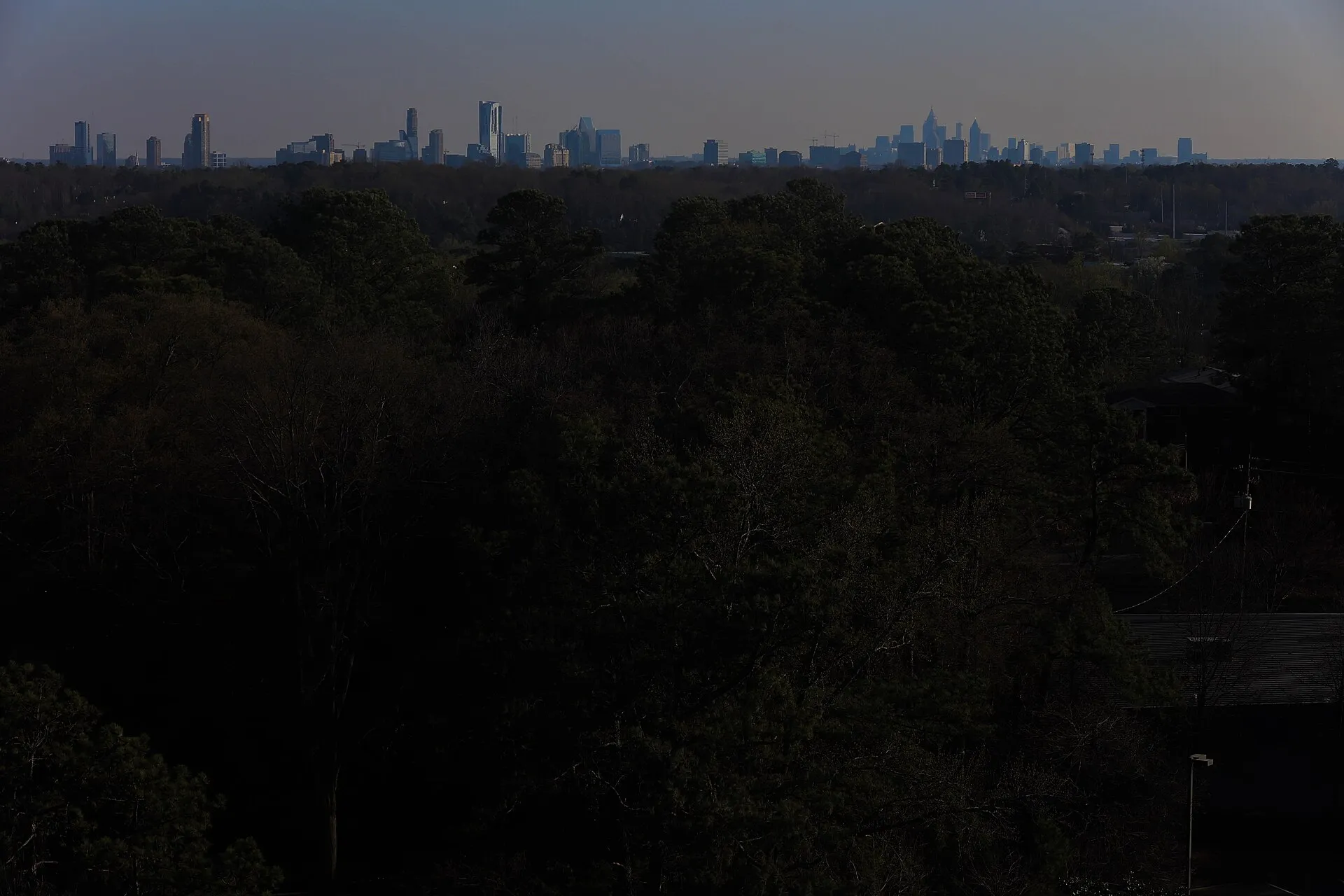
Fulton County is Georgia's most populous county — roughly 1.09 million residents, about one in ten Georgians — and it may be the state's most varied place to run a community association. At the center, Midtown and Buckhead hold the condominium towers of the mid-2000s boom: Spire opened on Peachtree Street in 2005, Viewpoint and 1010 Midtown followed in 2008, Buckhead Grand and the Paramount at Buckhead date to 2004, and Atlantic Station brought condos and townhomes to the redeveloped Atlantic Steel site in the same era. North of the Chattahoochee River, the GA-400 corridor through Sandy Springs, Roswell, Alpharetta, Johns Creek, and Milton is thick with swim/tennis and golf-course communities — 3,400-acre Windward around its 195-acre lake in Alpharetta, Horseshoe Bend along the river in Roswell, Country Club of the South and St Ives in Johns Creek. South of Atlanta, the older rail towns of East Point, College Park, and Hapeville sit between downtown and Hartsfield-Jackson, while farther south the story is newer: the City of South Fulton incorporated in 2017, and Chattahoochee Hills in 2007 — home to the Serenbe community, building since 2004.
No single template covers that range. A 2008 high-rise with curtain-wall glazing and a parking deck under its pool, a 1980s golf community whose amenity budget rivals a small town's, and a five-year-old townhome HOA in Fairburn share a county line and almost nothing else. Apex Reserve Group is based in Irvine, California, and our reserve studies for Fulton County are grounded in the ground itself: a team member based in metro Atlanta performs the on-site inspections, so component conditions are observed in person rather than assumed from a spreadsheet.
Why Fulton County Associations Need Current Reserve Studies
The county's association stock is hitting inflection points at both ends. Towers that rose along Peachtree between roughly 2004 and 2008 are now about two decades old — the age when original roofing membranes, cooling towers, garage-deck coatings, and amenity-level waterproofing tend to come due within the same few budget years. The swim/tennis and golf communities that built out North Fulton in the 1980s and 1990s are past their second round of pool resurfacing and into larger questions: clubhouse renovation, court reconstruction, entry monuments, aging retaining walls, and the stormwater detention ponds many Fulton HOAs own and will eventually have to dredge or rebuild. Atlanta's humid subtropical climate compresses every one of those timelines. Sustained heat and humidity degrade exterior paint and sealants faster than national useful-life tables assume; mildew keeps constant pressure on siding and fencing; wood decking and trim decay quickly where surfaces rarely dry out; the Piedmont's red clay takes on and sheds moisture with the seasons, and that soil movement works on walls, walks, and pavement; a heavy tree canopy loads roofs and gutters; and the occasional hail or ice storm forces roof work no one scheduled. A study built on a recent site inspection replaces borrowed averages with what your components are actually doing.
From Buckhead High-Rises to Windward and Serenbe: Fulton County's Association Landscape
In Atlanta proper, the vertical stock concentrates in Midtown, Buckhead, and Downtown. Reserve lists in buildings like Spire (2005), Viewpoint and 1010 Midtown (2008), or Buckhead Grand and the Paramount (2004) are dominated by elevators, facade and curtain-wall systems, parking structures, rooftop amenity decks, and fire-safety equipment — components with long lives and very large price tags. Across the river, Sandy Springs and Roswell blend garden condominiums and townhomes with established master plans; Horseshoe Bend in Roswell, whose golf course opened along the Chattahoochee in 1974, is now a half-century into its component cycles. Farther north on GA-400, Alpharetta's Windward — begun in the 1980s across 3,400 acres and more than 40 neighborhoods — and the gated Johns Creek golf communities of Country Club of the South (1988) and St Ives carry amenity inventories that function like small municipal budgets: lakes, gates, pools, courts, clubhouses, and miles of association-maintained hardscape. Milton, incorporated in 2006, adds newer estate subdivisions with a deliberately rural, equestrian character. In South Fulton, associations skew younger: townhome and single-family HOAs spreading through the City of South Fulton (2017), Fairburn, Union City, and Palmetto, and the planned hamlets of Serenbe inside Chattahoochee Hills (2007). Each type needs its own component inventory, and we build the study around yours.
What Georgia Law and Your Lenders Expect
Georgia has no statute requiring community associations to obtain reserve studies, set aside a minimum reserve balance, or inspect on any schedule. What binds a Fulton County board comes from three directions instead. First, your own governing documents: many declarations and bylaws commit the association to maintain adequate reserves or commission periodic studies, and a board that disregards its recorded obligations has nowhere to hide. Second, statute and fiduciary duty: condominiums operate under the Georgia Condominium Act (O.C.G.A. §§ 44-3-70 through 44-3-117), which imposes no reserve funding floor — its budget disclosure that breaks out reserve line items applies only to the first sale of each residential unit, not to resales — and many HOAs have opted into the Georgia Property Owners' Association Act. Neither act mandates a study — but directors owe the association duties of care and good faith, and a board that never quantified a foreseeable garage-deck or roofing project is poorly positioned to defend the omission. Third, lenders: Fannie Mae and Freddie Mac review condominium project finances before backing mortgages, generally looking for at least 10 percent of the annual budget allocated to reserves or a compliant, recent reserve study — and since the Surfside collapse, questionnaires probe deferred maintenance and reserve adequacy far more aggressively. For the mid-2000s towers along Peachtree, where most buyers finance conventionally, an outdated study is a resale problem as much as a planning one.
Our Reserve Study Services in Fulton County
Full Reserve Study — A complete on-site component inventory, condition assessment, and 30-year funding model calibrated to your community's construction era, amenity load, and Georgia's climate. Typical delivery: 3 to 4 weeks.
Reserve Study Update With Site Visit — Our Atlanta-based inspector walks the property, re-rates component conditions, and recalibrates the funding plan — the right move every 3 to 5 years or after major projects. Typical delivery: 2 to 3 weeks.
Off-Site Annual Update — A remote refresh in the years between inspections that folds in completed work, current pricing, and your latest reserve balance. Typical delivery: 1 to 2 weeks.
Fulton County Communities We Serve
We prepare reserve studies throughout Fulton County, including Atlanta — Buckhead, Midtown, and Downtown among its neighborhoods — Sandy Springs, Roswell, Alpharetta, Johns Creek, Milton, Mountain Park, East Point, College Park, Hapeville, Union City, Fairburn, Palmetto, Chattahoochee Hills, and the City of South Fulton. Since South Fulton's 2017 incorporation and its later annexations along the Fulton Industrial Boulevard corridor — long the county's last unincorporated territory — virtually all of Fulton County lies within a city, and all of it lies within our service area.