Buford's community associations reflect a town that reinvented itself around a mall, a lake, and an interstate. When the Mall of Georgia opened in 1999 just off I-85, it drew a wave of subdivision development north into what had been a quiet railroad and tannery town. Swim-and-tennis neighborhoods from that boom — Windrush (built roughly 1992 to 2005), Seneca Farms (2001 to 2004), Morningbrooke (2003), and Clearwater Plantation (2002–2017) among them — now sit twenty-plus years into their component life cycles, while townhome communities like the 1999-era Lanier Pointe and later single-family developments such as Bogan Meadows (2008 to 2019) and Lakeview at Hamilton Mill (roughly 2007 to 2017) fill in the decades between. Newer arrivals keep coming: Taylor Morrison's Overlook at Lanier delivered in 2024 and 2025, and townhome projects near the Mall of Georgia continue to add doors.
That range — a two-decade-old pool-and-tennis HOA on the Gwinnett side, a lakeside enclave up in Hall County, and a brand-new townhome cluster off Buford Drive — is exactly why an off-the-shelf reserve study misfits Buford associations. A community that has never funded past its builder-set dues carries different exposure than one facing its first clubhouse roof, and both differ from a lake community responsible for docks, retaining walls, and shoreline features. Apex Reserve Group works from Irvine, California, and sends a team member based in the metro Atlanta area to walk your property in person, so the numbers rest on what your buildings and grounds actually show rather than on a template built for somewhere else.
Why Buford Associations Need Current Reserve Studies
A reserve study is only useful if it matches the property in front of it, and Buford has changed too fast for old assumptions to hold. Most of the city's association housing went up during and after the Mall of Georgia era, which means many boards are now reaching the first real wave of big-ticket replacements: asphalt-shingle roofs baked by North Georgia summers, exterior paint and siding, pool resurfacing, and clubhouse systems installed by the original builder. A community built in 2003 that still contributes at its opening-year dues rate is almost certainly behind. Age is only half of it. This is humid-subtropical Georgia — sustained heat and humidity, red clay that swells and shrinks beneath pavement and foundations, a heavy tree canopy that loads gutters and roofs, and the occasional hail or ice event. Those conditions draw useful life out of components faster than national averages predict. A current study built on an on-site inspection trades guesswork for a funded, sequenced plan and keeps a surprise special assessment off the table.
From Historic Main Street to the Lake Lanier Shoreline: Buford's Association Landscape
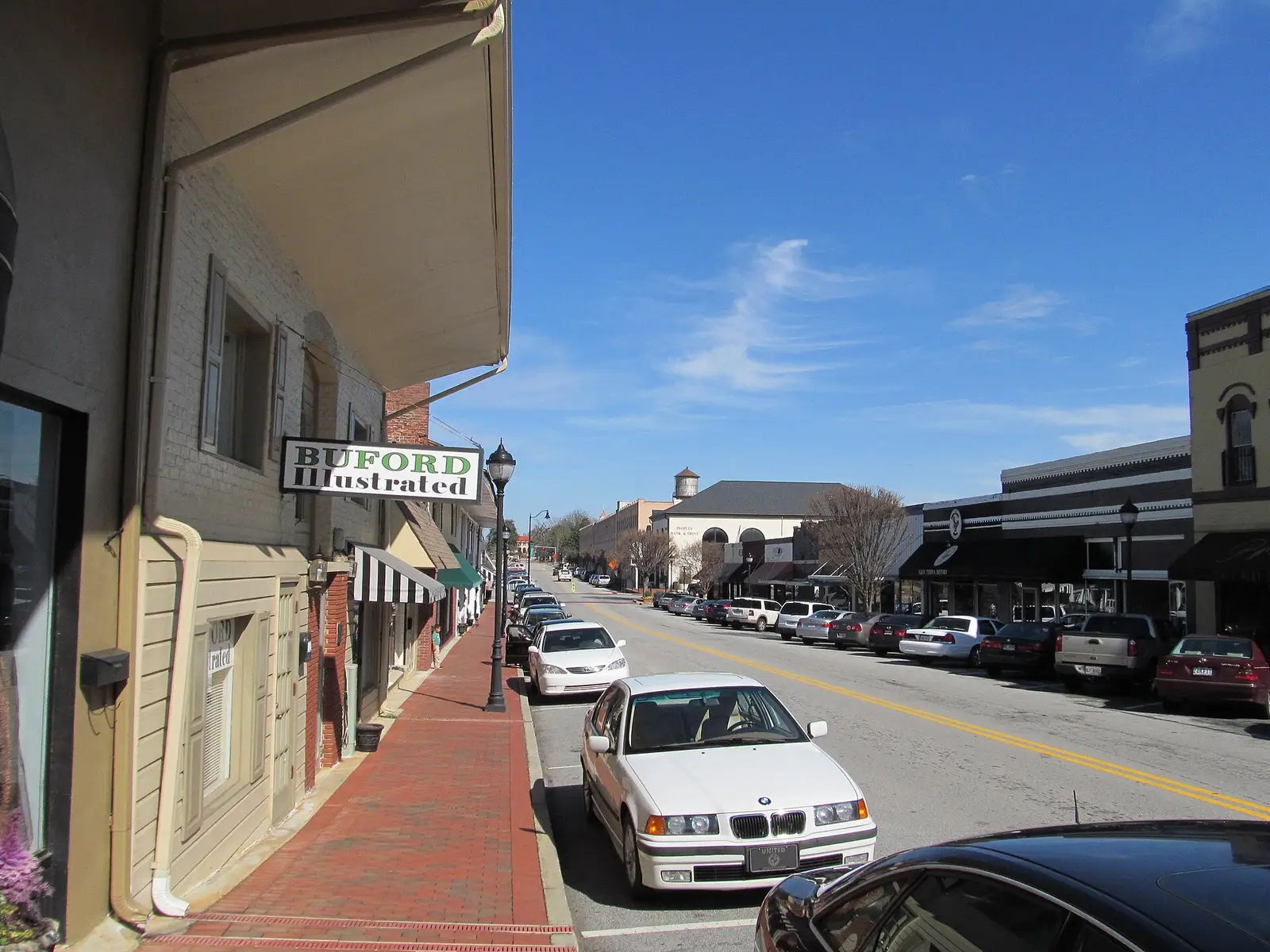
Buford's associations occupy several distinct settings, and each carries its own component list. Around historic downtown and Main Street — the old tannery district that became the Tannery Row Artist Colony — you find smaller-scale infill and townhome projects where shared roofs, siding, and parking dominate the reserve budget. South and west toward the Mall of Georgia and the Buford Drive corridor, the classic Gwinnett-side pattern takes over: pool-and-tennis subdivisions from the 2000s such as Seneca Farms and Morningbrooke, plus newer single-family and townhome communities like Bogan Meadows, Towns at Ivy Creek, and Greyton Springs Place. North toward the Hall County line and Lake Lanier, the mix shifts to lower-density and lakeside communities — including recent construction such as Overlook at Lanier — where docks, retaining walls, erosion control, and shoreline access become reserve items most inland studies never touch. A study for one of these settings should not read like a study for another, and ours is built around whichever one is yours.
What Georgia Law and Your Lenders Expect
Georgia has no statute that orders an HOA or condominium association to commission a reserve study. What fills that gap is a combination of your own documents, state association law, and the mortgage market. Start with your governing documents: many Buford declarations, bylaws, and covenants either require periodic reserve funding or give the board a clear duty to maintain common property, and a board that ignores its own recorded rules exposes itself to liability. State law frames those documents. Condominiums fall under the Georgia Condominium Act (O.C.G.A. Title 44, Chapter 3), which — during the period the developer still controls the association — directs that reserve contributions be kept in separate reserve accounts and not spent on common operating expenses unless owners holding two-thirds of the association's votes agree; even so, it stops short of mandating a study. Planned communities can adopt the Georgia Property Owners' Association Act (also O.C.G.A. Title 44, Chapter 3) by recording an election to be governed by it; that act likewise imposes no reserve-study requirement. Under either, directors owe fiduciary duties of care and loyalty, and letting a foreseeable capital expense — a failing roof, a spalling pool deck — go unplanned is precisely the neglect that turns into a claim. Then there are the lenders. FHA, Fannie Mae, and Freddie Mac all scrutinize condo and attached-townhome projects before backing a mortgage, and their reviews generally look for reserve contributions of at least 10 percent of the annual operating budget or a current, compliant reserve study — with markedly tighter attention to deferred maintenance since the 2021 Surfside collapse. That bar is rising: for loan applications dated on or after January 4, 2027, Fannie Mae and Freddie Mac raise the reserve-funding minimum to 15 percent of the budget unless the association is following a recent reserve study funded at its highest recommended level. For Buford's many townhome and condo communities that depend on conventional buyers, an underfunded reserve can quietly stall sales across the whole association.
Our Reserve Study Services in Buford
Full Reserve Study — A complete on-site inspection of your common-area components paired with a 30-year funding plan and percent-funded analysis, sized for Buford conditions from clay-soil movement to heat-aged roofing. The right starting point for a community that has never had a study or needs a fresh baseline. Typical delivery: 3 to 4 weeks.
Reserve Study Update With Site Visit — A return visit every three to five years to re-inspect, capture completed projects and fresh wear, and reset the funding plan. Especially valuable for Buford's 2000s-era communities, where conditions now change faster than a paper projection assumes. Typical delivery: 2 to 3 weeks.
Off-Site Annual Update — A remote refresh in the years between site visits that adjusts for inflation, finished work, and your latest balances so the plan and disclosures stay current. Typical delivery: 1 to 2 weeks.
Buford Communities We Serve
Our Buford service area reaches associations across both counties the city occupies and the settings in between. On the Gwinnett side, that includes swim-and-tennis and single-family communities such as Windrush, Seneca Farms, Morningbrooke, Autumnbrooke, Bogan Meadows, Chandler Grove, and Lakeview at Hamilton Mill near the Mill Creek and I-85 corridor, along with townhome communities like Lanier Pointe, Towns at Ivy Creek, Greyton Springs Place, and Weatherfield Townhomes. Toward the Hall County line and Lake Lanier, our service area covers lakeside and newer developments such as Taylor Morrison's Overlook at Lanier, along with established Hall County subdivisions like Clearwater Plantation, and it extends to smaller associations around historic downtown and the Buford Drive and Mall of Georgia corridor. If your community sits within Buford's city limits or its 30518 and 30519 ZIP codes, it falls inside the area we cover.