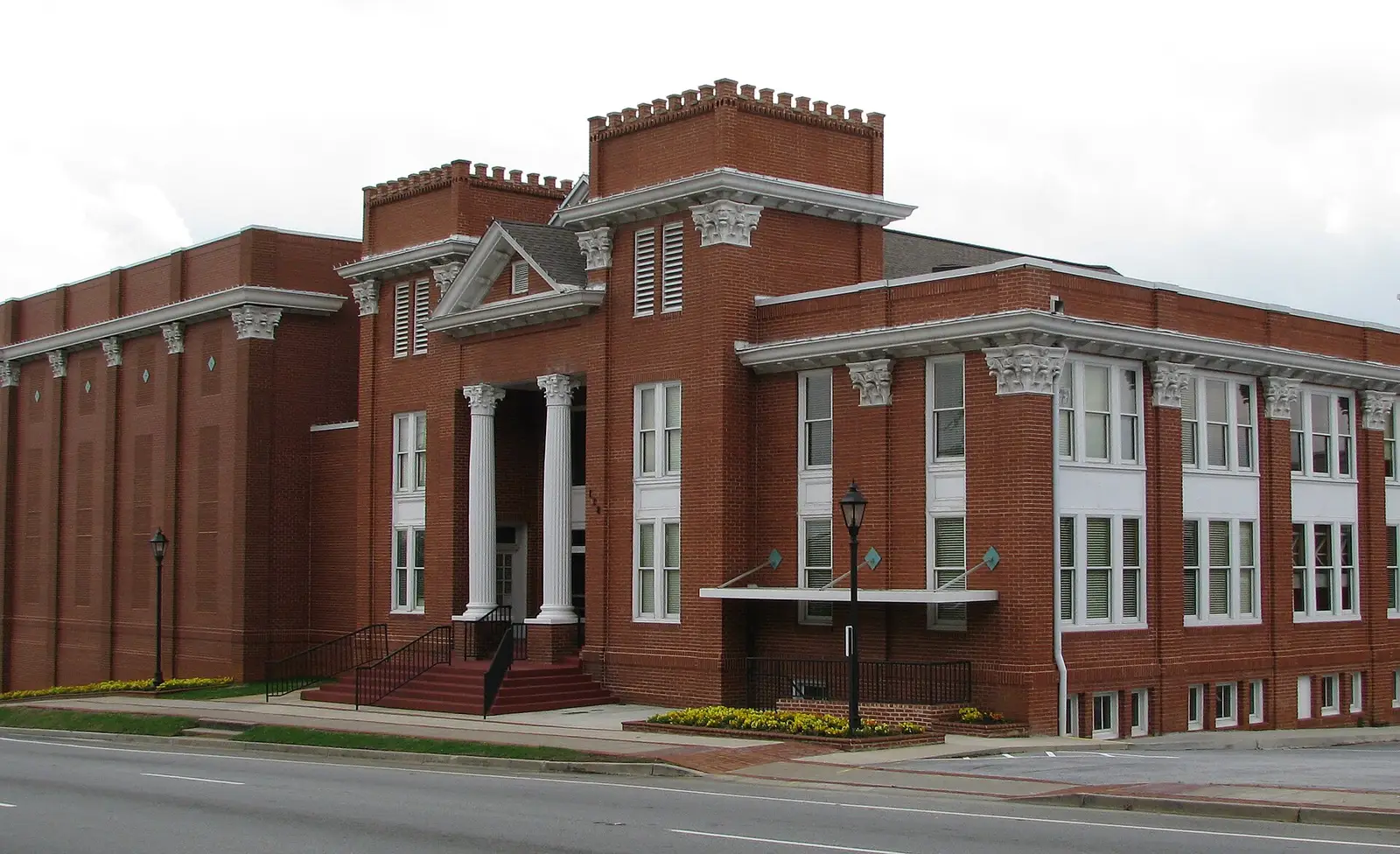
Lawrenceville anchors the center of Gwinnett County, and its association-governed housing reads almost like a timeline of the county's growth. Ring the historic square and you find in-town blocks whose oldest structures predate the Civil War — the Lawrenceville Female Seminary building dates to around 1855, and the 1885 Gwinnett Historic Courthouse still watches over the square from beneath its clocktower. Move outward and the pattern shifts to swim-and-tennis subdivisions that filled in from the 1980s through the 2000s: Connemara, with its traditional homes from the late 1980s; established communities like Flowers Crossing at the Mill, River Colony, Chandler Pond, and Rivershyre; and, more recently, the walkable SouthLawn townhomes that Smith Douglas built between 2019 and 2021 just south of the Lawrenceville Lawn. Townhome and condominium stock keeps expanding as well, from those downtown blocks out to newer enclaves farther from the square, such as Heritage Corners off Sweetgum Road.
That spread of eras is exactly why a boilerplate reserve study misfires here. A 1980s clubhouse-and-pool community, a cluster of new three-story townhomes near the square, and a small in-town condominium carry entirely different component lists and aging curves — and all of them sit in a humid, tree-shaded climate that presses on roofs, siding, decks, and coatings harder than a national average assumes. Apex Reserve Group works from Irvine, California, and builds each Lawrenceville study around the specific components, construction dates, and site conditions your association actually has. A team member based in the metro Atlanta area performs the on-site inspection in person, so the plan rests on what your property looks like today rather than a desk estimate.
Why Lawrenceville Associations Need Current Reserve Studies
Reserve planning in Lawrenceville answers to two pressures: the age spread of the housing and the Southern climate it sits in. A meaningful share of the city's association stock has passed the twenty- to forty-year mark, which is precisely when the big-ticket components installed at construction — asphalt drives, shingle roofs, pool systems, wood siding and trim, fencing, and clubhouse mechanicals — begin reaching the end of their service lives at roughly the same time. Heat, humidity, and a heavy tree canopy accelerate that timeline: coatings chalk, decking and siding hold moisture, and mildew works on any surface that stays shaded and damp. A reserve study built on generic national useful-life tables tends to overstate how long these components will last in Gwinnett, which quietly leaves an association underfunded. A current study grounded in an on-site inspection trades that guesswork for realistic replacement dates and a contribution schedule your board can defend — keeping a predictable annual funding plan in place instead of the sudden special assessment that blindsides owners when a roof or a pond structure finally fails.
From the Historic Square to Sugarloaf: How Lawrenceville Associations Are Built
Reserve components in Lawrenceville track closely with where a community sits and when it went up. Around the downtown square, the theme is redevelopment: the SouthLawn project threaded hundreds of townhomes, single-family homes, and apartments between the Lawrenceville Lawn and the historic core, introducing shared roofs, party walls, and common drives that a detached-home budget never had to carry. Newer townhome enclaves farther from the square, such as Heritage Corners off Sweetgum Road, bring those same shared components to other parts of the city. The older in-town blocks near the square, along with the areas around Georgia Gwinnett College and the Collins Hill corridor, blend early- and mid-century houses with later infill, where the reserve questions lean toward aging site infrastructure rather than resort-style amenities. Head out toward the Sugarloaf Parkway corridor and the residential roads radiating from town, and the picture becomes the classic Gwinnett swim-and-tennis subdivision — Connemara, Flowers Crossing at the Mill, River Colony, Chandler Pond, Rivershyre, and their neighbors — where pools, tennis courts, clubhouses, entry monuments, detention ponds, and long runs of interior asphalt drive the schedule. Each profile calls for its own component inventory, and we assemble the study around the one you actually have.
What Georgia Law and Your Lenders Expect
No Georgia statute orders an association to commission a reserve study or to hold reserves at any particular level. What governs instead is a stack of other obligations. First are your own recorded documents: many Lawrenceville declarations and bylaws call for reserve funding or a periodic study, and a board that ignores its own covenants exposes its directors to claims. Second is state association law. Condominiums here operate under the Georgia Condominium Act (O.C.G.A. Title 44, Chapter 3), which requires reserve line items to be disclosed in condominium budgets and resale documents even though it fixes no funding minimum; planned communities may have adopted the Georgia Property Owners' Association Act, an opt-in framework that likewise stops short of mandating a study. Neither statute lets a board off the hook, because directors owe fiduciary duties to the association, and knowingly deferring a foreseeable capital expense — a failing roof, a cracked detention structure, a pool at the end of its life — is the kind of decision that draws personal liability. Third, and increasingly decisive, are the lenders. FHA, Fannie Mae, and Freddie Mac review a condominium's finances before approving unit mortgages, and they generally want to see roughly ten percent of the annual budget directed to reserves, or a current and compliant reserve study in its place; since the Surfside collapse, their attention to deferred maintenance has sharpened considerably. Fannie Mae and Freddie Mac are also raising that floor: for loan applications dated on or after January 4, 2027, the minimum reserve allocation climbs from ten to fifteen percent of budget unless the association holds a reserve study completed within the previous three years and funds at its highest recommended level. For a Lawrenceville community whose townhome or condo buyers rely on conventional financing, that change turns a reserve study from good practice into a practical prerequisite for keeping units sellable.
Our Reserve Study Services in Lawrenceville
Full Reserve Study — A ground-up inspection of every common-area component, paired with a thirty-year funding projection, percent-funded analysis, and funding options your board can weigh — the right starting point for a community that has never commissioned a study or wants a clean baseline. Typical delivery: 3 to 4 weeks.
Reserve Study Update With Site Visit — A return visit every three to five years to re-inspect conditions, fold in completed projects and new components, and reset the funding plan against what has actually aged since the last study — especially useful for Lawrenceville's older swim-and-tennis communities, where conditions move faster than a spreadsheet predicts. Typical delivery: 2 to 3 weeks.
Off-Site Annual Update — A remote refresh for the years between site visits that adjusts your plan for inflation, finished work, and any change in reserve balance, keeping the funding schedule and budget disclosures current. Typical delivery: 1 to 2 weeks.
Lawrenceville Communities in Our Service Area
Our service area covers associations across Lawrenceville and the surrounding stretch of Gwinnett County, from the redeveloping downtown square out to the established swim-and-tennis subdivisions. That coverage includes the historic in-town neighborhoods around the square, the SouthLawn and Heritage Corners townhome areas, the Georgia Gwinnett College and Collins Hill corridors, and the Sugarloaf Parkway area, along with established communities such as Connemara, Flowers Crossing at the Mill, River Colony, Chandler Pond, Rivershyre, Stonehaven at Sugarloaf, Great River at Tribble Mill, Villages at Huntcrest, Magnolia Creek, and Turtle Creek Lakes. If your association sits in or near Lawrenceville, our metro-Atlanta reserve analyst can reach it and prepare your study.