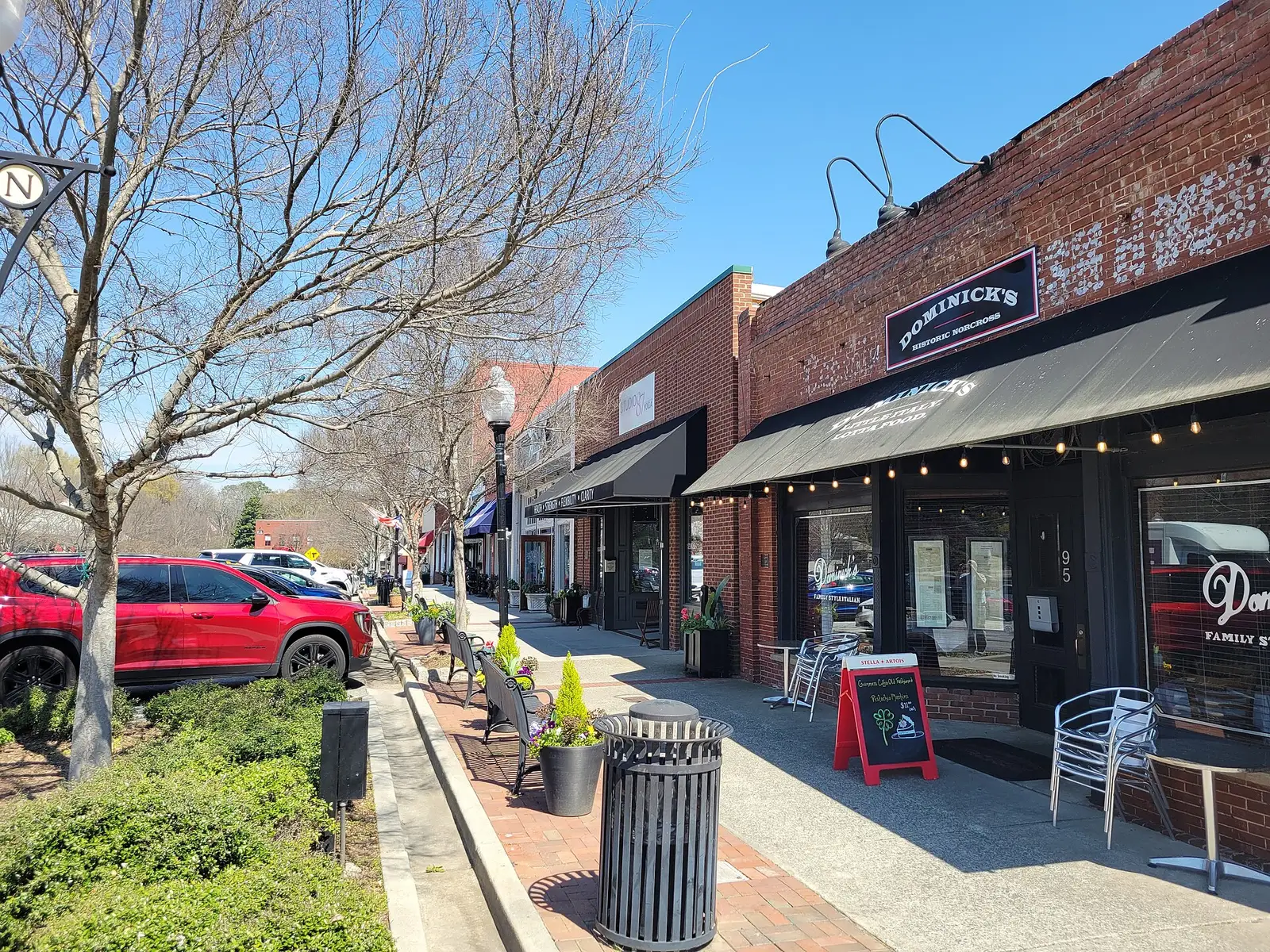
Norcross packs an unusually wide range of association housing into a small Gwinnett County footprint. The 1870s rail town at its center — a Victorian downtown grid added to the National Register of Historic Places in 1980 — is now ringed by condominium and townhome communities from several distinct building eras. Late-1970s and 1980s attached-housing developments such as Wintergreen, a condominium community of two-story townhomes and ranch-style units built between 1982 and 1985, and Sierra West, whose earliest townhomes date to 1978, sit alongside newer for-sale infill like Seven Norcross and the sixteen-home Ivey of Norcross tucked into the historic core. Threading between them are the older garden apartments and condo conversions along the Buford Highway and Peachtree Industrial corridors, one of metro Atlanta's most internationally diverse stretches.
Those communities have almost nothing in common on paper. A 1983 condo-townhome with shared roofs, a wood-decked pool, and a Gwinnett-regulated stormwater pond ages nothing like a 2010s townhome row or a downtown loft carved out of a century-old brick building. A reserve study built from national useful-life averages misses that difference entirely — and misses how Georgia's heat, humidity, and dense red-clay soils actually work on siding, coatings, and decks in this part of the state. Apex Reserve Group is based in Irvine, California, and works with a team member who lives in metro Atlanta and personally inspects Norcross properties on site, so your funding plan reflects your buildings, your components, and your climate instead of a template.
Why Norcross Associations Need Current Reserve Studies
Two forces make reserve planning urgent for Norcross boards: the age spread of the housing and the local climate. A large share of the city's condominium and townhome stock went up between the late 1970s and the 1990s, which means roofs, siding, exterior paint, pool equipment, and parking-lot asphalt from the first or second replacement cycle are wearing out right now — often faster than an out-of-town spreadsheet predicts. Humid subtropical summers push mildew into coatings and rot into wood decking, stairs, and trim; freeze-thaw swings and the occasional hail or ice storm add their own damage; and the region's heavy red clay holds water against foundations and retaining walls before baking hard in a summer drought. The newer townhome infill of the 2000s and 2010s is only now reaching its first real wave of major replacements. A reserve study grounded in an on-site inspection gives your board honest remaining-life numbers and a contribution schedule that heads off the surprise special assessment, rather than guessing from averages calibrated for a drier, cooler part of the country.
From the 1870s Depot to Buford Highway: How Norcross Associations Differ
The historic district around South Peachtree Street holds the oldest fabric — brick storefronts and Victorian-era homes from the depot years — where reserve questions turn on aging masonry, wood windows, and small-scale infill such as Ivey of Norcross and the loft-and-townhome mix of Seven Norcross. West and east of downtown, along the Buford Highway and Peachtree Industrial corridors, sit the workhorse attached-housing communities that dominate the local association count: condominium-townhome developments like Wintergreen and townhome communities like Sierra West, most from the late-1970s-through-1980s building wave, plus newer townhome rows such as Sherwin Townhomes from the early 2000s — all carrying shared roofs, wood siding and stairs, swimming pools, and paved parking as their heaviest reserve line items. Because the city itself spans only a few square miles, many communities that carry a Norcross mailing address actually sit in unincorporated Gwinnett County just past the city limits — newer townhome rows, garden-condo conversions, and swim-and-tennis subdivisions among them. Each of these profiles points to a different component list, and the study has to be built from the one that fits your property.
What Georgia Law and Your Lenders Expect
Georgia has no statewide law that orders an HOA or condominium association to commission a reserve study — the obligation, where it exists, comes from three other places. First, your own governing documents: many Norcross declarations, covenants, and bylaws direct the board to fund reserves or to study them on a set schedule, and a board that disregards its own recorded documents exposes itself to owner claims. Second, state association law sets the backdrop even without a study mandate. Condominiums here fall under the Georgia Condominium Act (O.C.G.A. Title 44, Chapter 3), while many planned communities record under the opt-in Georgia Property Owners' Association Act. The Condominium Act does not impose a blanket, ongoing duty to keep reserves segregated: its separate-reserve-account rule applies while the developer still controls the association, and even then owners holding two-thirds of the votes can agree to put those funds toward common expenses. Neither statute forces a reserve study, but both leave directors bound by fiduciary duties of care and good faith — and a board that shrugs off predictable big-ticket work like roof replacement, repaving, and pool systems is inviting personal-liability arguments. Third, and increasingly decisive, are the mortgage agencies. FHA and the two large secondary-market buyers, Fannie Mae and Freddie Mac, examine a condo project's finances before backing loans in it, generally expecting roughly ten percent of the annual budget to flow to reserves or a current, compliant reserve study in its place; their attention to deferred maintenance has sharpened considerably since the 2021 Surfside collapse. For loan applications dated on or after January 4, 2027, Fannie Mae and Freddie Mac raise that reserve-allocation floor to fifteen percent, with a reserve study completed in the last three years and followed at its highest recommended funding level as the accepted alternative. For Norcross's many 1980s condo-townhome communities, that pairing — aging components plus tighter lender review — is exactly where an underfunded reserve turns into stalled unit sales.
Our Reserve Study Services in Norcross
Full Reserve Study — A ground-up study built on a complete on-site inspection, a component inventory with condition notes and photos, and a 30-year capital plan with percent-funded projections. The right choice for an association that has never had a study or is working from an outdated one. Typical delivery: 3 to 4 weeks.
Reserve Study Update With Site Visit — A return inspection, generally every three to five years, that captures completed projects, new conditions, and changed pricing and refreshes the funding plan against what your buildings actually look like today. Typical delivery: 2 to 3 weeks.
Off-Site Annual Update — A between-visit refresh that rolls in inflation, finished work, and your current reserve balance to keep the plan and disclosures accurate without another site trip. Typical delivery: 1 to 2 weeks.
Norcross Communities We Serve
Our Norcross service area covers associations inside the city and across the surrounding unincorporated Gwinnett County that shares its ZIP codes. That reach spans a range of association types near the Buford Highway and Peachtree Industrial corridors — townhome and condominium communities such as Wintergreen, Sierra West, and Sherwin Townhomes, alongside single-family and swim-and-tennis subdivisions like Creekside at Rockbridge and Peachtree Station, plus other neighborhood associations such as Brookside Commons and Old Norcross Station — as well as the downtown-adjacent infill of Seven Norcross and Ivey of Norcross and the newer townhome and swim-and-tennis neighborhoods filling in toward Peachtree Corners, Lilburn, and Duluth. Wherever your community sits in and around Norcross, we can inspect it on site and build the study around it.