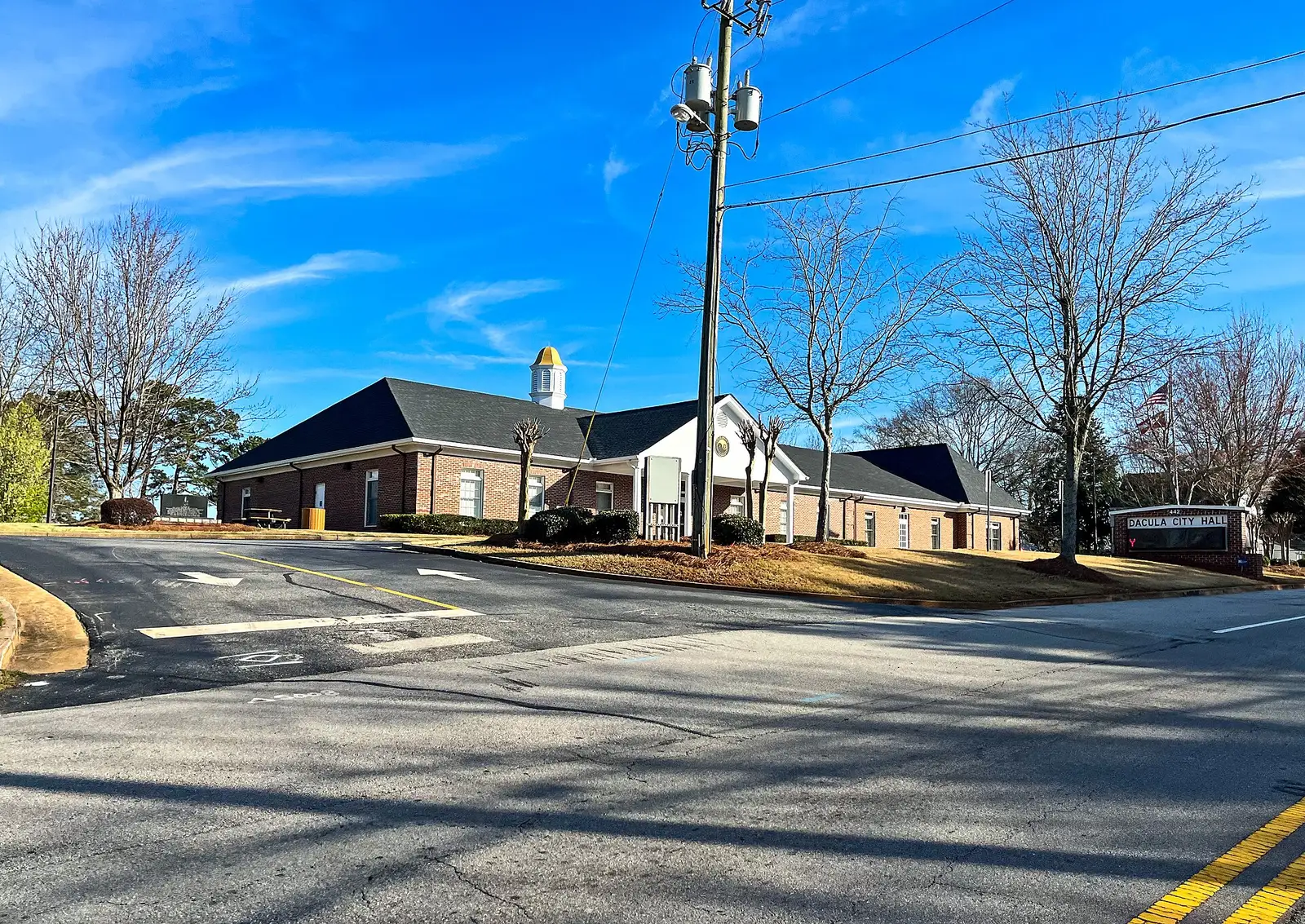
Dacula is a small city with a large mailing address. The incorporated city covers only about five and a half square miles in eastern Gwinnett County, roughly 37 miles northeast of Atlanta, but the Dacula 30019 ZIP code reaches far past the city limits into unincorporated Gwinnett — north toward the Dacula–Buford line and out along the Apalachee River. Most of the association-governed housing that carries a Dacula address actually sits in that unincorporated territory, where two decades of subdivision building turned former farmland into amenity-heavy neighborhoods. Hamilton Mill, a large unincorporated master-planned community built around a golf course co-designed by Fred Couples and Gene Bates, anchors the north end; Apalachee Farms, developed around 2000 in five sections beside the Trophy Club of Apalachee, sits to the south; and swim-and-tennis subdivisions such as Daniel Park, Apalachee River Club, Ivey Chase, and Mill Creek Station fill in between. Older neighborhoods like Ashton Wood, built in the 1990s, predate most of them, while new construction is still rising along Highway 316 and Dacula Road.
That range is exactly why a template reserve study tends to miss the mark here. A golf community with clubhouses and multiple pools, a mid-1990s swim-tennis subdivision, and a brand-new townhome enclave off 316 each own a different mix of shared components, were built in different decades, and are aging under the same demanding Georgia climate but on very different schedules. Apex Reserve Group is based in Irvine, California, and prepares reserve studies for associations nationwide, but our Dacula work is handled by a team member based in the metro Atlanta area who performs the on-site inspection in person. The result is a funding plan built around what your community actually has in the ground — not a national average dropped onto a Gwinnett County spreadsheet.
Why Dacula Associations Need Current Reserve Studies
The clock on Dacula's reserve components is set by when each subdivision was built, and most of them went up inside a compressed window. Communities like Apalachee Farms and Daniel Park date to roughly 2000 through 2008, which now puts them fifteen to twenty-five years old — squarely into the first major-replacement wave for asphalt streets, community pools, clubhouses, tennis and pickleball courts, wood fencing, and the original architectural-shingle roofs on shared structures. Slightly older neighborhoods from the 1990s, such as Ashton Wood, are already a cycle further along. When a study is out of date or was never done, a board tends to meet these costs all at once, and the only tool left is a special assessment that lands on every owner in the same year. A current reserve study grounded in an on-site inspection replaces that surprise with a year-by-year schedule, so the pool resurfacing, the repaving, and the roof replacements are funded deliberately out of reserves rather than scrambled for after a component has already failed.
From Hamilton Mill to the Apalachee River: How Dacula's Associations Are Built
The associations that share a Dacula address fall into a few recognizable types. At the north end, straddling the Dacula–Buford area in unincorporated Gwinnett, Hamilton Mill is a large master-planned golf community with a swim-and-tennis complex, a lake, and a long inventory of shared amenities that make its reserve budget genuinely complex. Along the Apalachee River to the south are the golf-oriented communities: Apalachee Farms, laid out around 2000 in five distinct sections next to the Trophy Club of Apalachee, and the neighboring Apalachee River Club with its own pools and courts. Between them sit the swim-and-tennis subdivisions that define suburban east Gwinnett — Daniel Park with its stocked lake, Ivey Chase, Mill Creek Station, Fairmont on the Park, Wolf Creek, and Enclave at Hamilton Mill among them. The incorporated City of Dacula itself, at just over five square miles, holds a smaller and more compact share of this housing; the bulk of the HOA stock lies in the unincorporated county wrapped around it. Nearly all of these communities carry a set of Gwinnett-specific reserve items — stormwater detention ponds, retaining walls set on red-clay slopes, entry monuments, and private streets shaded by heavy tree canopy — that generic studies routinely underweight.
What Georgia Law and Your Lenders Expect
Georgia has no statute that orders an association to commission a reserve study. There is no state mandate to point to and no funding percentage written into Georgia law. What governs your community instead is a layered set of obligations. First are your own recorded documents: many Dacula-area declarations and bylaws require the board to keep adequate reserves or to review capital needs on a schedule, and those provisions bind the directors who ignore them. Second is the statutory backdrop. Condominiums in Georgia fall under the Georgia Condominium Act (O.C.G.A. Title 44, Chapter 3), which applies automatically, while most detached-home and townhome communities operate under the Georgia Property Owners' Association Act — an opt-in law an association adopts by recording that election in its declaration. Neither statute commands a reserve study by name, but both rest on top of the fiduciary duties every board member owes the association; a board that can foresee a six-figure repaving or roof bill and plans nothing for it is exposed if that failure later harms the community. Third, and increasingly decisive, are the lenders. FHA, Fannie Mae, and Freddie Mac all weigh reserve funding when they decide whether a condominium is eligible for financing, generally expecting at least ten percent of the annual budget to go toward reserves or a current, compliant reserve study in its place. Attention to deferred maintenance tightened sharply across the lending industry after the 2021 Surfside collapse, and it is about to tighten again: for loan applications dated on or after January 4, 2027, Fannie Mae and Freddie Mac raise that reserve-contribution floor from ten to fifteen percent of the budget unless the association has a recent reserve study it is fully funding. For any Dacula condominium or attached-home community whose owners will eventually sell to a buyer using conventional financing, that math is no longer optional.
Our Reserve Study Services in Dacula
Full Reserve Study — A complete component inventory, an on-site inspection of every shared asset, and a 30-year funding plan with a percent-funded analysis, built for associations getting their first study or resetting a baseline. Typical delivery: 3 to 4 weeks.
Reserve Study Update With Site Visit — A return inspection every three to five years that re-measures conditions, folds in completed projects, and recalibrates the funding plan as your Dacula community ages. Typical delivery: 2 to 3 weeks.
Off-Site Annual Update — A between-visit refresh that adjusts for inflation, spending, and your current reserve balance to keep the plan and budget disclosures current. Typical delivery: 1 to 2 weeks.
Dacula Communities We Serve
Our service area covers HOA and condominium associations throughout Dacula and the surrounding 30019 area of eastern Gwinnett County — both inside the incorporated city and across the unincorporated county that shares its address. That footprint includes Hamilton Mill, Apalachee Farms, Apalachee River Club, Apalachee Heritage, Daniel Park, Ashton Wood, Ivey Chase, Mill Creek Station, Fairmont on the Park, Wolf Creek, Enclave at Hamilton Mill, Riversprings, Del Mar Club, and the many newer subdivisions still being built along Dacula Road, Highway 316, and the Hamilton Mill corridor. If your association carries a Dacula mailing address, we can inspect and study it.