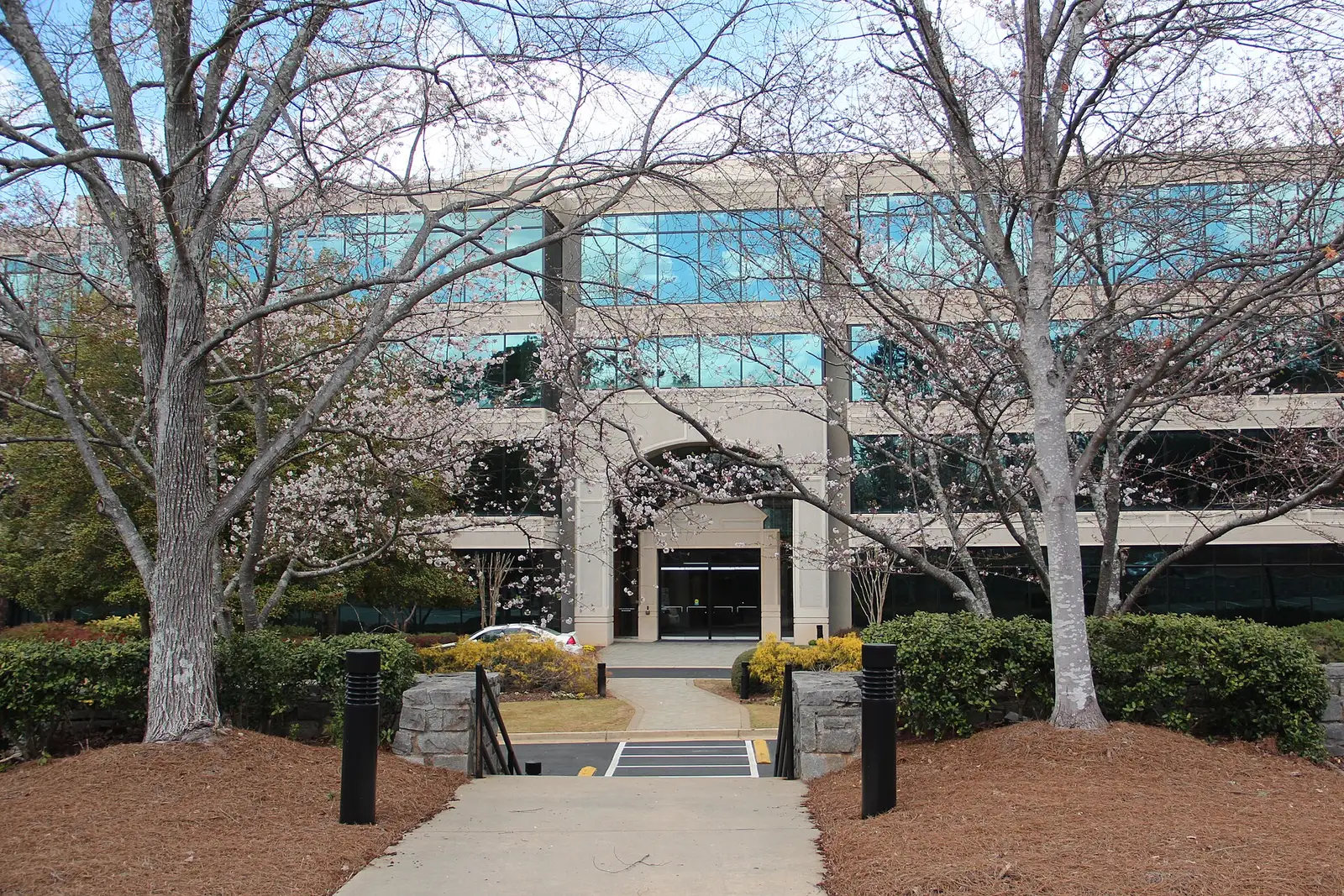
Peachtree Corners incorporated in 2012 and is Gwinnett County's largest city, and its housing grew up alongside Technology Park, the office campus planned in the late 1960s that pulled early employers like Scientific Atlanta and Hayes Microcomputer to this bend of the Chattahoochee. The subdivisions that followed track that timeline. Peachtree Station and Spalding Corners were platted in the late 1970s and filled in through the 1980s; Amberfield went up between 1992 and 1998 with its two pools and eight tennis courts; and Neely Farm laid out roughly 334 homes across a former dairy farm on the river. Newer stock sits beside the old: Waterside, a gated riverside development near The Forum and Town Center at Peachtree Corners, mixes single-family homes with townhomes and condominiums barely a decade into their component life.
A single reserve template cannot carry all of that. A 1970s swim-and-tennis association with mature asphalt, aging clubhouse roofs, and pools first dug during the Carter administration is a different financial animal than a 2010s townhome row still under its original siding warranty, and both differ again from a condominium building carrying shared structural and mechanical systems. Apex Reserve Group works from Irvine, California, and sends a team member based in the metro Atlanta area to walk each property in person, so the study reflects what your components actually are, how the humid Georgia climate has aged them, and when they will realistically come due.
Why Peachtree Corners Associations Need Current Reserve Studies
Two things put pressure on reserve budgets here: the age of the housing and the climate it sits in. A large share of the city's association stock was built between the late 1970s and the early 2000s, which means many communities are now cycling through their second or third round of major replacements — roofs, repaving, siding, pool shells and equipment, clubhouse systems, and perimeter fencing. Humid subtropical summers push that clock along, drawing down the useful life of exterior coatings, wood trim, decking, and shingles faster than the national averages baked into off-the-shelf useful-life tables. When a board funds against those generic numbers, it is usually funding too little without realizing it. A current study built on an on-site inspection replaces the guesswork with observed condition, realistic replacement dates, and a contribution schedule that keeps a failing roof or a cracked pool from becoming an emergency special assessment.
From Spalding Corners to Waterside: The Shape of Peachtree Corners Associations
The city's associations fall into a few broad types, each with its own reserve profile. The oldest are the large single-family swim-and-tennis communities that arrived with the area's early development — Spalding Corners and Peachtree Station from the late 1970s and 1980s, then Amberfield in the 1990s, alongside Riverfield, River Station, and Revington. Their reserve components lean on shared amenities: pool houses, tennis courts, entry monuments, streetlights, and long runs of common asphalt and fencing. Neely Farm, spread along the Chattahoochee on a former dairy tract, adds a twenty-acre riverfront park and the drainage and slope concerns that come with building near the water. At the newer end, Waterside and the townhome and condominium sections that have risen near The Forum and Town Center carry a different list — building envelopes, shared roofs, and in some cases elevators and structured parking — on components that are still young but will age together. We match the component inventory to whichever of these your community actually is, rather than forcing it into one mold.
What Georgia Law and Your Lenders Expect
Georgia does not have a statute that orders associations to commission reserve studies, so the obligation comes from three other directions. The first is your own paperwork: many declarations, bylaws, and covenants in Peachtree Corners commit the board to maintaining adequate reserves or reviewing them on a set schedule, and a board that ignores its own governing documents hands owners a straightforward grievance. The second is Georgia's association statutes. Condominiums fall under the Georgia Condominium Act (O.C.G.A. Title 44, Chapter 3, Article 3). It requires the operating budget disclosed when new units are first sold to itemize reserves for deferred maintenance and depreciation, and it requires reserve assessments to be held in separate accounts while the developer still controls the association, but it prescribes no reserve study, no funding percentage, and no ongoing reserve-funding minimum once owners take over. A planned community may instead have recorded an election under the Georgia Property Owners' Association Act (O.C.G.A. Title 44, Chapter 3, Article 6), which likewise imposes no reserve-study requirement. Neither statute settles the question for a board on its own: directors still owe fiduciary duties of care and loyalty, and letting a foreseeable roof or paving bill arrive unfunded is the kind of oversight owners can challenge. The third pressure is the lenders. FHA, Fannie Mae, and Freddie Mac review a condominium's finances before backing a mortgage in it, generally looking for at least ten percent of the operating budget going to reserves or a professional reserve study in its place, and their scrutiny of deferred maintenance has tightened sharply since the 2021 Surfside collapse. That bar is rising: for loan applications dated on or after January 4, 2027, Fannie Mae and Freddie Mac raise the reserve threshold to fifteen percent of the budget unless a current reserve study justifies a lower figure. For Peachtree Corners' older condominium and townhome associations, that makes a defensible study less a formality than a condition of keeping units financeable.
Our Reserve Study Services in Peachtree Corners
Full Reserve Study — A ground-up study for a community that has never had one or needs a clean baseline: an on-site inspection of every common component, remaining-useful-life estimates read against Peachtree Corners' climate, a 30-year funding projection, percent-funded analysis, and funding scenarios your board can weigh. Typical delivery: 3 to 4 weeks.
Reserve Study Update With Site Visit — A fresh inspection every few years to catch what has changed since the last visit — a re-roofed building, a resurfaced pool, storm or hail damage — and to reset the funding plan against current conditions and costs. Typical delivery: 2 to 3 weeks.
Off-Site Annual Update — A between-visit refresh that rolls in inflation, completed projects, and your latest reserve balance so the plan and disclosures stay current without a site trip. Typical delivery: 1 to 2 weeks.
Peachtree Corners Communities in Our Service Area
Our Peachtree Corners service area covers associations across the city and the surrounding 30092 and 30096 area, including established swim-and-tennis communities such as Spalding Corners, Peachtree Station, Amberfield, Neely Farm, Riverfield, River Station, Revington, Linfield, and Wellington Lake, along with newer riverside and mixed-use developments like Waterside and the townhome and condominium communities near The Forum and Town Center at Peachtree Corners. We also serve neighboring associations in the cities of Norcross, Berkeley Lake, and Duluth, and in the unincorporated Gwinnett County communities that border Peachtree Corners.